
In This Article
Every horse owner has a headcollar hanging on a hook somewhere. It’s the least glamorous bit of kit in the tack room, and it gets used more than almost anything else. That’s exactly why the leather headcollar vs nylon headcollar question matters more than it first appears.

A Hartpury University survey of 5,615 horse owners found that 31% had experienced a horse being injured while wearing a headcollar. The same study reported 134 incidents involving fractures and 167 equine fatalities attributed to headcollar use. Sobering numbers for something we buy without much thought.
So this guide does two jobs. It compares the two materials honestly, covering safety, durability, fit and cost. It then narrows the field to seven real, UK-available products across budget, mid-range and premium.
What is leather headcollar vs nylon headcollar?
It’s a comparison of two headcollar materials. Leather is a natural material that tends to break under extreme pressure, looks smart and needs regular care. Nylon is a synthetic webbing that is lighter, cheaper, washable and colourful, but it doesn’t break under load unless a dedicated breakaway section is built in.
One note before we go further. I haven’t hands-on tested any of these products, so everything below rests on published specs, manufacturer information, independent testing from Horse & Hound and published research. Where I couldn’t verify something, I say so.
Quick Comparison Table: Leather vs Nylon vs Breakaway Nylon
| Factor | Leather | Standard Nylon | Breakaway / Field Safe Nylon |
|---|---|---|---|
| Breaks under pressure | Generally yes, depending on quality and thickness | No | Yes, at a designed release point |
| Typical UK price range | £45-£100+ | £10-£30 | £25-£55 |
| Care needed | Regular cleaning and conditioning | Wipe or machine wash (check label) | Keep release point clean |
| Suitable for turnout | Better than standard nylon, not guaranteed | Not recommended | Designed for it |
| Best For | Travelling, shows, daily handling | Short supervised handling | Horses that must wear one in the field |
Looking at the table, standard nylon wins only on price and ease of cleaning. That’s a thin margin when the downside is a trapped horse. Leather and breakaway nylon both address the core hazard, but they do it differently. Leather relies on the material itself giving way. A breakaway design relies on an engineered release point you can inspect.
💬 Just one click — help others make better buying decisions too!😊
Top 7 Headcollars: Expert Analysis
These seven span the whole leather headcollar vs nylon headcollar debate. Three are leather, one is a hybrid, and three are nylon or fabric breakaway designs. Prices are ranges at the time of research, so check current price before buying.
1. LeMieux Anatomic Leather Headcollar — padded comfort that earns its price
The standout here is the anatomically shaped, padded headpiece and noseband, which spreads pressure rather than concentrating it behind the ears. According to Horse & Hound’s leather headcollar guide, it comes in black or brown, in cob or full, with solid metal fittings. The magazine scored it 9/10 and awarded H&H Approved status.
In practice, shaped padding matters most for horses that wear a headcollar daily or are tied up regularly, because poll pressure adds up. Only two sizes is the catch. Pony owners and anyone with a very large head will need to look elsewhere.
On feedback, the independent tester was para dressage rider Tamsin Addison. She praised the shape and padding and found it easy to adjust. That is a single expert review rather than aggregated buyer sentiment, and I couldn’t verify a large pool of customer reviews.
Pros:
- ✅ Anatomic padded shape spreads pressure evenly
- ✅ H&H Approved, scoring 9/10
- ✅ Solid metal fittings feel built to last
Cons:
- ❌ Only cob and full sizes available
- ❌ Needs regular leather care
Price sits in the low-to-mid £70s range. For a daily-use headcollar that may last years, the value verdict is strong.

2. Collegiate ComFiTec Leather Headcollar — anatomic padding at a friendlier price
The hook is padding under the nose, crown and cheek straps, plus an anatomically shaped headpiece. It comes in black or brown, in pony, cob, full or warmblood. Horse & Hound’s tester, event rider Sam Jennings, liked the shaped, padded headpiece, saying it works almost like a poll guard.
Here’s the detail most buyers miss. Horse & Hound notes that parts of this headcollar look like leather but aren’t, which helps keep the price down. That’s fine for comfort and value. But if your reason for choosing leather is that it breaks under pressure, you can’t assume every component behaves like full leather. Ask the retailer which parts are genuine leather and which are not.
On review sentiment, I could verify the H&H test result (9/10, H&H Approved) but not a reliable aggregate of buyer reviews.
Pros:
- ✅ Four sizes including warmblood
- ✅ Padded crown, nose and cheek straps
- ✅ Good price-to-comfort balance
Cons:
- ❌ Not all components are genuine leather
- ❌ Break behaviour of mixed materials is unverified
Price is around £60. A smart middle-ground pick for everyday handling and travelling.
3. Shires Velociti Gara Fully Adjustable Leather Headcollar — the awkward-head and youngster solution
The standout is sizing range. Horse & Hound lists sizes from suckling and foal through to extra full, with adjustment at both headpiece and noseband. The design is simple and unpadded, with solid brass fittings, in black or Havana.
Full adjustability is the key here. Foals, yearlings and horses whose heads fall between standard sizes are famously hard to fit. The ability to tweak both noseband and headpiece gets you much closer to a proper fit than a fixed-size cob or full.
For feedback, I couldn’t verify a robust pool of buyer reviews, so I won’t characterise sentiment. The independent evidence I found is H&H’s description of its suitability for very young horses and harder-to-fit heads.
Pros:
- ✅ Sizes from suckling to extra full
- ✅ Adjustable at headpiece and noseband
- ✅ Brass fittings at a budget-friendly price
Cons:
- ❌ Unpadded, so less cushioning on tight fits
- ❌ Plain styling
Price sits in the mid-£40s range. For growing youngsters, the value verdict is excellent, because you’ll be re-sizing often.
4. LeMieux Breakaway Headcollar — nylon practicality with a leather release
Here the standout is the hybrid approach. It’s strong premium nylon with a padded nose and stitched leather detail, plus a leather pressure-release mechanism that breaks under heavy load. LeMieux says this normally happens at the cheek rings when a horse pulls back or catches the headcollar on a fixed object.
That addresses the main weakness in the leather headcollar vs nylon headcollar debate: you get nylon’s low price and easy cleaning, with a deliberate failure point. LeMieux also recommends tying up with a release knot and monitoring difficult horses, which is sensible advice for any headcollar.
The brand’s own copy is the only feedback I could verify, so I can’t summarise buyer sentiment honestly.
Pros:
- ✅ Leather release breaks under heavy load
- ✅ Smart enough for shows and travelling
- ✅ Padded nose at a low price
Cons:
- ❌ A broken leather part must be replaced
- ❌ Release load isn’t published on the product page
Price lands in the mid-£20s range. Impressive value for a turnout-capable option.
5. Horseware Field Safe Headcollar — reusable hook-and-loop release with reflective webbing
What sets it apart is the reusable hook-and-loop breakaway strap beneath the headpiece buckle. It also has interwoven reflective webbing, plus buckles at both sides and under the chin. Horseware describes it as a lightweight fabric headcollar built for turnout.
The reflective element is a small detail with real practical value. Spotting a horse in a dim, wet field at dusk is easier when it catches your torch. The three buckles also give you more fit adjustment than many budget headcollars.
I couldn’t verify enough independent customer reviews to summarise sentiment. One general caution applies to hook-and-loop systems, which is that LeMieux advises keeping them clear of dirt and hair. That’s equally relevant here.
Pros:
- ✅ Reusable release rather than a one-off break
- ✅ Reflective webbing aids visibility
- ✅ Buckles at both sides and chin
Cons:
- ❌ Hook-and-loop can clog with mud and hair
- ❌ Release load isn’t published
Price falls in the high-£20s to low-£30s range, which makes it a fair-value entry into field safe headcollar territory.

6. Equilibrium Stellar Headcollar — the most research-led release system here
This headcollar’s headline feature is a reusable safety release designed around Dr David Marlin’s headcollar research. The manufacturer says the headpiece releases under poll pressure at a consistent load, quoting an average of 83kg for one version. Another Equilibrium page gives 68kg for a large size. So treat release figures as model- and size-specific.
The thinking is that a headcollar needs to hold during normal handling but let go before real harm. Equilibrium says it was field tested on the yard at Writtle University College. The fleece-padded Stellar Style version adds comfort.
All the release-force data I found is manufacturer-reported, and I couldn’t find a published independent comparison or a reliable pool of customer reviews. I also couldn’t verify a current price range. Some retailer listings flag certain sizes as discontinued, so check current availability.
Pros:
- ✅ Consistent, reusable release system
- ✅ Designed from published injury research
- ✅ Padded versions available for comfort
Cons:
- ❌ Release data is manufacturer-reported
- ❌ Some sizes may be hard to find
Check current price. If it fits your budget, it’s a compelling choice for horses that must wear a headcollar outdoors.
7. KM Elite ThinLine Breakaway Field Safe Headcollar — built around grazing muzzle use
The standout is purpose-built muzzle compatibility. It has keepers for the Flexible Filly grazing muzzle, a leather crown with two stainless steel buckles for adjustment and breakaway, and six sizes from Mini to Oversize.
If your horse wears a grazing muzzle for laminitis or weight management, muzzle slippage and rubbing are daily headaches. A headcollar that locates the muzzle correctly addresses both. One flag from the listing: the noseband isn’t adjustable and may feel roomy on arrival, and you’re meant to achieve the best fit through muzzle attachment.
I couldn’t verify a robust pool of customer reviews, so no sentiment summary here.
Pros:
- ✅ Keepers hold the grazing muzzle in position
- ✅ Leather crown provides a breakaway point
- ✅ Six sizes from Mini to Oversize
Cons:
- ❌ Noseband isn’t adjustable
- ❌ Less relevant if you don’t use a muzzle
Price is around £50. Good value if you use the muzzle, and arguably unnecessary if you don’t.
Top 7 Comparison Table
| Product | Material | Release mechanism | Price range | Best For |
|---|---|---|---|---|
| LeMieux Anatomic Leather Headcollar | Leather | Material-dependent | Low-to-mid £70s | Daily wear and comfort |
| Collegiate ComFiTec Leather Headcollar | Leather and non-leather parts | Material-dependent | Around £60 | Mid-range comfort |
| Shires Velociti Gara Fully Adjustable Leather Headcollar | Leather | Material-dependent | Mid-£40s | Youngsters and awkward heads |
| LeMieux Breakaway Headcollar | Nylon, leather release | Leather pressure release | Mid-£20s | Budget turnout |
| Horseware Field Safe Headcollar | Fabric | Reusable hook-and-loop | High-£20s to low-£30s | Fields and low light |
| Equilibrium Stellar Headcollar | Nylon | Reusable engineered release | Check current price | Evidence-led safety |
| KM Elite ThinLine Breakaway Field Safe Headcollar | Leather crown | Breakaway crown | Around £50 | Grazing muzzle users |
Looking at the table, the Shires Velociti Gara Fully Adjustable Leather Headcollar and LeMieux Breakaway Headcollar are the budget standouts. If comfort for a hard-working daily headcollar matters most, the LeMieux Anatomic Leather Headcollar justifies its premium. Only the Equilibrium Stellar Headcollar is explicitly built around measured release forces, though those figures are manufacturer-reported.
Leather Headcollar vs Nylon Headcollar: The Head-to-Head
Strip away the marketing and the leather headcollar vs nylon headcollar choice comes down to what happens when something goes wrong.
Leather’s reputation rests on giving way under extreme load, which is why Horse & Hound calls it the safer pick for travelling. Nylon doesn’t have that behaviour. Standard nylon webbing can hold until the horse or the fixture gives way. The cases where a headcollar snags on a fence or a horse panics while tied are exactly where that matters.
Nylon pushes back with practicality. It’s lighter and cheaper, easy to wipe or wash, and comes in far more colours. That’s a legitimate advantage for the yard’s spare headcollar or a pony who loses one a month.
| Benefit | Leather | Nylon |
|---|---|---|
| Release under pressure | Generally | Only with a breakaway design |
| Appearance | Smart and traditional | Colourful, casual |
| Weight | Heavier | Lighter |
| Cleaning | Soap and conditioner | Wipe or wash |
| Cost | Higher | Lower |
Looking at this, leather is the better safety default, but not a guarantee. Nylon wins on convenience. The sensible middle path is a breakaway nylon for everyday turnout and leather for travelling and shows.

Headcollar Safety: What the Research Actually Says
The most useful safety evidence comes from Nottingham-based researchers. An online survey of equestrian headcollar use and safety found 31% of respondents reported a headcollar injury to a horse, with 15% of incidents also injuring a person. Using a headcollar when mucking out raised injury odds, and leather or synthetic safety headcollars lowered the odds compared with standard headcollars of the same material.
The key insight is that “safety” isn’t the same as “leather”. Safety versions of both materials performed better than standard versions. Hartpury also reported that injury risk rose by 70% when horses were tied up in a headcollar.
For headcollar safety, three rules follow. Choose a design that releases. Don’t leave a standard headcollar on unsupervised. And pay attention to how and where you tie up.
Breakaway Headcollar and Field Safe Headcollar: How They Really Work
A breakaway headcollar contains a deliberate weak point. That might be a leather section (as with the LeMieux Breakaway Headcollar), a crown strap (as with the KM Elite ThinLine Breakaway Field Safe Headcollar), or a hook-and-loop strap (as with the Horseware Field Safe Headcollar). The LeMieux Breakaway Vogue Headcollar uses hook-and-loop release points at the headpiece and noseband, with neoprene padding.
Here’s the uncomfortable truth. Release loads vary a lot. A published Nottingham study on opening forces tested commercial headcollars and safety devices and found a wide range and variability, which it said may give owners a false sense of security. The lowest mean opening force was about 357 newtons (roughly 36kg) for one safety headcollar. Baler twine ranged from about 354N to 1,348N depending on grade.
The takeaway is that “field safe” labels aren’t all equal. A headcollar that releases too late is dangerous, and one that releases too early can be a nuisance. Look for published release figures where you can find them, and treat manufacturer figures as a guide rather than gospel.
Headcollar for Turnout: Should It Be On at All?
The safest answer is often “no headcollar at all”. Kingdom Equestrian’s guidance says it’s generally safest to turn horses out without one, because they can catch on fencing or trees. If you must leave one on, for example with a hard-to-catch horse, use leather or a purpose-built breakaway design. The same guidance says never to leave a nylon headcollar on in the field.
I’d add one nuance. A Hartpury-reported survey can’t tell you your own field’s risk, but the layout of your paddock can. Gateposts with protruding hooks, old wire and brambles raise the stakes. Playful herds add another hazard, because a hoof or a jaw can get caught in someone else’s headcollar.
A headcollar for turnout should be a breakaway design, correctly fitted, with no dangling lead rope. Check it at least twice a day. The BHS advises checking horses at least that often, as cited in LeMieux’s own product guidance.
Headcollar Durability Comparison: Leather vs Nylon Over Time
A fair headcollar durability comparison needs to consider how each material fails, not just how long it lasts.
Leather generally ages gracefully if cared for. Horze notes that regular cleaning stops leather becoming brittle, using the same soap and balm as your bridle. Neglect it and you get cracking, dried-out stitching and stiff straps. Sweat, rain and mud are its enemies.
Nylon shrugs off water and mud. The usual failure modes are fading, fraying edges, worn buckles and, on breakaway designs, tired release components. LeMieux’s guidance is to replace headcollars at the first signs of wear and tear, which applies to every material.
In general, a well-looked-after leather headcollar can outlast several nylon ones. But a neglected one can fail sooner. In both cases, hardware and stitching quality matter as much as the material. For safety-critical use, I’d treat durability as “how long until I inspect and replace it”, not “how long until it breaks”.
Headcollar Fit: Getting It Right
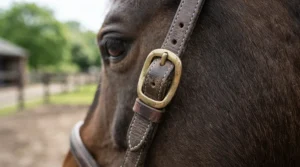
Headcollar fit is where good intentions often go wrong. Kingdom Equestrian’s guidance says the noseband should sit about two fingers’ width below the cheekbone, with room for two fingers under the noseband and one under the headpiece. LeMieux’s guidance says the noseband should sit beneath the projecting cheekbone, with room for two to three fingers between noseband and face. The two differ slightly, so use them as a range and check your horse for comfort and breathing.
Check these points when fitting:
- Noseband height: too high presses on the cheekbone, while too low can restrict breathing.
- Noseband looseness: a sloppy noseband can catch a hoof, a commonly cited hazard.
- Headpiece: it should sit snugly behind the ears without pinching.
- Adjustability: adjustable headpiece and noseband help, as sizes labelled pony, cob and full rarely suit every head.
The Nottingham survey’s authors identified fit and basic horse handling as major education gaps. So fitting well isn’t fussiness. It’s an injury-prevention measure.
How to Choose Between a Leather Headcollar vs Nylon Headcollar
Here’s a quick framework for deciding.
- Decide the main job. Daily handling, travelling, turnout and grazing muzzle use each point to a different product.
- Prioritise release. If the headcollar will ever be left on unsupervised, choose a breakaway or field safe design.
- Check what the leather really is. Mixed-material designs, like the Collegiate ComFiTec Leather Headcollar, may not behave like full leather.
- Measure for fit. Compare your horse’s head with the sizing guide and prefer adjustable headpiece and noseband.
- Consider comfort. Padding helps horses wearing a headcollar daily or tied regularly.
- Budget for lifespan. Compare cost per year, not just the price tag.
- Plan to inspect. Any headcollar needs checking for wear, hardware and, for breakaways, a clean release point.
Features That Actually Matter (And Those That Don’t)
Matter: a release mechanism you can inspect, adjustable fit, solid hardware and padding where the headcollar presses on bone. Reflective webbing, as on the Horseware Field Safe Headcollar, matters more than it sounds if you check horses in poor light.
Matter less: nameplates, crystals and colour-matching. They look lovely at a show. They don’t change how a headcollar behaves when a horse panics.
Worth questioning: vague “strong” or “safe” claims without release figures. As the Nottingham opening-force study shows, safety headcollars vary a great deal, so a label alone tells you little. Look for specifics, such as the tested release loads quoted for the Equilibrium Stellar Headcollar, and then remember they’re manufacturer-reported.
Common Mistakes When Buying a Headcollar
The first mistake is assuming leather equals safe. Leather safety headcollars did better than standard ones in the research. Quality, thickness and construction vary, so one leather headcollar isn’t equivalent to another.
The second is buying by size label alone. A “cob” from one brand can fit differently from another’s.
Third, trusting a hybrid without checking it. Something like the KM Elite Leather Webbing Headcollar combines leather fittings with nylon webbing and has a poll guard. Its listing doesn’t claim a breakaway, so don’t treat it as turnout-safe.
Fourth, using baler twine as a safety device. The opening-force study found fine baler twine broke at around 354N, while heavy-duty twine held to about 1,348N. That variability is exactly the problem.
Finally, forgetting to replace worn kit. Retire any headcollar with frayed stitching, cracked leather or a clogged release point.
Long-Term Cost & Maintenance
Cost per year is the fairest measure. As an illustrative scenario only: a leather headcollar in the £60-£75 range lasting five years works out around £12-£15 a year. A £25 breakaway nylon replaced every two years is about £12.50 a year. They land in the same place, so material alone doesn’t decide it.
| Option | Typical price range | Illustrative lifespan | Maintenance |
|---|---|---|---|
| Leather (mid-range) | £45-£75 | Years, if cared for | Regular soap and balm |
| Breakaway nylon | £25-£55 | Shorter, wear-dependent | Keep release clear |
| Basic nylon | £10-£30 | Shortest | Wipe or wash |
Looking at this, the cheapest purchase isn’t necessarily the cheapest option. Leather rewards owners who actually do the cleaning. Breakaway nylon suits owners who want low maintenance and a purpose-built release. Spend the saved money on a spare, because a spare means you never grab a worn headcollar in a hurry.
Practical Usage Guide: Setting Up and Looking After Your Headcollar
First use. Adjust it on a calm, standing horse, and check noseband height and finger gaps. Fasten clips with the opening facing away from the chin. Attach lead ropes to the correct ring, and tie only to something designed to break, using a quick-release knot.
Leather care. Horze recommends cleaning with a slightly damp sponge and leather soap, then applying balm once dry. Avoid leaving it soaked and baked.
Washable nylon. LeMieux says washable headcollars can go in a wash bag on a 30° cycle and should dry naturally. Always follow the label.
Breakaway care. Keep hook-and-loop clear of mud and hair, and check leather release sections for cracks.
First 30 days. Inspect weekly, note any rubbing, and re-check fit as the horse changes with the season or clipping. Replace at the first signs of wear.
Real-World Scenarios: Matching a Headcollar to Your Situation
Scenario 1: the competition yard. A rider travels weekly and wants something smart. A leather option like the LeMieux Anatomic Leather Headcollar or Collegiate ComFiTec Leather Headcollar suits, and keeping a breakaway one for the field means each does its best job.
Scenario 2: the hard-to-catch pony in a grass livery field. The horse must wear something. A breakaway such as the Horseware Field Safe Headcollar or LeMieux Breakaway Headcollar is the sensible route, with twice-daily checks.
Scenario 3: the laminitis-prone cob on a grazing muzzle. The KM Elite ThinLine Breakaway Field Safe Headcollar is designed for this, and adding the correct muzzle makes sense.
Scenario 4: the growing youngster. The Shires Velociti Gara Fully Adjustable Leather Headcollar gives sizing flexibility so you don’t buy a new one every few months.
Scenario 5: the safety-first owner. The Equilibrium Stellar Headcollar suits anyone who wants release figures to compare, bearing in mind they’re manufacturer-reported.
Problem → Solution Guide
Problem: the headcollar rubs behind the ears. Switch to a padded, anatomic style such as the LeMieux Anatomic Leather Headcollar, and recheck fit.
Problem: the horse keeps losing the headcollar. Check noseband and headpiece adjustment. A looser fit isn’t safer, and a published survey highlights fit as an education gap.
Problem: the release strap won’t hold in the field. Clean the hook-and-loop on the Horseware Field Safe Headcollar or replace worn parts.
Problem: leather has gone stiff. Clean, then apply balm. If it’s cracked, retire it.
Problem: the grazing muzzle keeps slipping. The KM Elite ThinLine Breakaway Field Safe Headcollar locates the muzzle with keepers.
Problem: you can’t tell if your headcollar is safe. Ask the manufacturer for release data, as the research suggests variation is wide.
FAQ
❓ How much does a breakaway headcollar cost in the UK?
❓ Can you machine wash a nylon headcollar?
❓ How often should you replace a leather headcollar?
❓ Is it safe to tie a horse up in a breakaway headcollar?
❓ What size headcollar does a cob need?
Conclusion
The leather headcollar vs nylon headcollar decision isn’t about tradition versus convenience. It’s about what happens in the worst thirty seconds of your horse’s day.
Standard nylon is cheap and cheerful, but it doesn’t release, so keep it for supervised handling. Leather is the safer default for travelling and everyday use, provided you buy well and check what the leather really is. Breakaway and field safe nylon fill the gap for turnout, though release loads vary, so ask questions.
If I had to match horse to headcollar, it would go like this. The LeMieux Anatomic Leather Headcollar or Collegiate ComFiTec Leather Headcollar suit daily wear and travelling. The Shires Velociti Gara Fully Adjustable Leather Headcollar suits youngsters and awkward heads. The LeMieux Breakaway Headcollar, Horseware Field Safe Headcollar and Equilibrium Stellar Headcollar suit turnout. The KM Elite ThinLine Breakaway Field Safe Headcollar suits muzzle wearers.
Whichever you choose, fit it carefully, inspect it often and replace it before it fails.
✨ Ready to Choose Your Safer Headcollar?
🐴 Click any highlighted product above to check current pricing and availability. A well-fitted, well-chosen headcollar is one of the cheapest safety upgrades you can make for your horse.
Recommended for You
- Synthetic Vs Leather Martingale: 7 Best Budget Picks (2026)
- Breastplate For Eventing: 7 Best Picks For UK Riders (2026)
- Standing Martingale For Horse: 7 Best UK Picks (2026)
Disclaimer: This article contains affiliate links. As an Amazon Associate, I earn from qualifying purchases. If you purchase products through these links, we may earn a small commission at no additional cost to you.
✨ Found this helpful? Share it with your friends! 💬🤗
