
In This Article
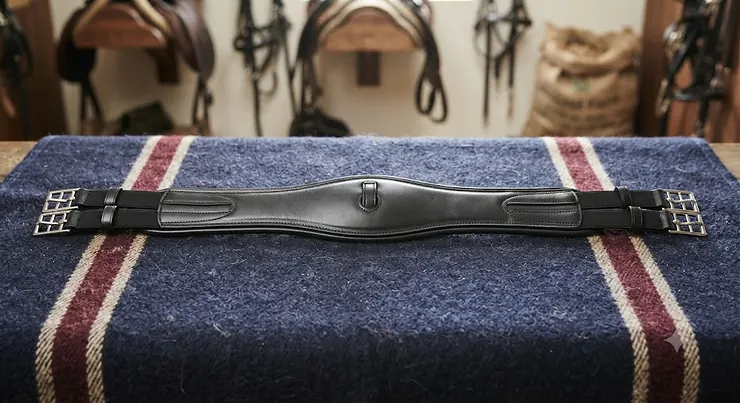
Let’s be honest: girths are the unsung workhorses of the tack room. Nobody photographs them for Instagram, nobody brags about them at the yard, and yet get the wrong one and your entire dressage test can unravel from the girth up. An affordable dressage girth doesn’t have to mean a flimsy strap of nylon that rubs your horse raw by lap three — it means finding genuine comfort, secure saddle stability, and decent build quality without paying premium-competition prices for the privilege.
This guide is built entirely around real, currently available products from well-known UK equestrian brands — no invented “miracle” girths, no fantasy price points. We’ve researched genuine specifications, aggregated customer sentiment where it’s verifiable, and cross-referenced current equine welfare research on girth pressure and fit. What you won’t find here is a rehashed Amazon listing; what you will find is honest commentary on which of these seven girths actually earns its place on your saddle, and why.
Whether you’re kitting out a first pony club horse, replacing a worn-out elastic girth before a competition season, or simply hunting for better value than your current leather dressage girth, we’ve grouped budget, mid-range, and genuinely premium options so you can compare like for like. Along the way we’ll dig into anatomic shaping, short girth systems, girth elastic quality, and the fit checks that matter more than the price tag ever will.
What Is an Affordable Dressage Girth?
An affordable dressage girth is a girth designed for the straight-flapped dressage saddle — typically shorter than a general-purpose girth, with anatomic or contoured shaping around the elbow — that delivers genuine comfort and secure fit at a lower price point than premium competition brands, usually somewhere between £20 and £90.
The trade-off buyers usually worry about is durability versus comfort, and that’s a fair concern. Cheaper materials can mean stiffer leather, less forgiving elastic, or foam that compresses within a season. But as you’ll see below, several of the girths on this list punch well above their price bracket.
Quick Comparison Table
| Girth | Material | Best For | Price Guide |
|---|---|---|---|
| HyCOMFORT Neoprene Dressage Girth | Neoprene, elasticated both ends | Tightest budgets, wipe-clean convenience | Under £30 |
| Shires ARMA Anti-Chafe Anatomical Girth with Elastic | Waffle PVC with supafleece lining | All-rounder anatomic budget pick | £35-£45 range |
| Rhinegold Softee Leather Comfort Dressage Girth | German leather, memory foam inner | Budget-friendly genuine leather | £55-£65 range |
| ARMA SupaFleece Anatomical Girth | PVC waffle outer, supafleece lining | Sensitive-skinned or clipped horses | £45-£55 range |
| Thorowgood Dressage Girth | Synthetic, Airoform cushioning | Contoured fit with reinforced stitching | £40-£50 range |
| LeMieux Arika Contoured Dressage Girth | Soft leather, D-ring | Competition-ready leather look | £75-£90 range |
| LeMieux Gel-Tek Anatomic Dressage Girth | Ultra-soft leather with gel pockets | Top-tier pressure relief | £125-£140 range |
Looking at this spread, the price gap between the cheapest and priciest girth here is roughly fourfold, yet all seven share the same core job: keep the saddle stable without restricting the horse’s shoulder. What separates them in practice is how each brand engineers pressure distribution and elasticity into that basic shape — the HyCOMFORT Neoprene Dressage Girth and Shires ARMA Anti-Chafe Anatomical Girth with Elastic aim for maximum value, the middle tier balances leather feel against synthetic practicality, and the two LeMieux girths lean on gel and premium leather to chase marginal comfort gains that matter most at higher training intensities.
💬 Already got a favourite from the table? Scroll down for the full breakdown before you commit — the “Best For” column only tells half the story.🤗
Top 7 Affordable Dressage Girths: Expert Analysis
1. HyCOMFORT Neoprene Dressage Girth — best value for money on a tight budget
The HyCOMFORT Neoprene Dressage Girth is about as no-nonsense as girths get, and that’s precisely its appeal. Its neoprene outer wipes clean in seconds after a muddy hack, which matters more than it sounds on a busy yard where girth-washing is nobody’s favourite chore.
The elasticated-both-ends (EBE) construction gives even pressure distribution along the whole barrel rather than just at one buckle point, and the stainless steel roller buckles resist the rust that plagues cheaper fittings after a season of rain. Where it can’t compete with pricier options is breathability — neoprene traps heat more than leather or waffle fabric, so it’s better suited to cooler climates or shorter schooling sessions than to sweaty summer competition days.
Based on the spec comparison with other entry-level girths, this is squarely aimed at first-horse owners, riding school yards replacing stock in bulk, or anyone who wants a reliable spare girth in the trailer. Reviewers of neoprene girths in this category consistently flag the easy cleaning and secure buckle action as the standout benefits, while the most common criticism across this material type is reduced airflow in hot weather.
Pros:
- ✅ Genuinely low price point for a first or spare girth
- ✅ Elasticated both ends spreads pressure evenly
- ✅ Wipes clean in seconds, ideal for muddy yards
Cons:
- ❌ Neoprene retains heat more than leather or fabric
- ❌ Less premium feel than leather alternatives long-term
At under £30 in most sizes, this is one of the cheapest genuinely anatomic-adjacent girths available, and for a backup or first pony’s kit, it represents solid value.
2. Shires ARMA Anti-Chafe Anatomical Girth with Elastic — best all-rounder anatomic budget pick
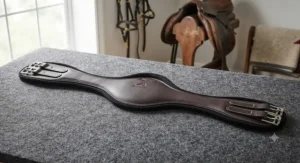
The Shires ARMA Anti-Chafe Anatomical Girth with Elastic takes the budget category up a notch by adding proper anatomic shaping — the girth is cut back at the elbow specifically to free up the shoulder through the swing phase of the stride, rather than sitting as a straight strap across the barrel.
Its waffle PVC construction increases airflow compared with solid neoprene, which reduces the sweat build-up that leads to girth galls, while the supafleece lining underneath adds a layer of cushioning against the sternum. Pressure-alleviating elastic inserts sit at both ends, and the stainless steel roller buckles are the same grade used across Shires’ higher-end ranges. What most buyers overlook about this model is that the anatomic cut genuinely changes how the saddle sits under work — it isn’t just marketing language, and it’s backed by the same shoulder-freedom principle that underpins the anatomic designs further up this list.
Reviewers consistently note the waffle material’s durability and the noticeable reduction in rubbing compared with straight girths they’ve previously used, though a recurring theme in feedback on this fabric type is that the surface can feel slightly stiff for the first few rides before it softens.
Pros:
- ✅ True anatomic cut, not just a marketing label
- ✅ Waffle fabric improves airflow versus neoprene
- ✅ Trusted, widely stocked UK brand with easy sizing
Cons:
- ❌ Slight break-in period before the fabric softens
- ❌ Elastic inserts wear faster with daily competition use
Sitting in the £35-£45 range, this is the girth we’d point most riders towards if they want genuine anatomic benefits without stepping into leather-girth pricing.
3. Rhinegold Softee Leather Comfort Dressage Girth — best budget-friendly leather pick
If the word “leather” is non-negotiable for you, the Rhinegold Softee Leather Comfort Dressage Girth is where the affordable end of that category actually starts. It’s made from German leather, fully padded with a memory foam inner, and finished with a touch-tape buckle guard that stops the buckles digging into the saddle flap — a small detail that saves your flaps from unsightly buckle marks over time.
The memory foam inner compresses under load to spread pressure across a wider surface area than a flat leather strap would manage alone, and the elasticated ends allow the ribcage room to expand during exertion. On paper this means you get much of the “feel” and longevity of leather — it moulds to the horse’s shape over time rather than staying rigid — at a price closer to synthetic girths than to premium competition leather.
Reviewers of Rhinegold’s leather tack range frequently comment on the leather softening quickly with regular conditioning, and note the anatomic shaping holds up well after repeated washing, which is a common failure point for cheaper padded girths.
Pros:
- ✅ Genuine leather at a price close to synthetic girths
- ✅ Memory foam inner spreads pressure effectively
- ✅ Touch-tape buckle guards protect the saddle flap
Cons:
- ❌ Requires regular leather conditioning to stay supple
- ❌ Heavier than synthetic or neoprene equivalents
Expect to pay in the £55-£65 range at the time of research, which for a padded leather girth undercuts most competition-branded alternatives by a significant margin.
4. ARMA SupaFleece Anatomical Girth — best for sensitive-skinned or clipped horses
The ARMA SupaFleece Anatomical Girth swaps the waffle-only construction for a full supafleece lining, and it’s this detail that makes it the pick for thin-skinned, clipped, or girth-shy horses. The fleece sits directly against the horse’s coat and reduces the friction that causes galls far more effectively than a smooth synthetic surface.
Underneath the fleece, the same anatomic cut and elastic-insert philosophy as Shires’ other ARMA girths applies, with stainless steel roller buckles for durability. Here’s what the spec sheet won’t tell you, but reviewers note: fleece linings need more frequent brushing to stay effective, because compacted fleece loses its cushioning properties and can start to feel more abrasive than a clean waffle surface. For horses coming back into work after time off, or for those with a known sensitivity to girthing (sometimes linked to underlying gastric discomfort, which is worth ruling out with your vet if girthiness persists), this style is usually the first thing a saddle fitter will suggest trying.
The aggregated feedback pattern across fleece-lined anatomic girths in this bracket is broadly positive on comfort, with the main maintenance complaint being that fleece takes longer to dry after washing than waffle or neoprene alternatives.
Pros:
- ✅ Fleece lining reduces friction for sensitive skin
- ✅ Anatomic shape frees the shoulder through the stride
- ✅ Popular first recommendation from saddle fitters
Cons:
- ❌ Fleece needs regular brushing to stay effective
- ❌ Slower to dry after washing than synthetic girths
At around £45-£55, this sits just above the entry-level anatomic girths but well below leather pricing, making it a sensible mid-point for horses with genuine sensitivity issues.
5. Thorowgood Dressage Girth — best contoured fit with reinforced stitching
The Thorowgood Dressage Girth takes a different route to comfort, relying on Thorowgood’s proprietary Airoform cushioning rather than fleece or foam inserts. The company’s own positioning is that Airoform “stays soft” through repeated use rather than compacting the way cheaper foams do, and the girth is gently curved specifically to create a snug, contoured fit that eliminates pinching behind the elbow.
A double-layer stitching system runs the length of the girth, which is a genuinely useful upgrade over single-stitched budget girths — stitching failure at the buckle points is one of the more common (and more dangerous) ways cheap girths fail mid-ride. Based on the build quality here, this is a girth aimed at riders who want contoured comfort without paying leather prices, and who value construction durability as much as day-one softness.
Because Thorowgood’s product reviews are thinner on independent retailer sites than some rival brands, we’d flag this honestly: verified aggregated review data for this exact model is limited at the time of research, so treat the comfort claims as brand-stated until you’ve had hands-on time with it, rather than as independently confirmed customer consensus.
Pros:
- ✅ Airoform cushioning resists compacting over time
- ✅ Double-layer stitching reduces failure risk at buckles
- ✅ Contoured cut specifically designed to avoid pinching
Cons:
- ❌ Independently verified customer reviews are limited
- ❌ Synthetic finish lacks the moulding feel of leather
At an estimated £40-£50 range, it competes directly with the ARMA SupaFleece on price while taking a stitching-durability-first approach instead of a fleece-comfort-first one.
6. LeMieux Arika Contoured Dressage Girth — best competition-ready leather option
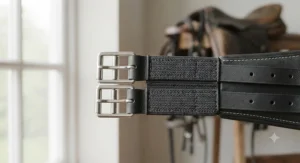
Stepping into genuinely premium territory, the LeMieux Arika Contoured Dressage Girth is soft, supple leather shaped around the elbows with a D-ring fitted as standard for attaching training aids or a breastplate. This is the girth you’ll see most often on the competition circuit precisely because it looks the part while still doing the anatomic job properly.
The contoured cut mirrors the shaping philosophy used across LeMieux’s whole girth range: material shifted away from the elbow to reduce restriction, with the leather itself supple enough from day one that it doesn’t need the lengthy break-in period some budget leather girths require. What most buyers overlook about this price bracket is that you’re not just paying for the LeMieux name — the leather grade and D-ring hardware are both genuinely a step up from the Rhinegold leather girth further up this list, which matters if you’re competing regularly and need consistent performance under sustained pressure.
Reviewers of LeMieux’s contoured girth range frequently mention how quickly the leather softens compared with rival brands, alongside praise for consistent sizing across the range — a detail that matters when you’re ordering online without trying before you buy.
Pros:
- ✅ Premium leather that’s supple from first use
- ✅ Integrated D-ring for training aids or breastplate
- ✅ Consistent sizing reported across the range
Cons:
- ❌ Meaningfully pricier than the Rhinegold leather option
- ❌ Overkill for riders who only hack occasionally
Sitting in the £75-£90 range, this is best justified if you’re competing regularly or want a girth that will still look presentable after two seasons of consistent use.
7. LeMieux Gel-Tek Anatomic Dressage Girth — best top-tier pressure relief
At the top of this list sits the LeMieux Gel-Tek Anatomic Dressage Girth, and it’s here that the pricing genuinely reflects a different level of engineering rather than just brand premium. Dynamic gel pockets sit along the leading edge of the girth, combined with ultra-soft oiled leather, to actively absorb and redistribute pressure rather than simply cushioning it passively the way foam does.
This matters more than marketing copy alone suggests. Independent research into girth design and tension — including a 2025 open-access study published in the journal Animals — found that girth design measurably alters peak pressure and limb protraction during ridden work, which is exactly the mechanism LeMieux is targeting with the gel-pocket approach. The contoured shape maximises space behind the elbow, and LeMieux states the design can improve stride length by reducing restriction through the front legs — a claim that aligns with what the pressure research above demonstrates in principle, even if you should treat any single manufacturer’s performance claim with appropriate scepticism until you’ve felt the difference yourself.
Reviewers consistently rate this model highly for comfort on sensitive or difficult-to-fit horses, with the most repeated theme being a visible reduction in girth-related resistance during tacking up compared with the horse’s previous girth.
Pros:
- ✅ Gel pockets actively redistribute pressure, not just cushion
- ✅ Backed by the design principles used in published pressure research
- ✅ Frequently reported to reduce girthing resistance in sensitive horses
Cons:
- ❌ Highest price point on this list by a clear margin
- ❌ Arguably unnecessary for horses with no girthing issues
Expect to pay in the £125-£140 range, which puts this firmly in “problem-solving” territory rather than a default first purchase — it earns its price when a horse has a genuine pressure-related issue standard girths haven’t resolved.
✨ Don’t Miss These Exclusive Deals!
🔍 Whichever affordable dressage girth catches your eye, click through to check current pricing, sizing, and availability before it changes. A well-fitted girth is one of the cheapest upgrades you can make to your horse’s comfort this season.
How to Fit Your Dressage Girth Correctly
Buying the right girth is only half the job — girth fit is where most riders actually go wrong, and it costs nothing to get it right. Start by measuring your horse: run a soft tape from the highest point of the withers, down behind the elbow, across the sternum and back up the other side, then subtract roughly 5-8cm to account for billet strap length, since the girth shouldn’t need to be buckled at the very top or bottom hole.
Once you’re tacking up, tighten in stages rather than all at once. A common first-30-days mistake is over-tightening cold, before the horse has had a chance to breathe out and settle — most experienced riders tighten enough to keep the saddle secure at halt, walk a few steps, then take up one more hole before mounting, and a final hole once warmed up. You should always be able to fit two flat fingers between the girth and the horse’s side once fully tightened; if you can’t, it’s too tight, and if you can fit a full hand, it’s too loose to be safe.
Maintenance matters as much as the initial fit. Leather girths need conditioning every few weeks to prevent cracking at the elastic attachment points, the single most common failure spot on any girth. Synthetic and neoprene girths should be rinsed after sweaty sessions to stop salt build-up stiffening the material, and every girth — regardless of price — deserves a monthly check of the stitching and buckle hardware for early signs of wear. The British Horse Society’s tack-fitting guidance is a genuinely useful free resource if you want a fuller walkthrough of checking tack safety beyond the girth alone.
Real-World Scenarios: Which Girth Suits Which Rider
If you’re a college student sharing a livery yard horse and riding three times a week on a tight budget, the HyCOMFORT Neoprene Dressage Girth or Shires ARMA Anti-Chafe Anatomical Girth with Elastic covers your needs without overspending on a girth that will see moderate, low-intensity use.
If you own a sensitive, recently clipped horse who’s started fidgeting during girthing, the ARMA SupaFleece Anatomical Girth is the logical first change to make before assuming a behavioural problem — fleece linings solve a surprising number of “girthy” horse issues that actually stem from friction rather than temperament.
If you’re competing regularly at Novice or Elementary level and want your kit to look consistent and professional in the ring while still delivering genuine anatomic comfort, the LeMieux Arika Contoured Dressage Girth strikes the right balance between polish and practicality, while riders training a horse with a diagnosed or suspected pressure sensitivity should look straight to the LeMieux Gel-Tek Anatomic Dressage Girth as the more targeted (if pricier) solution.
Anatomic Dressage Girth vs Straight Dressage Girth: What’s the Real Difference
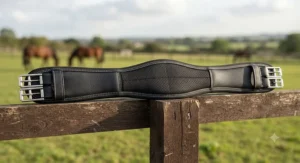
A straight girth is exactly what it sounds like: a flat strap of consistent width running from one billet to the other, with no shaping to accommodate the horse’s elbow. An anatomic dressage girth, by contrast, is cut with a curve or contour that narrows or shifts material away from the elbow, giving the front leg more room to swing freely at each stride.
The practical difference shows up most in horses with a forward, active gait or a naturally narrow girth area, where a straight girth can create a pinch point behind the elbow during collection or lateral work. Peer-reviewed research on girth strap placement has found that girthing method has a measurable influence on saddle pressure patterns during ridden work, lending scientific weight to what saddle fitters have argued anecdotally for years — girth shape isn’t cosmetic, it changes how pressure is distributed across the horse’s back and belly.
That said, anatomic shaping isn’t automatically “better” for every horse. Broad-chested horses or those with a naturally forward elbow placement sometimes fit a well-padded straight girth just as comfortably, and paying extra for anatomic shaping when a horse doesn’t need it is money that could be better spent elsewhere in your kit.
Short Dressage Girths and Dressage Saddle Flaps: Getting the Length Right
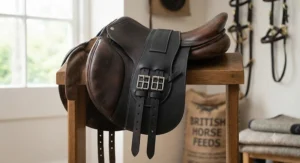
Dressage saddles are built with notably longer flaps than jumping or general-purpose saddles, designed to accommodate the longer leg position dressage riders use. This creates a specific sizing problem: a standard-length girth buckled under a long dressage saddle flap forces the buckles up under the rider’s leg, creating pressure and bulk exactly where you don’t want it.
A short dressage girth solves this by pairing shorter billet straps on the saddle with a correspondingly shorter girth, so the buckles sit well below the flap rather than underneath it. This is sometimes called a “mono girth” system when the billets converge to a single central strap. If your saddle’s flap already extends well past your knee, check whether it’s designed for a short or standard girth system before ordering — buying the wrong length is one of the most common (and most avoidable) mismatches in dressage tack.
Most of the girths on this list are available in both standard and shorter size options, so match the girth length to your saddle’s billet system rather than to your horse’s girth measurement alone; getting this wrong is a fit issue no amount of anatomic shaping can fix.
Leather Dressage Girth vs Synthetic: Which Wins Long-Term?
A leather dressage girth ages the way good boots do — stiff and slightly unforgiving out of the packet, then progressively softer and more moulded to your horse’s shape with every clean and condition. That moulding process is leather’s real advantage: after a season of proper care, a quality leather girth often fits better than it did on day one, something synthetic materials simply can’t replicate.
Synthetic girths (neoprene, waffle PVC, and fleece-lined variants) counter with lower maintenance, faster drying, and generally lower upfront cost, plus better performance in wet or muddy conditions where leather can dry out and crack if not cared for promptly. On a straight cost-per-use basis over three to five years, well-maintained leather often works out cheaper than replacing synthetic girths every season or two, but only if you’re realistic about whether you’ll actually keep up the conditioning routine leather demands.
The honest verdict: if you enjoy tack care and ride consistently enough to justify the investment, a leather dressage girth like the Rhinegold Softee Leather Comfort Dressage Girth or LeMieux Arika Contoured Dressage Girth rewards that commitment. If your yard routine is rushed or you’re prone to leaving tack in a damp trailer, a well-made synthetic option will serve you more reliably.
Girth Elastic: Why It Matters More Than You Think
It’s easy to treat girth elastic as an afterthought, but the quality and placement of elastic inserts genuinely changes how a girth performs. Elastic allows the girth to expand slightly as the horse’s ribcage moves during breathing and exertion, preventing the constant micro-pressure that a completely rigid strap would apply with every stride.
Where the elastic sits matters as much as whether it’s present at all. Elastic at both ends (EBE) distributes give symmetrically and is generally considered the safer, more balanced option; single-end elastic is cheaper to manufacture but can pull the girth slightly off-centre under tension. Cheap elastic also loses its stretch far faster than quality elastic — a common complaint across budget girths is elastic that’s gone slack within a single season, at which point the girth stops doing its job even if the rest of the material looks fine.
As a rule of thumb, check your girth’s elastic every few months by stretching it gently by hand; if it feels noticeably looser than when new, or doesn’t spring back promptly, it’s time to replace the girth even if the leather or fabric itself still looks serviceable.
How to Choose an Affordable Dressage Girth
- Measure your horse properly first. A girth that’s the wrong length undermines every other feature it has, however well engineered.
- Match the girth system to your saddle’s billets. Long-flap dressage saddles typically need a shorter girth; check before you buy.
- Decide leather or synthetic based on your routine, not your budget alone. Leather rewards consistent care; synthetic rewards low-maintenance convenience.
- Prioritise anatomic shaping for horses with an active, forward gait. Straight-cut girths can still suit broader, less sensitive horses just fine.
- Check the elastic quality and placement, not just the outer material. EBE construction generally distributes pressure more evenly than single-end elastic.
- Factor in coat sensitivity. Clipped or thin-skinned horses usually do better with fleece-lined or padded options regardless of price point.
- Set a realistic budget band and stick to it. The mid-range girths on this list often deliver 80% of the premium comfort benefit at half the price.
Common Mistakes When Buying a Dressage Girth
The single most common mistake is buying based on the horse’s overall size rather than an actual girth measurement — cobs and warmbloods of similar height can need very different girth lengths depending on barrel shape. A close second is ignoring the saddle’s billet system entirely and assuming any dressage girth will fit any dressage saddle, which trips up more first-time buyers than any other issue on this list.
Riders also frequently underestimate how quickly elastic degrades, replacing the whole girth when a simple elastic-insert check might have identified the real problem, and conversely, some riders leave a genuinely worn-out girth in service for too long because the leather or fabric still looks presentable on the outside. Finally, buying the most expensive option “just to be safe” without matching it to an actual comfort issue is its own kind of mistake — as the comparisons above show, several budget and mid-range girths perform very well for horses without specific pressure sensitivities.
Long-Term Cost & Maintenance
Thinking in cost-per-year rather than upfront price changes the calculation considerably. A £25 neoprene girth replaced every single season works out to roughly the same annual cost as a £75-£90 leather girth that lasts three to four years with proper conditioning — the leather option simply front-loads the expense.
Maintenance time is the less obvious cost. Leather girths need conditioning roughly every two to four weeks of regular use, adding perhaps ten minutes to your weekly tack-cleaning routine; synthetic girths need less frequent deep care but should still be rinsed after sweaty sessions and checked for salt staining, which can stiffen fabric over time. Whichever material you choose, budgeting for elastic replacement or a full girth swap roughly every 18-24 months of regular use is a realistic maintenance expectation across this entire price range.
Features That Actually Matter (And Those That Don’t)
Genuinely worth paying extra for: elastic quality and placement, anatomic shaping if your horse’s gait or shape calls for it, and stitching durability at the buckle points, since that’s the most common structural failure point on any girth. Gel or memory-foam padding also earns its cost for horses with documented pressure sensitivity.
Largely marketing noise for most riders: colour-matched hardware, branded packaging, and marginal weight differences between synthetic girths, none of which affect comfort or performance in any measurable way. Unless you’re specifically chasing competition presentation points, don’t let cosmetic extras push your budget past what the functional features above actually justify.
FAQ
❓ What's the difference between a dressage girth and a normal girth?
❓ How much should an affordable dressage girth cost?
❓ Do anatomic dressage girths really make a difference?
❓ How tight should a dressage girth be?
❓ How long does a leather dressage girth last with proper care?
Conclusion
There’s no single “best” affordable dressage girth here — there’s a best girth for your horse, your budget, and your riding routine, and this list is built to help you match those three variables honestly. If you’re working with a tight budget and a straightforward horse, the HyCOMFORT Neoprene Dressage Girth or Shires ARMA Anti-Chafe Anatomical Girth with Elastic will serve you perfectly well. If your horse has genuine sensitivity or you’re chasing that last percentage of competition-ready comfort, the step up to the ARMA SupaFleece Anatomical Girth, the leather options from Rhinegold and LeMieux Arika, or the pressure-engineered LeMieux Gel-Tek Anatomic Dressage Girth is money well spent rather than money wasted on marketing.
Whatever you choose, remember that even the best girth on this list can’t compensate for poor fit, degraded elastic, or a saddle that no longer suits your horse’s shape — the girth is one part of a system, not a standalone fix. Measure properly, check the elastic regularly, and revisit your choice whenever your horse’s condition or workload changes noticeably.
✨ Ready to upgrade your tack box? Check current prices and sizing on any of the girths above before your next competition entry closes! 💬🤗
Recommended for You
- Affordable Sheepskin Numnah: 7 Best Value Picks for 2026
- Affordable Half Pad: 7 Best Budget-Friendly Picks (2026)
- Memory Foam Saddle Pad Under £50: 7 Best Picks for 2026
Disclaimer: This article contains affiliate links. As an Amazon Associate, I earn from qualifying purchases. If you purchase products through these links, we may earn a small commission at no additional cost to you.
✨ Found this helpful? Share it with your friends! 💬🤗
