
In This Article
Somewhere between “my horse just won’t settle in a snaffle” and “I’ve heard bitless is kinder” sits a genuinely tricky decision, and it’s one that a lot of British riders are wrestling with right now. The bitless bridle vs snaffle bridle debate isn’t a new one — Dr Robert Cook was publishing on bit-induced behaviour problems decades ago — but it’s picked up real momentum as more owners start questioning whether a piece of metal in the mouth is actually necessary for control. A bitless bridle is any headgear that steers and stops a horse using pressure on the nose, jaw, poll and chin instead of the mouth, and a snaffle bridle is the traditional single-jointed-bit setup most riders learn on. Neither is automatically “better” — the honest answer depends on your horse’s mouth conformation, your riding discipline, and how much groundwork you’re willing to put in before you climb aboard.

This guide pulls together seven real bitless bridles currently sold in the UK, spanning budget synthetic side-pulls right up to premium anatomical designs, along with genuine spec breakdowns and aggregated review sentiment rather than invented anecdotes. We’ll also dig into the specific situations people search for most: what to do with a horse that fights the bit, how a cross-under bitless bridle actually works, what separates a hackamore from a side-pull, and how to run a proper bitless bridle training programme rather than just swapping tack and hoping for the best. According to Wikipedia’s overview of bitless bridles, the modern cross-under design only dates back around 30 years, so a fair amount of what’s on the market is still evolving — which is exactly why spec-reading and honest comparison matter more here than with, say, buying a headcollar.
Quick Comparison Table
| Bridle | Type | Best For | Price Range |
|---|---|---|---|
| Dr Cook Bitless Bridle | Cross-under | Widest all-round control | £80-120 |
| Horseware Rambo Micklem Multibridle | 3-in-1 anatomical | Riders wanting bitted/bitless flexibility | £90-150 |
| Nurtural Bitless Bridle | Cross-under (Circle-X) | Horses sensitive to poll pressure | £90-130 |
| Waldhausen X-Line Sensation | Side-pull | Everyday hacking and schooling | £60-90 |
| Waldhausen X-Line Supersoft | Scawbrig | Well-schooled, responsive horses | £60-90 |
| Zilco Sidepull Bitless Bridle | Side-pull | Budget-conscious first-time bitless riders | £50-90 |
| Zilco S Hackamore | Mechanical hackamore | Experienced riders, strong or dull-to-aid horses | £40-70 |
Looking at the spread above, the pattern that jumps out is that price doesn’t track directly with control — a £50 Zilco Sidepull Bitless Bridle and an £120 Dr Cook Bitless Bridle both work on completely different mechanical principles, so the extra money buys you a different type of pressure distribution, not simply “more bridle.” Riders coming from a snaffle background who want something that still feels familiar under the hand will likely gravitate toward the Waldhausen X-Line Sensation or Zilco Sidepull Bitless Bridle, while anyone dealing with a horse that actively resists the bit tends to see faster results with a cross-under design like the Dr Cook Bitless Bridle or Nurtural Bitless Bridle. Note that none of these prices are fixed — always check current listings before assuming a bracket still applies.
Just one click — help others make better buying decisions too! 😊
Top 7 Bitless Bridles: Expert Analysis
1. Dr Cook Bitless Bridle — the original cross-under design
The Dr Cook Bitless Bridle is the bridle that effectively started the modern bitless movement, developed by Dr Robert Cook, a Professor of Surgery Emeritus at Tufts University’s veterinary school, specifically to eliminate bit-induced pain responses. Two straps cross beneath the jaw and pass up to the opposite side of the headpiece, so a rein aid on the left doesn’t just pull the nose left — it applies a gentle “hug” across the poll, jaw, and opposite cheek simultaneously, distributing pressure rather than concentrating it in one spot.
In practice this means a horse gets a whole-head signal rather than a single point of pressure, which is precisely why so many riders report success with horses that previously reared or gaped against a snaffle. It’s built with genuine English bridle leather, stainless steel hardware that won’t rust, and is sized from pony through to extra full, so fit isn’t the limiting factor it can be with generic bitless nosebands.
Reviewers across equestrian forums consistently note that the cross-under action needs a short adjustment period for both horse and rider, since turning aids feel like “pushing” rather than “pulling” — some riders love this immediately, others need a few sessions of arena work before it clicks. A few users report the poll pressure feels stronger than expected on very sensitive horses, which lines up with documented feedback that led competitor Nurtural to design around this specific complaint.
Pros:
- ✅ Distributes pressure across nose, jaw and poll simultaneously
- ✅ Genuine English leather with rust-proof stainless hardware
- ✅ Backed by published veterinary research on bit-related behaviour
Cons:
- ❌ Noticeable poll pressure that some sensitive horses dislike
- ❌ Steering action takes retraining time for bit-experienced riders
At around £80-120 depending on size and leather grade, this sits mid-to-premium, and the value case is strong if your horse has a genuine bit-avoidance problem rather than just a rider preference for going bitless.

2. Horseware Rambo Micklem Multibridle — three bridles in one
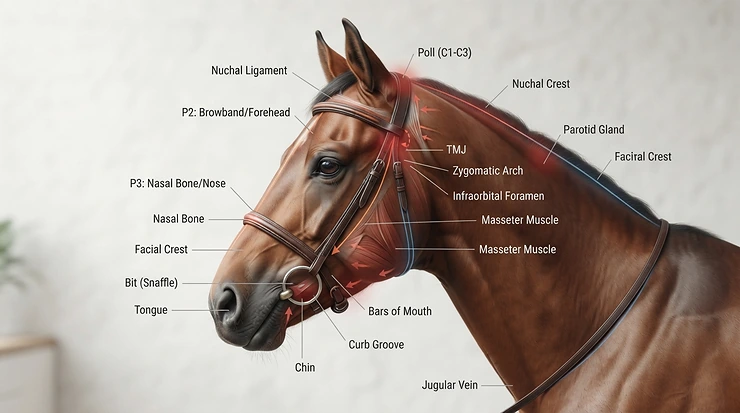
The Horseware Rambo Micklem Multibridle earns its standout spot by refusing to make you choose: with a handful of buckle adjustments it converts between a conventional bitted bridle, a lunge cavesson, and a full bitless bridle with three separate strength settings. The anatomical headpiece is engineered from the shape of the horse’s skull outward rather than guessed at from the outside, specifically avoiding five documented pressure points — the poll and ears, the molars, the infraorbital nerve, the nasal bones, and the tongue.
That last point matters practically: a badly designed noseband sitting low on the nasal bone can restrict breathing exactly like an overtightened flash noseband would, so the Micklem’s clearance there is a genuine functional advantage, not marketing fluff. It’s built from eco-tanned buffalo leather with soft-touch padding, and comes with rubber-covered reins for a secure grip in wet British weather.
Owners transitioning a horse between bitted and bitless work — common with young horses or ones recovering from a mouth injury — consistently praise not needing two separate bridles hanging in the tack room. The trade-off is that the strength-setting adjustments take a little studying the first time; it’s not as instantly obvious as clipping a snaffle in place.
Pros:
- ✅ Converts between bitted, bitless and lunging use in minutes
- ✅ Anatomical design avoids five documented facial pressure points
- ✅ Three bitless strength settings for gradual training progression
Cons:
- ❌ Learning the adjustment system takes longer than a fixed bridle
- ❌ Premium price reflects the multi-function engineering
Priced around £90-150, this is genuinely one bridle doing the job of three, which changes the long-term cost-per-use maths considerably.
3. Nurtural Bitless Bridle — built to solve the poll-pressure complaint
The Nurtural Bitless Bridle exists largely because riders using early cross-under designs kept reporting excessive poll pressure, and its Circle-X noseband mechanism is the direct engineering answer — rather than straps crossing under the jaw and pulling tight around the poll, the Circle-X applies pressure primarily to the nose and jaw while keeping the crown area comparatively free. For an off-track Thoroughbred or any horse with a poll sensitivity from past ill-fitting tack, this distinction genuinely changes how the bridle feels rather than just how it looks.
It’s manufactured in Canada from quality synthetic webbing that’s easy to clean and doesn’t absorb sweat the way leather can, which UK owners dealing with a wet climate tend to appreciate for maintenance reasons alone. Riders who’ve switched from Dr Cook-style bridles specifically because of poll discomfort report the Nurtural resolves the issue within the first few rides, though a handful note the release isn’t quite as instant as a true pressure-and-release system since the Circle-X mechanism has slightly more give built in.
That’s a genuine design trade-off rather than a flaw — a softer release can mean a horse needs a touch more consistency in the rein aid to fully understand what’s being asked. The company also offers a 30-day satisfaction guarantee, which is worth factoring in given how personal bitless fit can be.
Pros:
- ✅ Circle-X design specifically reduces poll pressure vs cross-under rivals
- ✅ Synthetic build resists UK weather and cleans easily
- ✅ 30-day trial period reduces the risk of buying blind
Cons:
- ❌ Release feels less immediate than pure pressure-release designs
- ❌ Limited UK stockists compared to European brands
Expect to pay in the £90-130 range imported, and the value proposition rests almost entirely on whether poll sensitivity is actually your horse’s issue.
4. Waldhausen X-Line Bitless Bridle Sensation — the accessible side-pull
The Waldhausen X-Line Bitless Bridle Sensation takes the most straightforward of all bitless mechanisms — the side-pull — and builds it from proper leather with an anatomically shaped headpiece rather than a flat, generic pattern. Two side rings sit on the noseband and take the reins directly, so pulling the left rein pulls the nose left in a way that feels almost identical to a bit ring being drawn back, which is precisely why side-pulls are considered the gentlest and most intuitive entry point for riders new to bitless work.
Even pressure distribution across the nasal bone is the headline engineering claim, backed by a curved browband and softly lined noseband that avoids the pinching some budget side-pulls are guilty of around the cheekbones. Waldhausen has 185 years in leatherworking behind this range, and it shows in the stitching quality and stainless steel fittings rather than painted hardware that eventually chips and rusts.
Riders coming straight from a snaffle report the steering feels almost too familiar in a good way, with minimal retraining required, though a few note that a genuinely strong or unbalanced horse can lean into a side-pull’s nose pressure in a way a hackamore’s leverage would prevent. It comes supplied with reins, which is a small but real convenience most competitors charge separately for.
Pros:
- ✅ Intuitive side-pull action feels familiar to snaffle riders
- ✅ Anatomically shaped headpiece with even nasal pressure
- ✅ Comes complete with reins, unlike most rivals
Cons:
- ❌ Offers less stopping leverage for genuinely strong horses
- ❌ Not ideal as a standalone solution for horses that lean on contact
Sitting around £60-90, this is a sensible mid-range entry point if your horse’s bit issue is more about comfort than genuine strength or control problems.
5. Waldhausen X-Line Bitless Bridle Supersoft — the scawbrig for schooled horses
The Waldhausen X-Line Bitless Bridle Supersoft uses a scawbrig action, which is a lesser-known mechanism that applies pressure primarily to the lower jaw rather than the nose or poll — a genuinely useful distinction if your horse has any nasal sensitivity or a previous injury in that area. Waldhausen markets this specifically as a bridle for “well-conditioned and responsive” horses, which is honest positioning: the scawbrig gives subtler feedback than a side-pull or cross-under, so it rewards a horse that’s already soft and listening rather than one still learning to yield to pressure at all.
Construction mirrors its Sensation sibling — fine leather, stainless steel fittings, a straight browband, and softly lined contact points throughout — but the mechanical difference in where pressure lands is the entire reason to choose one over the other. Aggregated feedback from UK tack retailers suggests this model performs best as a “second bitless bridle” bought once a horse has already proven comfortable and responsive in a side-pull or cross-under, rather than as a first introduction to bit-free riding.
That’s a genuinely useful piece of buying advice the spec sheet alone won’t tell you. It’s a touch less forgiving of a green or unbalanced horse than the alternatives on this list.
Pros:
- ✅ Jaw-based scawbrig action avoids nasal and poll pressure entirely
- ✅ Premium leather build with stainless steel hardware
- ✅ Ideal upgrade bridle for already-responsive horses
Cons:
- ❌ Too subtle for green horses still learning bitless cues
- ❌ Requires a genuinely soft, established contact to work well
At around £60-90, this is best thought of as a specialist tool rather than a universal first choice — buy it once you know your horse responds well to bitless principles generally.

6. Zilco Sidepull Bitless Bridle — the budget synthetic workhorse
The Zilco Sidepull Bitless Bridle takes the same side-pull mechanism as the Waldhausen above but builds it from Zilco’s proprietary synthetic material, which the manufacturer states won’t stretch, crack, fade or discolour the way cheaper leather or nylon copies tend to over a British winter of mud and rain. The waffle-padded noseband spreads contact pressure over a wider surface area than a flat strap would, which matters most on horses with a prominent nasal ridge where a narrow noseband can create uncomfortable hot spots.
Dual chin and noseband adjustment points let you fine-tune fit more precisely than a single-buckle budget bridle allows, and the stainless steel rings and fittings mean you’re not looking at rust developing after a season left in a damp tack room. This is frequently the bridle riders reach for as their very first bitless purchase specifically because the price point makes experimentation low-risk — if your horse simply doesn’t take to bitless riding, you haven’t sunk £120 into finding that out.
Endurance riders in particular favour Zilco’s synthetic range because it’s genuinely easier to hose down and dry quickly between long rides than oiled leather. The main compromise versus the Waldhausen leather equivalent is aesthetic and feel rather than function — synthetic simply doesn’t age or patina the way leather does.
Pros:
- ✅ Weather-resistant synthetic ideal for wet UK conditions
- ✅ Dual adjustment points for a genuinely precise fit
- ✅ Low price point makes first-time bitless experimentation safer
Cons:
- ❌ Lacks the classic look and feel of leather tack
- ❌ Padding can compress over several years of heavy use
At roughly £50-90, this is the pick for anyone testing the bitless waters without full commitment, and it holds up well enough that plenty of riders never feel the need to “upgrade” to leather.
7. Zilco S Hackamore — leverage-based control for experienced hands
The Zilco S Hackamore is a genuinely different animal from everything else on this list: rather than direct pressure like a side-pull or the distributed hug of a cross-under, its swept-back shank design uses leverage, meaning a given amount of rein pull is mechanically amplified before it reaches the horse’s nose and jaw. This makes it considerably stronger per pound of rein pressure than any bitless bridle above it, which is precisely why equine welfare guidance is consistent that hackamores are best suited to experienced riders with genuinely soft hands, not beginners looking for an easier steering option.
The PVC waffle-padded, contoured noseband at least tries to spread that amplified pressure rather than concentrating it on a thin strip of nasal bone, and the stainless steel shanks and rings resist the corrosion that cheaper hackamore copies suffer. Its “S” shaped shank is specifically the gentler end of the hackamore spectrum compared to long straight-shank designs, which multiply leverage even further and are generally reserved for genuinely dull, well-trained horses under professional supervision.
Trainers working with strong horses that “pull” out in open countryside — the classic case for a hackamore over a snaffle or side-pull — report good results, provided the rider understands that a small hand movement produces a proportionally larger effect than they’re used to. This absolutely isn’t the bridle to hand a novice rider as their introduction to bitless riding.
Pros:
- ✅ Leverage design gives genuine stopping power for strong horses
- ✅ Padded, contoured noseband spreads amplified pressure
- ✅ Swept shank allows easier grazing and drinking on the trail
Cons:
- ❌ Amplified leverage demands soft hands and real experience
- ❌ Unsuitable as a first bitless bridle for beginners or green horses
Priced around £40-70 as a noseband attachment (headpiece sold separately), it’s affordable but genuinely not the right starting point for most riders reading this article.
Getting the Fit and Transition Right
Switching a horse from a snaffle bridle to any bitless design isn’t as simple as swapping the tack and heading out on your usual hack, and rushing this step is the single most common reason bitless transitions fail. Start in an enclosed arena or round pen, not out hacking, because your horse needs to relearn what pressure means without the panic of open space compounding any confusion. Fit the noseband roughly two finger-widths above where a standard cavesson would sit, snug enough that it can’t slide down and obstruct the nostrils but loose enough that you can still fit two fingers underneath comfortably. Spend your first two or three sessions purely on halts and turns at walk, rewarding the lightest possible response rather than waiting for a big, obvious reaction — bitless cues are genuinely more subtle than bit cues for most horses initially. A common maintenance mistake is leaving leather bitless bridles unconditioned; because the noseband takes more direct pressure than a bitted noseband typically does, cracked or stiff leather there causes discomfort far faster than on a standard browband. Check stitching around the crossunder or side rings every few weeks, since these are higher-stress points than on a conventional bridle. Most riders can be confidently walking, trotting and cantering bitless within two to four weeks of consistent, patient schooling — pushing faster than that is where problems tend to start.

Real Riders, Real Situations
Picture three genuinely different UK riders and how their circumstances point toward different choices from this list. Sarah has a 14-year-old cob who’s started throwing his head and grinding his teeth in a snaffle after years of trouble-free riding — her vet found nothing dental, so a bit-pain response is likely, and a Dr Cook Bitless Bridle or Nurtural Bitless Bridle makes sense here because the whole-head pressure distribution tends to resolve genuine bit-avoidance behaviour fastest. Tom is starting a green four-year-old and wants an easy, low-risk way to introduce steering concepts before a bit ever goes near the mouth — the Zilco Sidepull Bitless Bridle or Waldhausen X-Line Sensation are ideal because side-pulls feel closest to eventual bitted contact and cost little enough that a young horse “growing into” the training doesn’t sting financially. Priya rides a strong, forward cob out on busy bridleways and has found her horse increasingly leaning through a snaffle on hacks — for her, a properly introduced Zilco S Hackamore, used only once she’s confident in her own hand independence, offers the leverage-based stopping power a side-pull simply can’t provide, though she’d be sensible to school extensively in an arena first. None of these are guaranteed outcomes, but matching the mechanism to the actual problem, rather than just “going bitless” as a blanket fix, is what separates a successful transition from a frustrating one.
Solving the Horse That Fights the Bit
A horse that fights the bit rarely does so without a reason, and jumping straight to a bitless bridle without investigating why can mean you’ve swapped the symptom’s expression rather than solved the underlying cause. First, rule out dental issues — sharp enamel points, wolf teeth, or an ill-timed float can make any bit genuinely painful, and this should always be a vet or equine dental technician’s first call before any tack change. Second, check bit fit itself: a bit that’s the wrong width pinches the lips, while one sitting at the wrong height in the mouth creates constant low-level discomfort that eventually manifests as headshaking or rearing under contact. Third, consider whether the resistance is actually a training gap rather than a pain response — a horse that’s never been taught to yield softly to rein pressure will often “fight” any form of contact, bitless included, until it understands what’s being asked. If pain has genuinely been ruled out and the issue is discomfort-specific to the mouth, a cross-under design like the Dr Cook Bitless Bridle tends to show the fastest behavioural improvement because it removes the mouth from the equation entirely while still giving clear directional signals. Fourth, if the horse has a documented mouth injury or dental abnormality that makes any bit unsuitable long-term, a bitless bridle isn’t a stopgap — it’s the permanent, correct solution, and the Horseware Rambo Micklem Multibridle‘s bitless settings work well here since they still allow a familiar bridle shape. Finally, be honest that some resistance is simply rider-error in hand position or timing, which no piece of tack — bitted or bitless — will fix on its own.
What Is a Bitless Bridle vs Snaffle Bridle?
A bitless bridle is headgear that controls a horse through pressure on the nose, jaw, poll and chin rather than the mouth, while a snaffle bridle uses a single-jointed metal or synthetic bit that applies pressure directly to the tongue, bars and corners of the mouth via rein tension. The core mechanical difference is where the signal lands: a snaffle communicates through the most nerve-dense soft tissue in the horse’s head, whereas bitless designs spread that same signal across bone and less sensitive tissue, which is why bitless is often framed as the gentler option for horses with dental issues, mouth injuries, or documented bit-avoidance behaviour, though it isn’t automatically kinder in every case.
Cross-Under Bitless Bridle Explained
The cross-under bitless bridle is the design most people picture when they hear the term “bitless bridle,” and understanding its mechanism explains why it behaves so differently from a side-pull or hackamore. Two straps run from the noseband, cross underneath the horse’s jaw, and continue up to attach at the opposite side of the poll, meaning a single rein aid doesn’t isolate to one side of the face — it produces a gentle, encircling pressure that touches the nose, the far jaw, and the poll all at once. According to the World Bitless Association’s evidence summary, this “push” style of steering is fundamentally different from the “pull” a horse learns to associate with a bit or side-pull, which is precisely why some horses take a session or two to adapt while others adjust almost instantly. The trade-off documented by riders and manufacturers alike is that a poorly fitted cross-under can create more poll pressure than intended, which is the entire design rationale behind alternatives like the Nurtural’s Circle-X mechanism. For horses being retrained away from genuine bit aversion, the cross-under’s whole-head signal is generally considered the most effective starting point among all bitless types.
Hackamore vs Side-Pull: What’s the Real Difference?
These two terms get used almost interchangeably by newcomers, but mechanically they’re worlds apart, and mixing them up is one of the fastest ways to buy the wrong bridle for your horse. A side-pull is direct pressure: pull the left rein, the nose moves left, with no mechanical amplification, making it the most predictable and beginner-friendly bitless option and the closest in feel to a conventional bit. A hackamore, by contrast, uses shanks — either curved “S” shapes like the Zilco S Hackamore or long straight bars on more severe designs — that act as levers, meaning the pressure the horse actually feels is multiplied well beyond what the rider’s hand applied. This amplification is genuinely useful for a strong horse that’s learned to lean through direct pressure, but it demands considerably softer, more educated hands than a side-pull ever would, because the same rein movement that produces a gentle side-pull cue can produce a sharp, potentially painful jolt through a hackamore’s shank. As a rule of thumb worth remembering: side-pulls suit beginners and green horses learning bitless concepts for the first time, while hackamores belong with experienced riders working established, genuinely strong horses, and the two should never be treated as interchangeable “bitless bridle” purchases.
How to Choose Between a Bitless Bridle and a Snaffle Bridle
- Rule out physical causes first — get a vet or dental technician to check teeth, mouth injuries and bit fit before assuming the problem is purely behavioural.
- Match the bitless type to the actual issue — poll-sensitive horses suit Circle-X designs like the Nurtural Bitless Bridle, while nasal sensitivity points toward a scawbrig like the Waldhausen X-Line Supersoft.
- Consider your discipline’s rules — British Eventing and British Showjumping now permit bitless bridles in most classes, but always confirm current rules before a competition entry.
- Assess your own hand independence honestly — hackamores and even cross-unders demand steadier hands than many riders think they have.
- Budget for a genuine trial period — the Nurtural Bitless Bridle‘s 30-day guarantee reflects how personal bitless fit really is.
- Factor in transition time — allow two to four weeks of dedicated schooling before judging whether the switch has worked.
- Don’t discount a well-fitted snaffle — if the actual problem was ill-fitting tack rather than the bit itself, a correctly fitted bitted bridle may solve things faster than any bitless alternative.
Bitless Bridle Training: A Step-by-Step Approach
Training a horse into bitless work properly is less about the bridle itself and more about rebuilding the pressure-and-release conversation from scratch, even with a well-schooled horse. Begin on the ground: lead your horse in the new bitless bridle and practise gentle direct-rein pressure toward you, releasing the instant they yield, so the core lesson — pressure means “give,” release means “good” — is established before you ever sit on top. Once mounted, work exclusively at walk in an enclosed space for your first two or three sessions, focusing on halt transitions and large, gentle turns rather than anything requiring precision. Introduce trot only once halt and walk-to-walk turns feel consistently soft, and expect steering to initially feel vaguer than under a bit — this is normal for a cross-under or scawbrig design specifically, since the signal is genuinely more diffuse by mechanical design. Canter transitions should wait until your horse demonstrates confident, immediate yields at trot; rushing this stage is the most common reason riders report “my horse doesn’t listen bitless,” when the real issue is an incomplete groundwork phase. Keep sessions short — fifteen to twenty minutes of focused bitless schooling beats an hour of frustrated repetition. Most riders following this structure see a fully confident, bitless-capable horse within three to five weeks, though horses with a strong prior bit-avoidance pattern sometimes need longer simply because they’re unlearning a defensive habit alongside learning a new signal.
Common Mistakes When Switching to Bit-Free Riding
Riders new to bit-free riding consistently make a handful of avoidable errors, and recognising them in advance saves weeks of frustration. The single biggest mistake is skipping groundwork entirely and heading straight out on a hack, which sets both horse and rider up to have their first miscommunication in an environment with real consequences rather than a controlled arena. A close second is over-tightening the noseband in an attempt to “get more control,” which with side-pulls and cross-unders in particular simply increases discomfort without meaningfully improving steering — the fix for vague steering is better timing and clarity of aid, not more pressure. Many riders also under-estimate how long the adjustment period genuinely takes, judging a bridle as “not working” after a single ride when two to four weeks of consistent practice is the realistic benchmark. Buying a hackamore as a first bitless bridle because it “looks stronger” is another frequent error — as covered above, the leverage amplification demands more skill, not less, making it a poor beginner choice despite the intuitive assumption that more control equals more suitable. Finally, some owners assume bitless automatically means “kinder” and stop paying attention to fit altogether; a poorly fitted bitless bridle can absolutely cause discomfort and even structural pressure issues, which brings us to an important safety point covered next.
Safety, Welfare Evidence and Competition Rules
It’s worth being genuinely honest here rather than simply repeating bitless-advocacy talking points: peer-reviewed research doesn’t universally support the idea that bitless is automatically gentler. A study covered by equine science publication The Horse found that average nasal pressure was 65% higher under a side-pull bitless bridle compared to a snaffle-and-noseband setup, with peak pressures 147% higher — figures high enough that the researchers raised concerns about potential structural damage to the nasal bones if a side-pull is over-tightened or used with heavy hands. A separate peer-reviewed paper in a 2023 equine behaviour study concluded that while side-pull bitless bridles should be used with genuine caution, the broader evidence still doesn’t suggest they carry greater welfare risk than bitted bridles overall, and notes bitless designs carry the advantage of being intrinsically less aversive regardless of how well or badly they’re used. The practical takeaway is simple: a bitless bridle is not a free pass to ride with heavy hands, and correct fit — not tight enough to move but never over-tightened — matters just as much as it does with any bit. On the competition side, British Eventing and British Showjumping now explicitly permit bitless bridles across most classes and both cross-country and showjumping phases, a meaningful shift from a decade ago, though British Dressage rules remain more restrictive and should always be checked directly before entering.
Long-Term Cost and Maintenance
Working out the real cost of going bitless means looking past the sticker price to how each material behaves over a British riding season. Leather options like the Waldhausen X-Line Sensation and Dr Cook Bitless Bridle need regular conditioning — expect to clean and feed the leather every few weeks if ridden regularly, with a decent leather balm costing a few pounds and adding perhaps twenty minutes to your weekly routine, but a well-maintained leather bitless bridle can easily outlast five or six years of consistent use. Synthetic options like the Zilco Sidepull Bitless Bridle trade that maintenance time for lower upfront cost and genuine weather resistance — no conditioning needed, and a quick hose-down after a muddy hack is all it takes, though the padding does eventually compress and lose some cushioning after several years of daily wear. Hardware matters more than riders often realise: stainless steel fittings, present on every bridle in this list, resist the rust that cheap plated hardware develops within a single wet winter, avoiding a false economy where you replace a “bargain” bridle’s rings within eighteen months. Factoring in that many riders who switch to bitless never go back to a bit — meaning this is typically a one-time purchase decision rather than a recurring cost — the genuine total cost of ownership over five years usually favours whichever bridle actually solves your horse’s specific issue, rather than whichever was cheapest to buy initially.
Ready to find the right fit for your horse? Explore the full range and compare current prices before you decide. 🐴

Frequently Asked Questions
❓ Is a bitless bridle better than a snaffle for a nervous horse?
❓ Can you jump a horse in a bitless bridle?
❓ How long does it take to train a horse to a bitless bridle?
❓ Do bitless bridles give less control than a snaffle?
❓ Is a hackamore the same as a bitless bridle?
Conclusion
There’s no universal winner in the bitless bridle vs snaffle bridle debate, and anyone promising you one is oversimplifying a genuinely nuanced decision. What the research and real-world feedback consistently point to is this: bitless bridles solve specific problems well — genuine bit aversion, dental or mouth injuries, poll or nasal sensitivity depending on the design chosen — but they demand the same attention to fit, timing and rider skill that a bit does, and a poorly fitted side-pull can create real discomfort of its own. If your horse has a documented, specific reason to avoid the bit, start with a cross-under like the Dr Cook Bitless Bridle or Nurtural Bitless Bridle and commit to a proper multi-week transition rather than expecting instant results. If you’re simply curious or starting a young horse, the accessible Zilco Sidepull Bitless Bridle or leather Waldhausen X-Line Sensation offer a low-risk, intuitive entry point. And if versatility matters most, the Horseware Rambo Micklem Multibridle genuinely does let you keep every option open. Whatever you choose, the horse’s actual response over those first few honest weeks of schooling will tell you far more than any spec sheet or forum thread ever could.
Recommended for You
- Anatomic Bridle For Horse Comfort: 7 Best UK Picks (2026)
- Show Bridle For Showing: 7 Best UK Picks & Tips (2026)
- Double Bridle for Dressage: 7 Best Picks for UK Riders (2026)
Disclaimer: This article contains affiliate links. As an Amazon Associate, I earn from qualifying purchases. If you purchase products through these links, we may earn a small commission at no additional cost to you.
✨ Found this helpful? Share it with your friends! 💬🤗
