
In This Article
Here’s the short version: a stable rug keeps your horse warm indoors, and a turnout rug keeps your horse warm and dry outdoors. Simple enough in theory. In practice, the average UK horse owner stares at a wall of rugs in the tack shop — or scrolls through Amazon.co.uk at eleven o’clock on a drizzly Tuesday — and has absolutely no idea which one they need.
So let’s fix that.
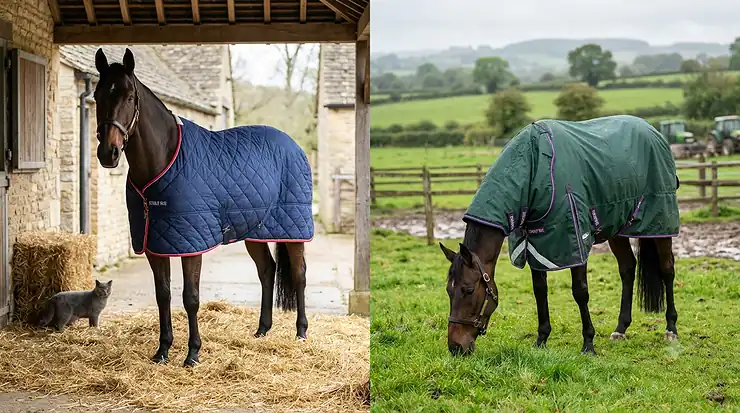
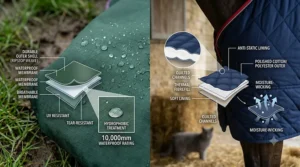
When it comes to stable rug vs turnout rug, the distinction comes down to three things: waterproofing, durability, and breathability. A stable rug is essentially a quilted duvet for your horse. No waterproofing, no need for heavy-duty outer fabric, just cosy polyfill in varying weights from 50g (barely-there) up to 400g (proper winter warmth). A turnout rug, on the other hand, has to handle everything the British weather throws at it — horizontal rain, sub-zero frost, February mud — while remaining breathable enough not to turn your horse into a sweating, overheated mess. That means a waterproof outer shell (typically 600D to 1680D denier fabric), a breathable membrane, and hardware tough enough to survive being rubbed against fence posts by a horse with too much to say about breakfast.
What most UK buyers overlook is that these two rug types serve completely different purposes, and using the wrong one in the wrong context doesn’t just waste money — it can genuinely compromise your horse’s welfare. Putting a non-waterproof stable rug on a horse in the field on a wet British day is roughly as effective as sending them out in a dressing gown. And over-rugging with a heavy turnout when the temperature barely dips below 10°C is, frankly, one of the more common welfare mistakes in UK yards today.
According to the British Horse Society, horses are highly capable of thermoregulating and many native breeds need considerably less rugging than their owners assume. This guide will help you navigate both types, match the right rug to the right situation, and find the best current options on Amazon.co.uk — with honest commentary on who each product genuinely suits.
Quick Comparison: Stable Rug vs Turnout Rug at a Glance
| Feature | Stable Rug | Turnout Rug |
|---|---|---|
| Waterproof | ❌ No | ✅ Yes |
| Breathable | ✅ Yes | ✅ Yes (good ones) |
| Outer Denier | 210D–600D | 600D–1680D |
| Used outdoors? | ❌ Stable/arena only | ✅ Field/paddock |
| Typical fill range | 0g–400g | 0g–300g |
| Leg straps | Usually none/surcingles | Yes, usually required |
| Price range (GBP) | £25–£150 | £40–£200+ |
| Best for | Clipped/stabled horses | Field-kept or part-time turnout |
The key takeaway from this table isn’t just the waterproofing — it’s the denier figure. A 210D stable rug outer is fine for a horse standing in a stable, but it would shred within a season on an active horse in the field. Turnout rugs start at 600D for a reason: horses are hard on kit, and UK fields are even harder. Budget buyers should note that cheap turnout rugs often cut corners on the waterproof membrane rather than the fill weight — which stings when your horse comes in soaked despite wearing a rug labelled “waterproof.”
💬 Just one click — help others make better buying decisions too! 😊
✨ Don’t Miss These Exclusive Deals!
🔍 Take your horse’s comfort to the next level with these carefully selected rugs. Click on any highlighted item below to check current pricing and availability on Amazon.co.uk — each pick has been chosen to give your horse exactly what they need, inside or out.
Top 7 Stable Rugs and Turnout Rugs: Expert Analysis
1. WeatherBeeta ComFiTec Channel Quilt II Standard Neck Medium Stable Rug (200g)
WeatherBeeta’s ComFiTec Channel Quilt II is probably the most recognisable stable rug on UK yards right now, and for good reason. The 600D polypropylene channel-quilted outer and 200g polyfill hit a sweet spot that suits a clipped horse through the middle portion of a British winter — roughly October to December and again in early March when the nights are still cold but you’re not quite in full-heavyweight territory.
What actually sets it apart from cheaper stable rugs is the memory foam wither-relief pad. This lifts the rug clear of the withers rather than pressing down on them — a feature that sounds minor until you’ve dealt with a horse with white hair patches from rug rub. The quick-clip front closure means you’re not fumbling with buckles in a dark stable at 7 a.m. UK reviewers on Amazon.co.uk specifically praise the fit across a range of horse types, with several noting it works well on warmbloods who tend to be broader across the shoulder than the rug expects.
This is the rug for a horse clipped to a hunter or blanket clip who’s stabled overnight through the core winter months. It’s not glamorous, but it is extremely reliable.
✅ Memory foam wither pad prevents rubbing
✅ Available in 15 sizes on Amazon.co.uk
✅ Machine washable at 30°C
❌ Not suitable for horses with very deep shoulders without trying on first
❌ Medium weight only — won’t suit very cold horses without a liner
Price range: Around £60–£75 | Value verdict: Solid mid-range choice with premium comfort features.
2. Shires Tempest Original 200 Stable Rug
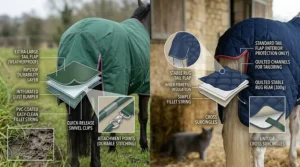
If WeatherBeeta is the Land Rover of stable rugs, Shires’ Tempest range is the reliable Ford Focus: no frills, decent build quality, honest value. The Tempest Original 200 features a 210D polyester outer with 200g polyfill and a basic touch-tape front closure. It sits in the more accessible price bracket, making it particularly popular on yards where multiple horses need kitting out and budget is a real consideration.
The honest assessment? The outer fabric is lighter than WeatherBeeta’s 600D equivalent, which means it won’t take as many seasons of daily stable use before it starts to pill or thin. But for a horse who’s relatively gentle on rugs and lives in a well-maintained stable with minimal friction points, it performs perfectly well. UK buyers on Amazon.co.uk note it runs slightly narrow across the back, so cobs and broader native types may want to size up.
This is the rug for an owner with two or three horses to kit out who needs a decent, practical stable rug without spending premium money on every single one.
✅ Budget-friendly without sacrificing warmth
✅ Navy colourway suits most yard aesthetics
✅ Good availability in multiple sizes on Amazon.co.uk
❌ Lighter outer fabric than premium alternatives
❌ Narrower cut — less suited to cob types without sizing up
Price range: Around £45–£60 | Value verdict: A workhorse of a rug at a sensible price.
3. John Whitaker Rastrick 200G Standard Stable Rug
The John Whitaker Rastrick is something of an underrated gem among Amazon.co.uk’s stable rug offering — it holds a 4.6-star rating from 17 UK reviews, which is notably high for a rug in the under-£50 bracket. The 200g fill and standard neck cut suit a wide range of horse types, and the construction quality punches above its price point.
What distinguishes the Rastrick from other budget-friendly options is the attention to the front closure system and the silkier lining, which reduces friction against the coat. For horses prone to rubbing their manes in winter, a smoother lining genuinely makes a difference — coat condition in spring is partly determined by what the horse has been wearing all winter. This is the rug I’d point a first-time horse owner towards: simple, effective, appropriately priced, and available on Amazon Prime for next-day delivery.
✅ Excellent value for under £50
✅ Smooth lining helps preserve coat condition
✅ Prime-eligible on Amazon.co.uk — fast delivery
❌ Less robust than branded premium options
❌ Colour range is limited compared to larger brands
Price range: Around £35–£50 | Value verdict: Best budget stable rug on Amazon.co.uk right now.
4. Horseware Amigo Hero Ripstop 200g Standard Neck Turnout Rug
Now we move outdoors. The Horseware Amigo Hero Ripstop is one of the most trusted turnout rugs in the UK market, and the 200g version is arguably the most useful weight in the entire range — it covers the broadest temperature window across a typical British autumn and spring. The 600D ripstop outer is waterproof and breathable, and Horseware’s classic front disc closure has been refined over years to be genuinely secure without being fiddly.
The standout feature for UK conditions is the antibacterial, anti-static polyester lining. British fields are muddy, and horses who spend time rolling or pressing against hedgerows build up static — which then attracts more debris. A lining that actively fights this keeps the inside of the rug cleaner for longer, which matters when washing a turnout rug means a full day’s project (they won’t fit in most domestic machines; plan for a launderette or specialist rug wash). UK reviewers specifically call out how well the leg arches preserve freedom of movement, noting the rug doesn’t bunch at the shoulder even on horses with active, varied paces.
For a horse in part-time turnout through the UK’s October–April wet season, this is a serious contender.
✅ 600D ripstop — handles field conditions without tearing
✅ Antibacterial, anti-static lining stays cleaner longer
✅ Leg arches maintain freedom of movement
❌ Premium price compared to budget turnout alternatives
❌ Classic front cut may not suit very broad-chested cobs
Price range: Around £85–£100 | Value verdict: Worth every pound for reliable outdoor protection.
5. Horseware Mio Turnout Medium 200g
The Mio is Horseware’s everyday workhorse — more budget-accessible than the Amigo Hero, but still carrying the Horseware quality DNA. With 174 Amazon.co.uk reviews and a 4.4-star rating, it’s one of the most reviewed horse rugs in the UK’s Amazon equestrian category. The 200g fill in a standard turnout outer means it handles British drizzle and cool temperatures efficiently without overheating a horse in the 8–12°C range that defines much of our autumn.
The construction is notably lighter than the Amigo Hero’s 600D ripstop, using a 300D outer — adequate for moderate weather and a horse who isn’t particularly rough on rugs, but worth bearing in mind for field-kept horses who live out 24/7 in mud-heavy paddocks. UK reviewers mention it’s excellent for ponies and cobs in particular, citing a forgiving fit across broader body types. For a horse who comes in at night and spends mornings and afternoons turned out, the Mio Medium is entirely sufficient and considerably easier on the wallet.
✅ 174 Amazon.co.uk reviews — highly tested by UK buyers
✅ Well-suited to native breeds and cob types
✅ More accessible price point than premium Amigo range
❌ 300D outer — less durable than 600D alternatives for 24/7 turnout
❌ Less breathable than top-tier membranes in persistently wet conditions
Price range: Around £65–£85 | Value verdict: Strong choice for moderate turnout use on a sensible budget.
6. Gallop Trojan 600D Standard Neck 50g Turnout Rug
Don’t overlook the Gallop Trojan. At 50g fill with a 600D outer, this is the rug for the awkward British shoulder season — those days in September or April when it’s not cold enough for any fill but absolutely wet enough to need waterproofing. It holds a 4.6-star rating from 84 UK reviews and appears in Amazon.co.uk’s best-seller list for horse rugs, which is genuinely telling for a relatively modest brand.
What Gallop does well is price-to-denier ratio. A 600D outer at this price point is unusual; most competitors offer 300D at similar cost. For a native breed or a horse who naturally runs warm, this is practically a rain sheet with a whisper of fill — and that’s exactly what the British climate asks for six months of the year. The cross surcingles are straightforward and secure. Nothing revolutionary here, but that’s rather the point.
✅ 600D outer at a budget-friendly price — excellent denier-to-cost ratio
✅ 4.6 stars from 84 Amazon.co.uk UK reviews
✅ Ideal for shoulder-season turnout and warmer native breeds
❌ 50g fill insufficient for horses that feel the cold
❌ Simpler hardware than premium alternatives
Price range: Around £40–£55 | Value verdict: The best-value light turnout rug on Amazon.co.uk.
7. Rhinegold Aspen Full Neck Outdoor Rug
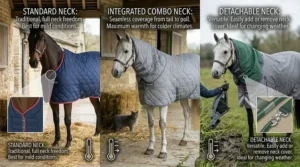
The Rhinegold Aspen is a combo-neck turnout — meaning the neck cover is attached — and it’s the top option for horses who need consistent coverage without the fuss of attaching a separate neck piece on dark, wet mornings. With 139 Amazon.co.uk reviews and a 4.6-star rating, it’s one of the platform’s most consistently well-reviewed horse rugs. The full neck cuts down on mud crust and rain exposure at the neck and shoulders, which is particularly relevant for horses stabled at night but turned out during the day in exposed, windy paddocks.
The Aspen is built for practicality rather than luxury. The 600D outer handles field conditions well, and the full neck design means one garment replaces two (the rug plus a separate neck cover), which appeals to anyone who’s ever lost half a neck cover to a horse who decided the fence post needed decorating. UK reviewers highlight the durability and the good sizing range, noting it works well on everything from 14.2hh ponies to 17hh sport horses.
For any horse turned out in windswept UK paddocks — Wales, Scotland, Northern England, Yorkshire — the full-neck design earns its keep from November to March without argument.
✅ Full neck cover integrated — no separate neck piece needed
✅ 4.6 stars from 139 Amazon.co.uk reviews — very reliable rating
✅ Great for exposed, windy paddocks in northern UK
❌ Full neck style adds warmth that some horses don’t need in milder southern winters
❌ Fitting the neck correctly takes a little practice
Price range: Around £55–£70 | Value verdict: Superb combination of coverage, durability and price.
How to Choose the Right Rug for Your Horse: A Practical UK Guide
The biggest mistake UK horse owners make isn’t buying the wrong rug — it’s buying the right rug for the wrong situation. Here’s how to approach the decision methodically.
1. Ask where your horse lives. If your horse is stabled overnight, you need a stable rug. If they live out, you need a turnout rug. If they’re both stabled and turned out, you need — brace yourself — one of each, and probably in two weight options. This is normal. It’s not over-complicating things; it’s what the British climate demands.
2. Consider the clip. A fully clipped horse in work is wearing what is essentially a short-sleeved top in January. They need significantly more rug weight than an unclipped horse. A hunter-clipped horse stabled overnight in a poorly insulated barn in Yorkshire will need a 300g–400g stable rug. The same horse in a warm, bedded stable in Somerset might be fine at 200g.
3. Match fill weight to temperature, not to how cold you feel. Horses thermoregulate differently from humans. Research from the University of Edinburgh’s Royal (Dick) School of Veterinary Studies confirms that native breeds in particular have evolved to cope with temperatures well below 0°C without supplementary rugging. Over-rugging suppresses the natural winter coat and impedes thermoregulation — the very opposite of what’s intended.
4. Check the denier on turnout rugs. For a horse who lives out 24/7 or rolls enthusiastically, aim for 600D minimum. For a horse in moderate turnout (4–6 hours daily), 300D can suffice but expect to replace it sooner.
5. Factor in the British shoulder seasons. March–May and September–October are the most rug-challenging months in the UK. Temperatures swing 15°C in a single day, from 4°C at 6 a.m. to 18°C by 2 p.m. Having a lightweight option (50g–100g) alongside a mid-weight means you’re not choosing between roasting your horse and soaking them.
Real-World Rugging Scenarios: Which Rug for Which UK Horse?
The Clipped Competition Horse in Cheshire A 16.2hh warmblood, hunter clipped, stabled overnight, turned out for three hours in a managed paddock each morning. This horse needs a 200g–300g stable rug for overnight use (WeatherBeeta ComFiTec Channel Quilt is ideal here) and a 100g–200g turnout for the short morning turnout. In January, during sub-zero nights, adding a 200g liner under the stable rug is far more cost-effective than buying a new heavyweight rug.
The Welsh Section D on a Yorkshire Smallholding Lives out 24/7. Hardy native type with thick winter coat, naturally runs warm. This horse is one of the most over-rugged horses in Britain — their owners mean well, but a heavyweight turnout from October is often genuinely harmful. A lightweight 50g–100g turnout (the Gallop Trojan is perfect) handles the wet without overheating them. Only in genuinely prolonged sub-zero conditions does the fill weight need increasing.
The Veteran in a Dorset Livery Yard A 24-year-old TB, poor doer, partly clipped, stabled from 4 p.m. to 8 a.m. daily. This horse has changed thermoregulation, less body condition, and probably has some arthritis making warmth a genuine welfare priority. A 300g stable rug overnight, combined with the Rhinegold Aspen for daytime turnout (the full neck keeps the older horse’s neck and shoulder warm), is a sensible package. Don’t cheap out on stable rug quality for a horse at this life stage.
The First-Time Pony Owner in Surrey 12hh native pony cross, unclipped, field shelter available, part-time turnout. Honestly? This pony may not need a stable rug at all if it’s stabled with adequate bedding and hay. For turnout, the Horseware Mio in 0g fill acts as a rain sheet for wet days, and a 100g option covers the chillier autumn months. Resist the urge to rug according to how you feel looking at them through the kitchen window.
 The Over-Rugging Problem in the UK (And How to Avoid It)
Britain has a rugging culture. Walk into any UK livery yard in October and you’ll see horses in heavyweight turnouts when it’s 13°C and partly cloudy. It’s well-intentioned but worth interrogating.
Over-rugging has measurable consequences. When a horse consistently wears more fill than the temperature warrants, their body suppresses natural coat growth, meaning you’re committed to the rug for the rest of the season because the coat never developed. It also impairs thermoregulation — a horse who’s too warm cannot efficiently lose heat, which means they sweat, the rug becomes damp, and suddenly the “warmth” you’ve provided is working actively against them. A wet coat loses heat dramatically faster than a dry one.
The British Horse Society advises owners to touch the base of the horse’s ears and the skin under the rug at the shoulder to check temperature, rather than relying on air temperature alone. Equine welfare guidance from the RSPCA suggests that for unclipped native breeds, a rug is rarely necessary above 5°C unless weather is severe.
A useful heuristic: rug for the horse’s needs, not your emotions. The number of stable rugs sold in the UK’s mildest autumn months — when unclipped horses genuinely need nothing more than shelter and ad-lib forage — is a testament to how persuasive equestrian marketing can be.
What Every UK Horse Owner Gets Wrong at the Start of the Rugging Season
The annual mistakes appear with the reliability of the autumn equinox.
Reaching for the heavyweight too early. October in England averages 10–14°C in most parts of the country. A 400g stable rug in early October on an unclipped horse is like wearing a ski jacket in a centrally heated house. Start lighter than you think you need.
Ignoring the denier specification on turnout rugs. “Waterproof” on a product listing means nothing without denier context. A 210D outer can be waterproof initially, but it won’t stay that way for long under field conditions. For full turnout use, treat 600D as your minimum.
Buying a stable rug for outdoor use. This one sounds too obvious to mention, but stable rugs are sold in large volumes to buyers who use them as “just a quick turnout.” The moment a non-waterproof rug gets wet, it becomes a heat sink — the opposite of its intended purpose. A soaked quilted outer is both heavy and cold.
Neglecting to re-proof turnout rugs. UK wet weather seasons are long. A turnout rug that was waterproof in September may be leaking by Christmas without re-proofing. Nikwax Rug Proof is widely available on Amazon.co.uk and takes about twenty minutes to apply. It extends rug life meaningfully and is one of the most underused products in UK equestrian care.
Fitting without checking. A rug that’s too tight across the shoulder — regardless of whether it’s a stable rug or turnout rug — causes white hair patches and muscle tension. The traditional two-finger gap rule at the withers applies to both types.
Long-Term Cost and Value: What Does Rugging Really Cost in the UK?
Horse rugging is a surprisingly significant annual cost when you add it all up. Let’s think about it realistically.
A well-cared-for stable rug should last three to four seasons with regular washing and proper storage. A turnout rug in active daily use might last two to three seasons, depending on the horse, the field conditions, and whether re-proofing is maintained. The Horseware Amigo Hero’s higher initial cost (around £85–£100) is actually competitive with replacing a £45 budget turnout every twelve months — the economics of quality hold up.
Rug washing is a hidden cost. Domestic machines struggle with full-size turnout rugs, and commercial rug-washing services in the UK typically charge £15–£30 per rug depending on the service level. Factor that in twice per season per turnout rug and the running cost adds up. Some livery yards offer bulk washing, which can reduce this.
Repair is worth considering. Both WeatherBeeta and Horseware have reasonable parts availability in the UK, and replacement leg straps, surcingles, and front clips can be sourced without replacing the entire rug. Budget brands are often not repairable in any meaningful sense — hardware is proprietary enough that replacement parts simply aren’t sold.
The total cost of ownership over three seasons for a well-chosen mid-range rug versus a series of budget replacements is often comparable — but the mid-range rug delivers a better experience throughout.
✨ Ready to Find the Perfect Rug?
🔍 Check current prices and availability on Amazon.co.uk for any of the rugs featured in this guide. These picks cover every UK horse owner’s needs — from the hardened native in the field to the pampered warmblood in a warm stable.
FAQ
❓ Can I use a stable rug for turnout?
❓ How do I know what fill weight my horse needs in the UK?
❓ Do horses need rugs in summer in the UK?
❓ What's the difference between a turnout rug and a horse rug?
❓ How often should I wash my horse's turnout rug in the UK?
Conclusion: Stable Rug vs Turnout Rug — Make the Right Call
The stable rug vs turnout rug debate, ultimately, isn’t really a debate at all. They do different jobs, serve different environments, and the answer to which one you need is almost always “both, in appropriate weights.” Britain’s climate demands flexibility: the ability to layer a 200g stable rug with a liner on a bitter January night, swap to a lightweight turnout for a wet but mild afternoon in March, and drop to a breathable rain sheet in early May.
The seven products featured in this guide cover that full spectrum — from the budget-friendly John Whitaker Rastrick for stable warmth on a tight purse to the reliable Horseware Amigo Hero Ripstop for serious outdoor protection. What connects them is that all are currently available on Amazon.co.uk, all have genuine UK buyer feedback, and all serve a specific purpose rather than claiming to do everything at once.
Buy for your horse’s actual needs. Touch the skin under the rug daily, not just in theory. And if in doubt, go lighter — you can always add a liner.
✨ Don’t Miss These Exclusive Deals!
🔍 Click any highlighted product above to check current pricing and availability on Amazon.co.uk. All featured rugs ship via Amazon.co.uk with Prime next-day delivery available for eligible members — useful when the forecast is looking threatening and your horse is about to be caught out in a rug that’s past its best.
Recommended for You
- Summer Turnout Rug Horse Owners Need: 7 Best UK Picks for 2026
- Best Lightweight Turnout Rug for Horses: Top 7 UK Picks (2026)
- Best Turnout Rugs for Horses UK 2026: 7 Top Picks Reviewed
Disclaimer: This article contains affiliate links. As an Amazon Associate, I earn from qualifying purchases. If you purchase products through these links, we may earn a small commission at no additional cost to you.
✨ Found this helpful? Share it with your mates! 💬🤗
