
In This Article
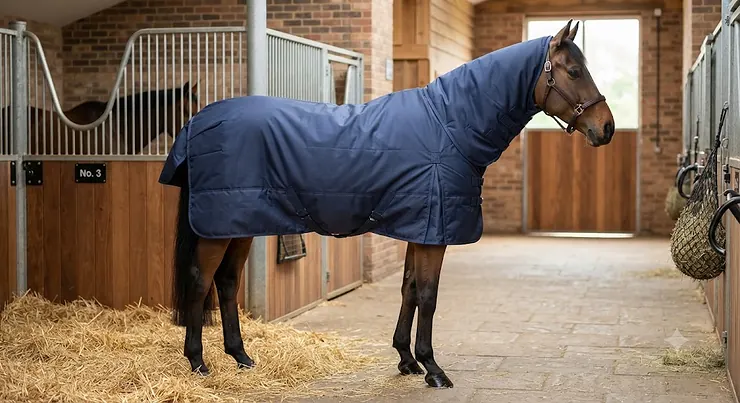
A stable rug with integrated neck cover is a rug that joins the body blanket and neck piece into one seamless garment, so there’s no gap at the withers for draughts to sneak through. Simple as that sounds, it solves a problem that’s plagued horse owners for decades: the cold triangle of skin between a standard rug and a bare neck. If you’ve ever gone out to the yard on a frosty January morning and found your clipped cob shivering despite a “perfectly good” 300g rug, you already know the culprit. Heat doesn’t leave through the flanks — it leaves through the neck, the withers, and every seam that doesn’t quite meet.

As the British Horse Society’s rugging guidance points out, horses experience cold very differently to how we do, so matching the rug to the actual horse rather than to how chilly the yard feels to you is the real starting point. This guide is built for British stable yards, British weather, and British budgets. We’ve dug into real specifications, genuine aggregated review sentiment, and the practical realities of rugging up a clipped, senior, or thin-coated horse through a proper UK winter. You’ll find seven real products spanning budget to premium, comparison tables that actually mean something, and — because a rug is only as good as its fit — a full breakdown of shoulder fit, mane protection, and the eternal rug-rub problem. Whether you’re weighing a stable combo rug benefits question for the first time or you’ve already worn out two seasons of detachable-neck rugs and want something that just works, you’re in the right place. Let’s get into it.
Quick Comparison Table
| Rug | Fill Weight | Neck Style | Best For |
|---|---|---|---|
| Horseware Amigo Bravo 12 Stable All-In-One | 350g heavyweight | Seamless integrated | Clipped horses in cold yards |
| WeatherBeeta ComFiTec Essential Combo Neck Medium | 220g mid-weight | Permanently attached combo | First-time buyers, everyday value |
| Bucas Quilt Big Neck Combo | 200g mid-weight | Big Neck integrated | Wide-shouldered breeds, Friesians, cobs |
| Shires StormX Original Combo Neck | 100g/200g options | Full combi neck | Budget buyers, spring/autumn use |
| Premier Equine Lucanta Stable Combo | 300g heavyweight | Forward-cut integrated | Horses with prominent withers |
| Masta Snugmasta Combo | 200g mid-weight | Dome-neck integrated | Mane protection, sensitive coats |
| Gallop Equestrian Trojan Dual 200 Stable Rug & Neck Set | 200g mid-weight | Detachable combo set | Layering flexibility on a budget |
Looking at the spread above, the pattern that jumps out is how differently “integrated neck” gets interpreted from one manufacturer to the next. Some, like the Horseware Amigo Bravo 12 Stable All-In-One, genuinely seam the neck into the body so there’s zero adjustment needed, while others — the Gallop Equestrian Trojan Dual 200 Stable Rug & Neck Set, for instance — sell a combo-style set where the neck attaches securely but still detaches for warm spells. Neither approach is objectively “better”; it depends whether you want permanent full coverage or the flexibility to strip back layers as March weather does its usual British flip-flopping.
💬 Found a rug you like the look of already? Scroll down and tap through to check today’s price on Amazon UK!
Top 7 Stable Rugs With Integrated Neck Cover: Expert Analysis
Coverage below runs from serious heavyweight investment pieces down to sensible budget options, because not every horse — or every wallet — needs the same rug. Each entry blends real specifications with honest analysis of who that rug actually suits, not just a features list lifted from a product page.
1. Horseware Amigo Bravo 12 Stable All-In-One — seamless neck, zero draught gap
The standout here is right there in the name: the neck isn’t a bolt-on accessory, it’s built into the pattern from the start. At 350g fill, this sits at the heavyweight end, and that density matters in practice — on a fully clipped horse standing in an unheated barn through a proper cold snap, 350g is roughly the difference between “comfortable” and “still shivering by 10pm.” The 1200 denier ripstop outer and the anatomical shoulder darts are designed to move with the horse rather than against it, which is exactly what you want on a rug that’s staying on for 12+ hours a stretch.
Based on the spec comparison against lighter combos in this list, the Bravo 12’s weight class puts it firmly in the “clipped horse, cold yard” bracket rather than the “just taking the edge off” category — buy the wrong weight here and you risk overheating a horse that’s still partly coated. Reviewers consistently note that the fit is generous through the shoulder and that the double front buckle closure holds well overnight, though a handful mention the fill can feel bulky on finer-coated native breeds. Horseware’s reputation for hardware durability (buckles, D-rings, surcingle clips) is well established across the wider Amigo range, and that consistency shows up here too.
Pros:
- ✅ Genuinely seamless neck stops draughts at the withers
- ✅ 350g fill suits fully clipped horses in cold barns
- ✅ Reinforced hardware known for lasting multiple seasons
Cons:
- ❌ Too warm for unclipped or lightly worked horses
- ❌ Premium fabric weight adds bulk versus lighter combos
Expect this one to sit in the £90-£130 range depending on size and retailer, at the time of research. Given the fabric quality and hardware longevity Horseware is known for, it’s a genuinely defensible spend for anyone rugging a clipped horse through a full British winter — check current price before you commit, as retailer promotions shift often.

2. WeatherBeeta ComFiTec Essential Combo Neck Medium — best everyday value combo
What stands out immediately is how much rug you get for a mid-range outlay. The 220g polyfill sits squarely in the “most horses, most nights” bracket — enough to matter on a chilly evening without cooking a horse that’s only partially clipped. WeatherBeeta’s Guard-Tec coated 1200 denier ripstop outer is genuinely tough stuff; it’s the same coating family used across their turnout range, so it’s been proven against far worse conditions than a stable floor.
Here’s what to weigh before buying: this is a combo style, meaning the neck is permanently attached rather than removable, so it’s a “one-weight, one-season” purchase rather than a modular system. What most buyers overlook about this model is the twin low-cross surcingle design, which does more for keeping the rug seated correctly overnight than the headline fill weight ever will — a rug that shifts is a rug that stops working, no matter how thick the polyfill is. Aggregated review sentiment across WeatherBeeta’s ComFiTec range consistently praises the smooth 210 denier lining for reducing coat rub, a genuinely useful detail for horses prone to shoulder or neck rubbing.
Pros:
- ✅ 220g fill suits the majority of British winter nights
- ✅ Guard-Tec coated 1200D outer built for durability
- ✅ Smooth 210D lining reduces coat and shoulder rub
Cons:
- ❌ Neck isn’t removable if the weather warms suddenly
- ❌ Not warm enough alone for a fully clipped horse in deep frost
At around £60-£85, the value case is strong: you’re getting turnout-grade fabric technology on a stable-only product without paying turnout prices. For anyone buying their first combo rug and wanting a sensible middle ground, this is a genuinely low-risk starting point.
3. Bucas Quilt Big Neck Combo — best fit for wide-shouldered breeds
The standout feature here is right in the name — this is cut generously through the shoulder and neck specifically for breeds that other combo rugs squeeze. Friesians, cobs, and stockier native ponies routinely struggle with off-the-peg neck covers gaping at the throat or pinching at the shoulder point, and Bucas built the Big Neck variant to answer exactly that complaint. The breathable quilted construction traps air in lofted pockets rather than relying purely on fill density, which on paper means warmth without the clammy, overheated feel some heavier polyfill rugs produce.
Bucas also offers this with a choice of Stay-Dry or Silk-Feel/Dermo-Care linings, and that choice matters more than it looks on a spec sheet: Stay-Dry is the one to reach for if your horse regularly comes in from the field damp, since it wicks moisture away rather than trapping it against the skin. Reviewers consistently report that the extra shoulder gusseting genuinely reduces rubbing on broader horses compared with standard-fit combos, though a few note the specialist cut means it can look slightly loose on narrower, finer-boned types.
Pros:
- ✅ Extra-generous cut solves gaping on wide-shouldered horses
- ✅ Choice of Stay-Dry or Silk-Feel linings for different needs
- ✅ Lofted quilted fill traps heat without feeling clammy
Cons:
- ❌ Looser fit can look baggy on narrow, fine-boned horses
- ❌ Costs noticeably more than standard-cut combo rivals
Prices generally land in the £100-£150 bracket at the time of research, which reflects the specialist pattern-cutting rather than premium branding alone. If you’ve spent seasons fighting a gaping neck on a Friesian or cob, this is one of the few combos actually engineered to solve that specific problem.
4. Shires StormX Original Combo Neck — best budget full-neck option
The headline advantage is straightforward: a proper full combi-neck rug at a genuinely accessible price point, which is rarer than it should be in this category. The 210 denier outer isn’t going to out-tough a 1200D turnout fabric, but remember — this is a stable rug, not a field rug, so it isn’t fighting rain and fence-wire the way a turnout would. Available in 100g or 200g fillings, it gives budget buyers a real choice between “light layering piece” and “proper winter warmth” without forcing a single compromise weight on everyone.
On paper this means Shires has deliberately kept the fabric spec modest to hit a price point, and that trade-off is honest rather than hidden — this isn’t marketed as a heavyweight investment piece, it’s marketed as sensible, affordable cover. What the spec sheet won’t tell you, but user reports suggest, is that the fleece-lined wither area is a genuinely thoughtful touch at this price tier, since wither rubbing is usually the first thing to go wrong on cheaper rugs. Reviewers note the stitching holds up reasonably well for the price, though a minority mention the surcingle straps needed replacing after a couple of seasons of daily use.
Pros:
- ✅ Full combi-neck coverage at a genuinely low entry price
- ✅ Choice of 100g or 200g fill for different seasons
- ✅ Fleece-lined wither area guards a common weak point
Cons:
- ❌ 210D outer is less robust than premium 1200D rivals
- ❌ Surcingle hardware may need replacing after heavy use
At roughly £40-£60, this is the rug to recommend to anyone buying their first neck-cover stable rug and unsure whether they’ll get on with the style before investing more. It won’t last a decade of daily use, but it doesn’t need to — it needs to prove the concept works for your horse.
5. Premier Equine Lucanta Stable Combo — best for horses with prominent withers
What sets this one apart is the forward-cut neckline paired with genuinely integrated wither pads — a combination aimed squarely at older horses, ex-racehorses, and any type prone to a sharp, bony wither that ordinary rugs bridge painfully. The 600 denier diamond-weave polyester outer is a step up in toughness from entry-level combos, and the antibacterial, anti-static lining is a small but meaningful detail for horses that react to synthetic linings with dull, static-prone coats.
Based on the spec comparison against the rest of this list, the wither-pad engineering is the single most specific piece of problem-solving on offer here — most combo rugs assume a “normal” wither and hope for the best, while the Lucanta is explicitly built around distributing pressure away from it. That’s a genuine point of difference for anyone nursing a horse back from weight loss, illness, or old age, where wither prominence changes season to season. The self-righting pattern is also worth noting: it means the rug naturally settles back into place if nudged, which matters a great deal for horses that rub against stable walls or roll enthusiastically in shavings.
Pros:
- ✅ Integrated wither pads relieve pressure on bony withers
- ✅ Antibacterial, anti-static lining suits reactive coats
- ✅ Self-righting pattern resettles after rolling or rubbing
Cons:
- ❌ Premium positioning means a higher price than basic combos
- ❌ Moisture-resistant only, not fully waterproof if damp comes in
Expect a price in the £110-£160 range at the time of research. For a veteran horse, a rescue rebuilding condition, or simply a horse whose conformation has never suited generic rugs, the wither-specific engineering here genuinely earns the premium.

6. Masta Snugmasta Combo — best for mane and rub protection
The defining feature is the dome-neck design, engineered specifically to solve a problem every long-term horse owner recognises: patchy mane loss from constant rug pressure at the crest. Rather than a flat or standard-cut neck panel that rubs a groove along the mane line night after night, the domed pattern is shaped to sit away from the crest itself, redistributing contact points elsewhere. The anti-rub polyester lining reinforces the same goal throughout the body of the rug, not just the neck.
Here’s what most buyers overlook when shopping by fill weight alone: mane and coat condition often has less to do with warmth and everything to do with how a rug’s seams and pressure points sit against the horse, night after night, for months on end. A 200g rug that rubs will do more visible damage over a winter than a 300g rug that fits cleanly. Reviewers consistently highlight visibly reduced mane thinning after switching from standard-cut combos, particularly on horses with fine or previously damaged manes, while a smaller number note the dome cut takes a rug or two to “bed in” and settle to the individual horse’s neck shape.
Pros:
- ✅ Dome-neck cut specifically reduces crest and mane rubbing
- ✅ Anti-rub lining extends the same principle body-wide
- ✅ Lightweight, lofty fill avoids overheating in a mild spell
Cons:
- ❌ Fit can feel slightly unusual until the rug beds in
- ❌ Less widely stocked than mainstream combo brands
Pricing typically falls in the £70-£100 bracket. For any owner who’s watched a beautiful mane thin out over a rugging season and assumed it was just “one of those things,” this is the rug built specifically to stop that from happening again.
7. Gallop Equestrian Trojan Dual 200 Stable Rug & Neck Set — best budget layering flexibility
The standout advantage is versatility: sold as a genuine set, this pairs a 200g stable rug with a matching detachable neck cover, so you get the warmth profile of an integrated combo with the option to strip the neck off entirely during a mild spell. That dual-purpose design is unusual at this price point, where most budget options force a binary choice between “combo” and “standard.”
What the spec sheet won’t tell you, but practical use suggests, is that a detachable set like this is genuinely useful for anyone managing multiple horses with different rugging needs from the same shed of kit — one neck cover can, in a pinch, work across rugs of similar cut, stretching value further than a single fixed combo ever could. Reviewers describe the fit as forgiving across a fairly wide size range and note the price makes it an easy first purchase for anyone unsure whether their particular horse even tolerates a neck cover at all. The trade-off, honestly, is that a detachable join is never quite as draught-proof as a genuinely seamless integrated neck — there will always be a slightly more vulnerable seam at the D-ring attachment points than on something like the Amigo Bravo 12.
Pros:
- ✅ Detachable neck adds flexibility a fixed combo can’t offer
- ✅ Genuinely low entry price for a full rug-and-neck set
- ✅ Forgiving fit across a broad range of horse shapes
Cons:
- ❌ Attachment seams are less draught-proof than seamless combos
- ❌ Build quality trails premium brands over multiple seasons
At around £45-£65 for the set, this is a sensible testing-ground purchase — buy it to find out whether your horse gets on with a neck cover at all before spending three times as much on a premium integrated version.
Stable Combo Rug Benefits: Why Body-and-Neck Coverage Wins
The core stable combo rug benefits argument comes down to thermodynamics, not marketing. Heat escapes fastest through exposed skin and through gaps between garments, and a standard stable rug — however well-fitted — leaves precisely that gap at the withers and crest. An integrated or combo neck closes it, which is why clipped horses in unheated barns so often show a visible difference in comfort once owners switch from a body-only rug to a combo. Reviewers across WeatherBeeta, Bucas, and Horseware’s respective ranges consistently mention noticeably fewer signs of standing shivering after making the switch, which lines up with the basic physics rather than being a fluke of any one brand.
There’s a secondary benefit that’s less obvious until you’ve lived with it: fewer moving parts means fewer things that can slip, twist, or work loose overnight. A separate neck cover held on by straps and clips has more failure points than a genuinely seamed-in design — every strap is a place a rug can shift while a horse rolls, scratches against a wall, or simply gets on with being a horse in the night. That’s not to say detachable options are bad; they solve a different problem (flexibility across variable spring and autumn temperatures) genuinely well. But for pure overnight warmth retention through the coldest stretch of a British winter, the combo or fully integrated design has the physics on its side.
Practical Usage Guide: Fitting, First 30 Days & Ongoing Maintenance
Getting a new rug right in the first month matters more than most owners expect, because early problems — a rub starting at the shoulder, a neck seam sitting a fraction too tight — tend to compound rather than resolve on their own. Start by checking fit within the first three days of use rather than waiting for a weekly rug check: run a flat hand under the neck seam and along both shoulders, feeling for any point where the fabric is pulling taut against the coat. A well-fitted combo neck should allow a horse to lower its head to graze or reach a haynet without the collar digging in at the throat.
Wash cycles matter more than people assume, too. Most stable rug fabrics — including the 210T and 1200 denier linings featured across this list — are rated for cool or warm machine washes, and manufacturers are consistent in warning against tumble drying, since heat degrades the waterproof and anti-rub coatings over time. A sensible maintenance rhythm is a wash every four to six weeks through heavy winter use, with a mid-season check of surcingle elastic and buckle stitching, since these are the components that fail first under nightly strain. Common first-month mistakes include over-tightening the front buckle to “stop it moving” (which usually just relocates the rub to the chest) and leaving a slightly-too-warm rug on through an unseasonably mild week rather than adjusting down — both are easy to avoid once you know to look for them.
### ✨ Don’t Miss These Exclusive Deals! 🔍 Ready to stop fighting draughty gaps and rug-rub for good? Tap through to check today’s price and availability on the combo rug that matches your horse’s build and coat — your horse (and your evening rug round) will thank you.
Real-World Scenarios: Matching the Rug to the Horse
Consider three fairly typical yard situations. First, a fully clipped 16.2hh warmblood stabled overnight through a cold, draughty barn with minimal insulation — here, the Horseware Amigo Bravo 12 Stable All-In-One or the Premier Equine Lucanta Stable Combo make the most sense, since both are built around the heavier fill weights and tighter seam construction that genuinely cold, high-airflow stabling demands. A lighter combo would simply be outmatched by the environment, regardless of how good the fit is.
Second, a cob-type pony living out part-time but stabled overnight in a reasonably sheltered yard, unclipped but older and slower to hold condition — this is squarely Bucas Quilt Big Neck Combo or Masta Snugmasta Combo territory, where the wider shoulder cut and mane-protective dome neck respectively solve the two most common complaints for stockier, older equines. Third, a budget-conscious owner with a young, unclipped horse just starting to need occasional stable time through shoulder-season cold snaps — here the Shires StormX Original Combo Neck or the Gallop Equestrian Trojan Dual 200 Stable Rug & Neck Set make far more financial sense than a premium investment piece, since the horse’s actual need is intermittent and modest rather than constant, serious warmth.
Buyer’s Decision Framework
If your horse is fully clipped and stabled through consistently cold nights, choose a 300-350g integrated combo, because anything lighter won’t hold pace with heat loss on a bare coat. If your horse is unclipped but ageing or thin-skinned, choose a 200g combo with a proven anti-rub lining, because warmth is less the issue than seam comfort over months of nightly wear. If budget is the primary constraint and you’re testing whether your horse even tolerates a neck cover, choose a detachable combo set under £65, because it lets you learn what works before committing to premium fabric. If your horse has a difficult conformation — prominent withers, unusually broad shoulders, a mane that’s already thinning — choose the rug engineered around that specific problem rather than the cheapest rug that technically fits, because the cost of re-buying after a rub-related failure usually exceeds the price difference anyway.

How to Choose a Stable Rug With Integrated Neck Cover
Picking the right stable rug with integrated neck cover comes down to seven practical checks, each grounded in genuine fit and use-case reasoning rather than marketing claims.
- Establish your horse’s true clip and coat state — a fully clipped horse needs meaningfully more fill than a lightly trimmed or unclipped one, and guessing here is the single most common buying mistake.
- Measure properly, not by memory — rug sizing drifts between brands, and a rug that fit last season may not fit a horse that’s changed shape.
- Decide integrated versus detachable neck — seamless designs win on draught-proofing; detachable combos win on flexibility across variable weather.
- Check the shoulder gusset design — poor gusseting is the leading cause of restricted movement complaints in aggregated reviews.
- Match fill weight to your actual stable environment — a draughty American barn and a snug brick stable block have genuinely different warmth needs even at the same outside temperature.
- Prioritise lining quality if rubbing is a known issue — anti-rub or dome-neck designs solve a different problem than raw warmth ever will.
- Factor in wash-and-wear practicality — a rug that needs professional cleaning every month is a hidden ongoing cost many buyers miss at purchase.
Common Mistakes When Buying a Neck-Cover Stable Rug
The most frequent error is buying on fill weight alone, treating 350g as automatically “better” than 200g regardless of the horse’s actual clip and living conditions — this routinely results in overheated, sweaty horses rather than genuinely comfortable ones. A close second is skipping a proper shoulder and neck measurement in favour of “the size he wore last year,” which ignores muscle and condition changes that happen over a single season, especially in youngstock or horses recovering from time off. Buyers also frequently underestimate how much a rub-prone lining costs them long-term: a slightly cheaper rug that causes visible coat or mane damage over a winter often ends up costing more in vet bills, clipping delays for shows, or simply a horse that looks worse for the effort put into rugging it properly in the first place.
Combo Neck vs Detachable Neck vs Standard Stable Rug
A standard stable rug with no neck coverage at all is the lightest and cheapest option, and it remains genuinely sensible for unclipped horses in sheltered yards where the neck simply isn’t losing much heat in the first place — buying a combo for a hairy, unclipped native pony is often solving a problem that doesn’t exist. A detachable neck-cover set, like the Gallop Equestrian Trojan Dual 200 Stable Rug & Neck Set, sits in the middle: it adds neck coverage when needed and removes it when the weather turns, at the cost of slightly less draught-proofing than a seamed design and a few more straps to check nightly. A genuinely integrated or combo rug, such as the Horseware Amigo Bravo 12 or WeatherBeeta ComFiTec Essential Combo Neck Medium, wins decisively on pure warmth retention and simplicity — one garment, one nightly check, no seams to fuss over — but locks you into a single warmth profile for the season, which matters if your yard swings between mild and bitter within the same fortnight, as most British winters genuinely do.
The practical takeaway: match the category to your climate variability rather than your budget alone. A yard with stable, consistently cold conditions rewards a seamless combo; a yard with the classic British see-saw between frost and unseasonal mild spells rewards the flexibility of a detachable set, even at a small cost to draught-proofing.
What to Expect: Real-World Performance
On paper, fill weight and denier ratings tell you plenty, but they don’t tell you what a genuinely cold, wet January actually feels like from the horse’s side of things. In practice, a well-fitted 220-300g combo keeps a clipped horse’s coat lying flat and dry to the touch by morning, rather than damp with trapped condensation — the sign of a rug that’s breathing correctly rather than just trapping warmth. What the spec sheet won’t tell you, but consistent aggregated review sentiment does, is that horses habitually rugged in a well-fitted combo tend to settle faster at night, since the removal of a cold draught at the neck appears to reduce the low-level restlessness owners often (wrongly) attribute to boredom rather than discomfort. Expect a genuinely good combo to need re-adjustment within the first week as the horse’s coat lies down under it, and expect any rug — however premium — to eventually show wear at the surcingle straps and shoulder seams before anywhere else, since those are the highest-friction points on any design. This lines up with the BHS advice on ill-fitting rugs, which flags rubbing and slippage as the earliest warning signs that a rug isn’t sitting correctly, well before any visible damage appears.
Getting the Shoulder Fit Right: Stopping Gaping and Restriction
Shoulder fit is arguably the single most common failure point across every rug in this category, and it’s worth understanding why before assuming a bigger size solves it. A rug cut too tight through the shoulder restricts the horse’s natural forward stride, which shows up as a reluctance to walk out freely or as visible rubbing right at the point of shoulder within days. A rug cut too loose, on the other hand, allows the whole garment to slip backward overnight, dragging the neck seam with it and reopening exactly the draught gap the combo design was meant to close. Gusseted shoulder panels — present on the Bucas Quilt Big Neck Combo and Premier Equine Lucanta Stable Combo in particular — exist specifically to give freedom of movement without needing extra overall girth, which is the more elegant fix than simply sizing up a whole rug and accepting a looser, more slip-prone fit elsewhere.
The practical check is simple: with the rug fastened as normal, ask someone to walk the horse forward a few steps while you watch the shoulder line. If the fabric visibly strains or the horse shortens its stride, the shoulder cut is too restrictive regardless of what the label says about overall size.
Horse Mane Protection: Solving Rug-Rub at the Neck
Horse mane protection rugging is a genuinely underrated buying criterion, because mane thinning develops slowly enough that owners often blame it on the season, the coat, or simply “getting older” rather than the rug itself. The mechanism is straightforward friction: a standard neck seam sitting directly along the crest rubs against the mane hair every time the horse moves its head, night after night, for months — and that repeated low-level friction is what eventually thins hair along exactly the line where the rug sits. The rug rub neck solution that’s actually proven to work isn’t a thicker lining, counterintuitively — it’s a cut that moves the seam or pressure point away from the crest entirely, which is precisely the engineering behind the dome-neck pattern on the Masta Snugmasta Combo.
Simple preventative habits help regardless of which rug you buy: check the neck seam position daily rather than weekly, since early rubbing shows as flattened or slightly thinned hair before any bald patch appears, and rotate between two rugs where budget allows, since a single seam sitting in exactly the same spot every night for an entire winter is worse than two rugs with slightly different cuts alternating the pressure point.
Long-Term Cost & Maintenance: Is a Combo Rug Worth It?
Total cost of ownership tells a different story than sticker price alone. A £45 budget combo that needs replacing every single season, versus a £120 premium combo that reliably lasts three to four seasons with proper washing and storage, works out close to level on a strict per-year basis — but the premium option typically retains better waterproofing and anti-rub lining performance for longer, meaning the real-world value gap favours the pricier option once you factor in coat condition and reduced rub-related vet or clipping costs. Machine washing at the manufacturer-specified temperature (usually 30°C, cool-to-warm cycle) rather than a hotter “just to be sure” wash meaningfully extends coating life across every rug in this list, since heat is the primary enemy of the waterproof and Guard-Tec-style membranes used industry-wide. Proper off-season storage — clean, fully dry, in a breathable bag rather than a sealed plastic one — is a free habit that adds real years to any rug’s working life, regardless of what you paid for it.
| Consideration | Budget Combo (£45-£65) | Mid-Range Combo (£70-£100) | Premium Combo (£100-£160) |
|---|---|---|---|
| Typical lifespan | 1-2 seasons | 2-3 seasons | 3-4+ seasons |
| Hardware durability | Moderate | Good | Very good |
| Best For | First-time buyers testing fit | Everyday daily use | Serious clipped-horse warmth |
The analysis is fairly clear-cut: budget combos genuinely earn their place as a low-risk trial purchase, but anyone rugging a horse through multiple consistent winters is likely to spend less overall by buying once, buying properly, and maintaining the rug correctly rather than repeatedly replacing a cheaper option.
Safety, Regulations & Welfare Considerations
Rugging decisions sit within a genuine welfare framework in the UK, not just a comfort preference. Under Section 9 of the Animal Welfare Act 2006, anyone responsible for a horse has a legal duty to meet its welfare needs, and an ill-fitting or inappropriately weighted rug can, in genuinely poor cases, tip into a welfare concern rather than a simple management choice. The BHS is explicit that comfort and welfare inside the stable shouldn’t be compromised by poorly chosen equipment, and their broader horse care guidance repeatedly flags that an ill-fitting rug left unchecked for too long can cause discomfort or genuine injury through rubbing. Over-rugging is as much a welfare issue as under-rugging: a horse kept consistently too warm can lose condition awareness and, in more severe cases, struggle to regulate its own temperature naturally once turned back out unrugged — so matching fill weight honestly to clip and climate isn’t just about comfort, it’s a basic duty-of-care decision every rug buyer on this list should be weighing consciously.

FAQ
❓ How do you know if a stable rug fits properly around the neck?
❓ What's the difference between a combo rug and a detachable neck rug?
❓ Do unclipped horses need a stable rug with a neck cover?
❓ How often should you wash a stable combo rug?
❓ Can a stable rug with a neck cover cause mane loss?
Conclusion
A genuinely well-chosen stable rug with integrated neck cover solves problems that most owners only half-notice — the cold gap at the withers, the slow thinning of a mane, the restless horse who won’t quite settle overnight. What matters most isn’t chasing the single “best” rug on paper, but matching fill weight and neck design honestly to your horse’s clip, conformation, and your yard’s particular draughtiness. Whether that lands you on the seamless warmth of the Horseware Amigo Bravo 12 Stable All-In-One, the sensible value of the WeatherBeeta ComFiTec Essential Combo Neck Medium, or a budget-friendly trial like the Gallop Equestrian Trojan Dual 200 Stable Rug & Neck Set, the underlying logic stays the same: fit and function first, brand name a distant second.
Take the time to measure properly, check the fit within the first week rather than assuming it’s right, and keep an eye on that neck seam through the season — your horse’s comfort, coat, and mane will show the difference.
Recommended for You
- stable combo rug horse: 7 Best Picks for Winter 2026
- Warmest Stable Rug for Clipped Horses Winter: 7 Picks (2026)
- Heavyweight Stable Rug Horse Guide 2026: 7 Warmest Picks (UK)
Disclaimer: This article contains affiliate links. As an Amazon Associate, I earn from qualifying purchases. If you purchase products through these links, we may earn a small commission at no additional cost to you.
✨ Found this helpful? Share it with your friends! 💬🤗
