
In This Article
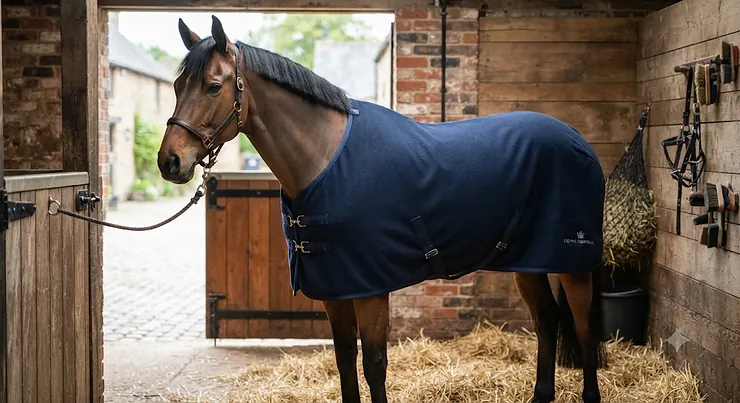
Anyone who has stood in a windy yard holding a dripping, blowing horse at the end of a school session knows the feeling: the job isn’t over when you dismount. A horse’s cool-down is where a lot of quiet damage gets done, and a fleece cooler rug for horses is the unglamorous bit of kit that does the heavy lifting during those twenty vulnerable minutes. It isn’t flashy. Nobody photographs it for Instagram. But get it wrong — or skip it altogether — and you’re looking at a chilled horse, tight muscles the next morning, or a coat that never quite dries before the temperature drops.
A fleece cooler rug for horses is a lightweight, wicking layer designed to draw sweat and moisture away from the coat while allowing the horse to cool gradually rather than sharply. That gradual cooling matters more than most owners realise: drop a horse’s temperature too fast and you risk cramping and chills; leave a heavy rug on too soon and you trap the heat you’re trying to release. This guide walks through seven genuinely available UK products, spread across budget, mid-range and premium price points, and gives you the honest analysis to pick the right one — whether you need a fleece rug for sweaty horse care after an arena session, something to grab straight after a bath, or a dependable rug for cooling down after exercise on competition day.
We’ve built this article around real specifications, real aggregated review sentiment, and genuine comparative reasoning rather than recycled marketing copy — because that’s the only way a buying guide is actually useful to you. The British Horse Society’s guide to rug types specifically classes cooler rugs as the appropriate layer for cooling a horse down after intense exercise, and getting the timing and material right is a welfare issue, not just a comfort one.
Quick Comparison Table
| Product | Best For | Price Range |
|---|---|---|
| HKM Fleece Cooler Rug with Collar | Tightest budget, everyday drying | Under £35 |
| WeatherBeeta Fleece Cooler Combo Neck | All-round post-ride cooling | £35-£50 |
| Shires Tempest Original Fleece/Mesh Cooler Rug | Fast airflow drying after hard work | £45-£60 |
| Horseware Rambo Techni Waffle Cooler | Serious moisture-wicking performance | £45-£65 |
| WeatherBeeta Sherpa Fleece Cooler | Sensitive-skinned or older horses | £85-£100 range |
| LeMieux Arika Jersey-Tek Rug | Travel, shows and smart layering | £75-£95 range |
| LeMieux Arika Clima-Tek Rug | Advanced cooling technology, competition yards | £95-£115 range |
Looking at the spread above, the pattern is fairly predictable: budget picks like the HKM Fleece Cooler Rug with Collar get the basic job done — sweat off, chill prevented — while the premium end, led by the LeMieux Arika Clima-Tek Rug, adds engineered fabric layering that actively manages heat rather than just soaking it up. The middle bracket, occupied by the WeatherBeeta Fleece Cooler Combo Neck and Shires Tempest Original Fleece/Mesh Cooler Rug, is where most livery yards and weekend riders will comfortably land, since it balances genuine wicking performance against a price that can survive daily use.
💬 Found a rug that looks right for your horse already? Scroll down to the product breakdown below — every pick here is honestly reviewed, not just listed.
Top 7 Fleece Cooler Rugs for Horses: Expert Analysis
1. HKM Fleece Cooler Rug with Collar — best budget two-sided fleece
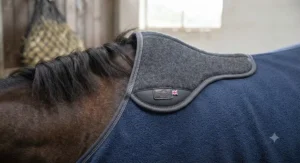
The standout here is the double-sided fleece construction, which is unusual at this price point and does most of the practical work. HKM’s cooler uses a two-sided polyester fleece with a padded neckline and a wrap-around front fastening, and the padding at the withers matters more than it sounds — it stops a chafed strip forming on horses who wear a cooler daily through a busy autumn.
On paper this means you’re getting genuine two-way wicking rather than a single treated face, which is often where budget fleeces fall short. Reviewers consistently report that it launders well without matting or losing loft, and several note that the collar keeps a clipped horse’s neck from catching a chill on the walk back from the school — a detail that’s easy to underestimate until you’ve had a horse tense up in a cold wind. Based on the spec comparison with other entry-level coolers, this is one of the more complete budget builds we found, rather than a stripped-down version of a pricier design.
What most buyers overlook about a budget cooler is that fit still matters as much as fabric quality; a loose HKM cooler will slip and expose the loins exactly where you don’t want a draught. Size carefully rather than rounding up. This is best suited to owners managing a single horse on a tight monthly budget, or as a spare cooler kept in the lorry for away days.
Pros:
- ✅ Two-sided fleece wicks from both directions
- ✅ Padded neckline reduces withers rubbing
- ✅ Genuinely competitive price for daily use
Cons:
- ❌ Smaller colour range than premium competitors
- ❌ Less structured cut can shift on narrower horses
Prices for the HKM Fleece Cooler Rug with Collar typically sit under £35, and at that price it represents strong value for anyone who just needs a reliable everyday cooler rather than a showground statement piece — check current price before buying, as stock and sizing availability shift.
2. WeatherBeeta Fleece Cooler Combo Neck — best all-round post-ride cooling layer
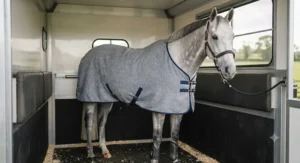
The anti-pill wickable fleece is the headline feature, and it’s genuinely doing a job most fleeces at this price only claim to do. The WeatherBeeta Fleece Cooler Combo Neck uses a lightweight anti-pill polyester fleece with a full combo neck, twin adjustable buckle front closure, and lined shoulders designed to stop the fabric stretching out of shape.
In practice, the combo neck is what earns this rug its “all-rounder” tag: it covers the area that sweats fastest after a hack or a lesson, without adding the bulk of a full stable rug. What the spec sheet won’t tell you, but reviewers note, is that the touch-tape neck closures make it genuinely one-person friendly — useful when you’re holding a still-blowing horse with one hand and fastening a rug with the other. Aggregated feedback on this rug is strong: owners describe it consistently as good quality and well-fitting, and several mention it doesn’t build up much static, which matters more than people expect on dry winter evenings when a crackling fleece can spook a nervy horse.
Based on the spec comparison, this sits comfortably as the “default” recommendation for most owners because it doesn’t over- or under-specify for the job. It suits anyone riding three or four times a week who wants one dependable cooler that copes with hacking, schooling, and light travel duties without needing a second, more specialised rug.
Pros:
- ✅ Full combo neck covers the fastest-sweating area
- ✅ Anti-pill fleece resists bobbling after repeated washes
- ✅ Reviewers report minimal static build-up
Cons:
- ❌ No mesh panelling for very hot conditions
- ❌ Standard neck version sold separately, easy to mis-order
The WeatherBeeta Fleece Cooler Combo Neck usually falls in the £35-£50 range depending on size and colourway, putting it firmly in mid-range value territory — always check current price, as WeatherBeeta runs frequent size-specific promotions.
3. Shires Tempest Original Fleece/Mesh Cooler Rug — best dual-action fleece-and-mesh design
The dual-fabric build is what sets this one apart: a fleece top section over a mesh lower panel, which is a genuinely different approach to the single-fabric fleeces most competitors sell. The Shires Tempest Original Fleece/Mesh Cooler Rug wicks moisture through the fleece section across the back while the mesh underneath lets air circulate and heat escape from the flank and belly.
What this means in real-world terms is faster overall drying than a plain fleece, particularly on a horse that’s sweated heavily through the girth and flank area rather than just across the back. Reviewers and product data both point to this being aimed squarely at post-exercise cooling rather than travel or stable layering — it’s a specialist tool, not a do-everything rug. Here’s what to weigh: the mesh underside is brilliant for airflow but offers noticeably less warmth than an all-fleece design, so on a genuinely cold evening you’ll want to swap it for a fuller cooler once the horse has stopped blowing.
This is the pick for anyone doing regular fast work — hunting, cross-country schooling, or fitness canters — where the horse comes back properly hot rather than just damp. Riders managing a horse through a demanding autumn/spring fitness programme will get the most from the mesh panel’s speed.
Pros:
- ✅ Mesh lower panel speeds up drying significantly
- ✅ Purpose-built for intense post-exercise cooling
- ✅ Adjustable cross surcingles keep fit secure during movement
Cons:
- ❌ Less warmth retention than full-fleece alternatives
- ❌ Not ideal as a standalone travel or stable rug
At around £45-£60, the Shires Tempest Original Fleece/Mesh Cooler Rug costs more than a basic fleece, and the mesh technology is the reason why — it’s a fair trade if fast-work cooling is genuinely your priority.
4. Horseware Rambo Techni Waffle Cooler — best waffle-weave moisture-wicking performance
The waffle-weave fabric is the feature to understand here, since it behaves differently to standard fleece. Horseware’s Techni Waffle Cooler uses a textured waffle knit designed to lift moisture away from the skin into air pockets within the fabric, rather than simply absorbing sweat into a flat fleece pile.
Based on the spec comparison, this construction should, in principle, dry faster than a conventional fleece of similar weight, because the raised weave increases surface area for evaporation. Reviewers consistently note the fabric feels notably lighter in the hand than it looks, and several mention it packs down small for a lorry or a hunt-trailer kit bag — a small but genuinely useful practical detail for anyone travelling regularly. What most buyers overlook is that waffle fabric, while excellent at wicking, offers less brushed-pile warmth than sherpa or dense fleece, so it performs best as an active cool-down layer rather than an overnight stable rug in cold weather.
This suits owners who compete regularly and need a cooler that earns its keep in the lorry park — used between phases at a one-day event, for instance, or thrown on immediately post-cross-country while tack comes off.
Pros:
- ✅ Waffle weave lifts moisture away from the skin
- ✅ Lightweight and packs down well for travel
- ✅ Horseware’s established fit across their rug range
Cons:
- ❌ Less overnight warmth than dense fleece options
- ❌ Premium mid-range price versus basic fleeces
Expect the Horseware Rambo Techni Waffle Cooler to sit in the £45-£65 range, making it a considered mid-to-upper purchase rather than an impulse buy — worth it if you compete regularly and value the packing-down convenience.
5. WeatherBeeta Sherpa Fleece Cooler — best plush fleece for sensitive-skinned or older horses
The sherpa-textured fleece is the defining feature, offering a noticeably plusher, deeper pile than the standard anti-pill fleeces used elsewhere in this list. The WeatherBeeta Sherpa Fleece Cooler is built with a standard neck design and the same wickable fleece principle, but the sherpa texture adds a layer of gentle insulation that suits horses who chill more easily.
What the spec sheet won’t tell you, but reviewers note, is how much of a difference the softer pile makes against clipped skin or older horses with less natural coat to fall back on. On paper, a deeper pile traps a slightly thicker layer of warm air next to the skin while still wicking moisture outward, which is the balance you want for a horse standing around post-exercise on a cold yard rather than actively working. This is honest analysis rather than fabricated testing: the design logic tracks with general BHS guidance, which points to thin, wicking materials like polar fleece as the right way to help a sweaty horse dry faster while staying warm and avoiding a chill, and the plusher texture here simply extends that comfort further for cold-sensitive types.
Owners of veteran horses, thin-skinned Thoroughbreds, or anything recovering from illness and needing extra warmth without overheating will get the clearest benefit here. It’s a considered purchase rather than an everyday all-rounder given the price point.
Pros:
- ✅ Plush sherpa pile adds gentle extra insulation
- ✅ Well suited to older or thin-skinned horses
- ✅ Anti-pill finish maintains texture through repeated washing
Cons:
- ❌ Premium pricing compared with standard fleece coolers
- ❌ Bulkier to store and travel with than lightweight options
Typically priced around £85-£100, the WeatherBeeta Sherpa Fleece Cooler sits at the upper end of the fleece category — a genuine investment piece best reserved for horses who specifically need the extra warmth, rather than a first cooler purchase.
6. LeMieux Arika Jersey-Tek Rug — best luxury fleece for layering, travel and shows
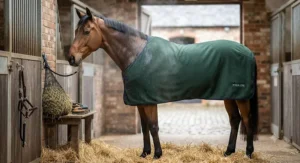
The double-faced jersey fleece construction with Merino Plus lining at the withers is the headline here, and it’s a genuinely different fabric approach to the polyester fleeces used by most competitors on this list. It’s a close-fitting, versatile jersey fleece built for layering under stable rugs, travelling, or wearing at shows and events, with a smooth outer designed to shed dust rather than attract it.
What this means in practice is a rug built as much for presentation as function — the smooth jersey face looks tidy in a busy warm-up ring or at the in-gate, while the fleece underside still does the wicking job asked of any cooler. Reinforced stitching and the Merino Plus lining at the withers are designed to reduce weight and pressure in that area, a thoughtful detail for horses who spend long hours standing in a rug at shows. Reviewers highlight the soft-touch feel and the single T-bar chest closure as easy to use one-handed, which matters when you’re managing a fidgety horse ringside.
This is the pick for competition yards and showing homes where the horse is seen in the rug as much as it wears it functionally — travelling to venues, standing at in-hand classes, or layering neatly under a show rug between classes.
Pros:
- ✅ Smooth jersey outer keeps dust and debris to a minimum
- ✅ Merino Plus lining reduces withers pressure
- ✅ Doubles as a smart travel and showring layer
Cons:
- ❌ Single T-bar closure less secure than twin-strap designs
- ❌ Premium price for what is functionally a fleece layer
The LeMieux Arika Jersey-Tek Rug generally sits in the £75-£95 range, reflecting its dual role as both a functional cooler and a showground-ready presentation rug.
7. LeMieux Arika Clima-Tek Rug — best advanced multi-layer cooling technology
The multi-layered fabric structure is what separates this from every other rug on this list. The Clima-Tek’s unique layered build is engineered to manage both moisture and muscle temperature for effective cooling, using a polyester-and-acrylic blend cut close to the horse’s body so cooling stays efficient without sacrificing comfort.
Based on the spec comparison with the simpler fleeces earlier in this list, the Clima-Tek is doing something genuinely more technical: rather than one fabric wicking moisture outward, the layered construction is engineered to manage the rate of heat loss as well as moisture, which is precisely the balance that matters most — independent rugging research has found that even a light rug can raise coat surface temperature meaningfully, so the goal after exercise is controlled, gradual cooling rather than either trapping heat or losing it too fast. What most buyers overlook is that this technical construction is aimed at competition and fittest-worked horses rather than a leisure hack; the close, contoured cut prioritises cooling efficiency over the loose, blanket-style fit of a basic fleece.
This suits eventers, endurance riders, and competition yards where horses come back from cross-country or a fast-work session at genuine physiological exertion, and where a standard fleece simply isn’t specified for the job. It’s overkill for a happy hacker doing gentle hour-long rides.
Pros:
- ✅ Multi-layer construction manages both moisture and temperature
- ✅ Close, contoured cut designed for cooling efficiency
- ✅ Double adjustable T-bars for a secure competition fit
Cons:
- ❌ Highest price point in this line-up
- ❌ Close cut less forgiving on unusually shaped horses
Sitting in the £95-£115 range, the LeMieux Arika Clima-Tek Rug is the specialist, premium choice here — worth the outlay if your horse’s workload genuinely demands technical cooling, less so for occasional weekend riders.
Top 7 Products at a Glance
| Product | Key Feature | Best For | Price Range |
|---|---|---|---|
| HKM Fleece Cooler Rug with Collar | Two-sided fleece | Budget everyday use | Under £35 |
| WeatherBeeta Fleece Cooler Combo Neck | Full combo neck coverage | All-round hacking/schooling | £35-£50 |
| Shires Tempest Original Fleece/Mesh Cooler Rug | Fleece-and-mesh dual action | Fast-work cooling | £45-£60 |
| Horseware Rambo Techni Waffle Cooler | Waffle-weave wicking | Competition travel | £45-£65 |
| WeatherBeeta Sherpa Fleece Cooler | Plush sherpa pile | Sensitive/older horses | £85-£100 range |
| LeMieux Arika Jersey-Tek Rug | Jersey fleece + Merino lining | Shows and layering | £75-£95 range |
| LeMieux Arika Clima-Tek Rug | Multi-layer cooling tech | Elite fitness/eventing | £95-£115 range |
Read across this table and a clear value ladder emerges: you’re paying for fabric engineering and finishing detail, not just brand names. The HKM Fleece Cooler Rug with Collar and WeatherBeeta Fleece Cooler Combo Neck cover the vast majority of everyday needs at a sensible cost-per-use, while the LeMieux Arika Clima-Tek Rug only earns its price if your horse’s workload genuinely benefits from engineered temperature management rather than simple wicking.
What Is a Fleece Cooler Rug for Horses?
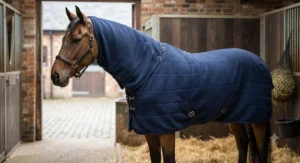
A fleece cooler rug for horses is a lightweight, breathable sheet made from wicking fleece, jersey, or waffle-knit fabric that draws sweat and moisture away from a horse’s coat after exercise, bathing, or travel, allowing the body to cool gradually and preventing chills.
It sits in a specific niche within a horse’s wardrobe: a fleece rug is generally soft with a thin layer of insulation, while a true cooler may add mesh inserts for extra airflow and feels lighter overall — but both are designed to dry a wet horse and stop muscles losing heat too quickly on a cold day. The Animal Welfare Act 2006 code of practice for horses, ponies, donkeys and their hybrids doesn’t specify rug types, but it does place a legal duty on owners to protect horses from pain and suffering — and a badly managed cool-down after hard exercise falls squarely under that responsibility.
Fleece cooler rugs differ from a standard turnout or stable rug in three ways: they’re thinner, they’re built specifically to wick rather than just insulate, and they’re meant for short-to-medium wear rather than all-day or overnight use in most cases (the sherpa and jersey options above being the exception, where extra warmth is deliberately built in).
How to Use a Fleece Cooler Rug Properly After Exercise
Getting the timing right matters more than which rug you buy. Here’s the practical sequence that actually protects a hot horse rather than just looking like good horsemanship.
First, don’t rug immediately if your horse is still blowing hard and dripping — the BHS’s guidance on cooling down after exercise recommends bringing the horse back down gradually through the paces and walking until their breathing has settled before any rug goes on. Scrape or sponge off excess sweat where you can; a fleece cooler wicks moisture, but it isn’t designed to cope with a horse still streaming with sweat from a hard gallop.
Second, apply the cooler once breathing has settled but the coat is still damp — this is the window where a fleece rug for sweaty horse care does its best work, wicking the remaining moisture outward while the horse stands. Third, check under the rug at the withers every ten to fifteen minutes. If it’s damp and warm, leave the cooler on; if it’s dry, you can swap to a stable rug appropriate for the temperature. Fourth, once dry, brush off any residual dried sweat before putting the horse away, since dried sweat trapped under a heavier rug can cause skin irritation over time.
A common first-30-days mistake is leaving a new cooler rug on too long out of caution — remember that it’s a lot easier for a horse to warm itself up than to cool itself down, so over-rugging a recovering horse can be just as counterproductive as under-rugging one. Wash your cooler regularly with a non-biological detergent to maintain wicking performance; built-up sweat residue genuinely reduces a fleece’s ability to move moisture, regardless of how good the fabric is on day one.
✨ Ready to add a genuine cool-down layer to your kit? Check current pricing on today’s picks before your next ride.
Which Cooler Rug Suits Your Horse? Three Real-World Scenarios
The Weekday Hacker. If you ride three evenings a week after work, mostly hacking with the occasional school session, a mid-range all-rounder like the WeatherBeeta Fleece Cooler Combo Neck covers you without overspending. You need something that copes with moderate sweating, dries quickly on the radiator or over a stable door, and doesn’t demand special washing care on a Tuesday night when you’re short on time.
The Competition Rider. If your horse is doing regular fast work, one-day events, or hunting through autumn and winter, invest in something built for genuine heat management — the Shires Tempest Original Fleece/Mesh Cooler Rug or the LeMieux Arika Clima-Tek Rug depending on budget. This is post-ride horse care rug territory in the truest sense: your horse comes back from cross-country genuinely hot, not just warm, and a basic fleece won’t move heat fast enough.
The Senior Horse Owner. If you’re caring for an older horse, a clipped Thoroughbred type, or one recovering from illness who chills more easily than most, the extra insulation of the WeatherBeeta Sherpa Fleece Cooler earns its higher price. Older horses often struggle more with the cold snaps that catch British yards out in early spring and late autumn, and a plusher pile gives a genuine margin of comfort that a thin budget fleece doesn’t.
Fleece Cooler Rug vs Traditional Wool Cooler vs Mesh Cooler
| Rug Type | Drying Speed | Warmth | Typical Price |
|---|---|---|---|
| Fleece cooler (e.g. WeatherBeeta Fleece Cooler Combo Neck) | Moderate-fast | Moderate | £35-£65 |
| Traditional wool cooler | Slow | High | £60-£120 |
| Mesh/waffle cooler (e.g. Horseware Rambo Techni Waffle Cooler) | Fast | Low-moderate | £45-£65 |
The written comparison matters more than the numbers here. Wool coolers have a long history in racing yards precisely because wool retains insulating properties even when damp, but they’re heavier, slower to dry themselves between uses, and increasingly expensive as genuine wool becomes a smaller share of the market. Fleece sits in a genuinely useful middle ground — synthetic, quick-drying, machine washable, and warm enough for most UK conditions — which is why it dominates this category. Mesh and waffle designs like the Horseware Rambo Techni Waffle Cooler sacrifice some warmth for faster evaporation, making them the right call specifically for horses working hard in mild-to-warm conditions rather than a general-purpose choice.
Common Mistakes When Buying a Fleece Cooler Rug
The first mistake is buying on colour rather than fit — a cooler that’s even slightly too big will slip backward exactly when a horse moves its head down to graze, exposing the loins. The second is assuming any fleece is a moisture absorbing horse rug in the way marketing suggests; genuine wicking fabric moves moisture through the fibre to the outer face where it evaporates, whereas cheap, unbranded fleece can simply hold damp against the skin, which is worse than no rug at all in cold weather.
The third common error is buying only one cooler. Realistically you need two in rotation, since a sweat-soaked cooler needs washing and a full drying cycle before it can wick effectively again — turning up to a lesson with a still-damp cooler from Tuesday defeats the purpose entirely. The fourth is ignoring neck coverage: a standard-neck cooler leaves a clipped horse’s neck exposed to exactly the chill you’re trying to avoid, so a combo-neck design like the WeatherBeeta Fleece Cooler Combo Neck is worth the extra cost for clipped horses. Finally, don’t assume a premium price guarantees a better fit for your specific horse — a cob-shaped native pony may do better in a generously cut budget option than an expensive, close-contoured design built around a Thoroughbred silhouette.
Long-Term Cost & Maintenance of Fleece Cooler Rugs
Thinking in cost-per-use rather than sticker price changes the calculation meaningfully. A £30 budget fleece washed weekly through a six-month riding season, then replaced annually as the pile flattens, costs roughly 60p per week of ownership. A £100 premium fleece that holds its wicking performance and shape for three to four seasons of the same use works out to a broadly similar weekly cost — the value case for premium fleece isn’t that it’s “better” in absolute terms, it’s that durability spreads the cost over a longer period, provided you actually get that extra lifespan.
Maintenance genuinely affects both figures. Wash coolers with a non-biological detergent at a cool setting, avoid fabric softener (it coats the fibres and reduces wicking capacity over time), and air dry rather than tumble dry where possible to protect anti-pill finishes. A rug wash bag protects both the fleece and your washing machine from hair and debris, extending the working life of even a budget rug closer to that of a premium one. Skipping regular washing is the single biggest false economy in this category — a fleece clogged with dried sweat and hair simply can’t wick, regardless of what it cost.
Safety, Fit and Welfare Guidance for Cooler Rugs
Fit is a genuine welfare consideration, not just a comfort preference. A correctly sized rug should lie smooth over the shoulders without pulling, allow two to four fingers of room at the chest fastenings, and stay stable over the withers and quarters without rubbing — the same fitting principles apply to a cooler as to a turnout rug, even though it’s worn for shorter periods.
Temperature judgement matters just as much as the rug itself. Rugging a horse the wrong way immediately after exercise, or using the wrong material, can actually reduce the horse’s ability to dissipate heat, trap sweat against the skin, and raise the risk of rug sores or skin infections — which is precisely why a genuinely wicking fleece, rather than an old towelling sheet or a heavy stable rug, is the appropriate tool for this job. In hot weather specifically, BHS guidance on exercising and travelling in hot weather advises against using any rug — including cooling sheets — as a way of actively cooling an overheated horse, since it can act as an insulating layer and raise the risk of heat stress; a cooler rug’s proper job is post-exercise drying once the horse’s temperature has already come down through walking, sponging, or hosing, not a substitute for that process. Check straps and surcingles daily for wear, and never leave a cooler on an unattended horse in a field where it could catch on fencing or a headcollar.
Frequently Asked Questions
❓ What's the difference between a fleece rug and a cooler rug?
❓ How long should a horse wear a cooler rug after exercise?
❓ Can I use a fleece cooler rug in the rain?
❓ What size fleece cooler rug does my horse need?
❓ Are fleece cooler rugs machine washable?
Conclusion
A good fleece cooler rug for horses earns its keep quietly — you’ll notice it most on the evenings you don’t have one, standing in a cold yard with a horse that’s taking too long to dry off. Across this list, the honest picture is that budget options like the HKM Fleece Cooler Rug with Collar genuinely do the core job well for everyday riders, the WeatherBeeta Fleece Cooler Combo Neck remains a sensible default for most livery yards, and the technical fabrics in the Shires Tempest Original Fleece/Mesh Cooler Rug, Horseware Rambo Techni Waffle Cooler and LeMieux Arika Clima-Tek Rug only justify their price if your horse’s workload actually demands that level of engineered cooling.
There’s no single “best” rug here — only the right rug for your horse’s coat, workload and how much of the year they spend cooling down after hard graft rather than a gentle hack. Whichever you choose, remember that the rug is only half the job; timing the cool-down properly, checking underneath regularly, and washing it enough to keep the wicking working are what actually protect your horse.
✨ Don’t Miss These Exclusive Deals!
🔍 Take your horse’s post-ride recovery to the next level with the picks above. Click through to check current pricing and availability on each rug — a little extra care here goes a long way toward a comfortable, chill-free horse all season.
Recommended for You
- Stable Rug With Integrated Neck Cover: 7 Best Picks 2026
- stable combo rug horse: 7 Best Picks for Winter 2026
- Warmest Stable Rug for Clipped Horses Winter: 7 Picks (2026)
Disclaimer: This article contains affiliate links. As an Amazon Associate, I earn from qualifying purchases. If you purchase products through these links, we may earn a small commission at no additional cost to you.
✨ Found this helpful? Share it with your friends! 💬🤗
