In This Article
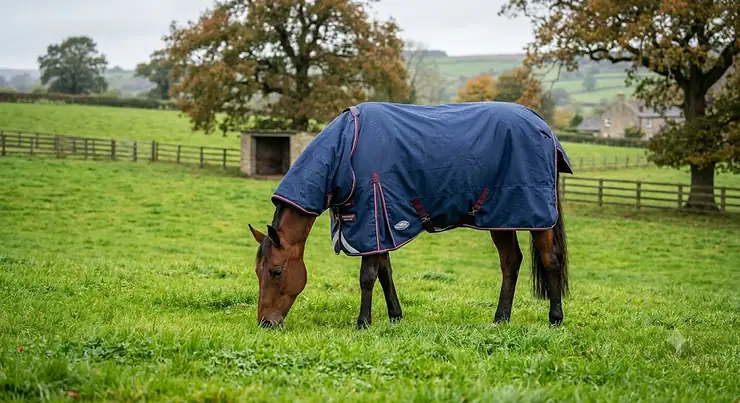
A waterproof breathable horse rug is a turnout blanket with an outer shell treated or laminated to block rain while still letting sweat vapour escape, so a horse stays dry outside and dry underneath at the same time. That second half of the definition is the bit most owners skip past, and it’s the whole reason some rugs feel like a bin bag by lunchtime while others keep a horse comfortable through a proper Pennine downpour.
If you’ve ever peeled a “waterproof” rug off a horse only to find the lining clammy and the coat matted with condensation, you already know the two words don’t automatically travel together. Plenty of fabrics keep rain out brilliantly and trap moisture in just as brilliantly, which is arguably worse than no rug at all. British weather doesn’t help, and the British Horse Society’s rugging guidance is worth reading in full if you want the welfare reasoning behind fill-weight decisions, not just the fabric technology. One afternoon you’re dodging a squall off the Irish Sea, the next you’re standing in a field wondering why your cob is steaming like a kettle in October sunshine. Choosing the right rug means understanding denier, hydrostatic head, fill weight and fit well enough to match the garment to the actual conditions your horse lives in, not the conditions on the label.
This guide walks through seven genuinely available rugs (and one essential care product), what their specs mean in the field, and how to keep a rug performing once it’s earned its keep with a season of mud, gates and over-enthusiastic rolling. We’ll also cover what to do when a once-reliable rug starts letting water through, because that’s a maintenance problem far more often than it’s a “buy a new rug” problem.
Quick Comparison Table
| Rug | Outer / Denier | Waterproof Rating | Typical Price Range | Best For |
|---|---|---|---|---|
| Horseware Rambo Original | 1000D ballistic nylon | 3000mm+ | £250-£320 | Long-term durability, tough fields |
| WeatherBeeta ComFiTec Classic | 1200D ripstop | 2000mm+ | £100-£145 | All-round value, mid-weight use |
| Shires Tempest Original | 600D ripstop | 3000mm | Under £90 | Budget entry, milder wet weather |
| Bucas Freedom Turnout | 600D ripstop | 5000mm+ | £95-£130 | Fine-coated horses, native ponies |
| Hy Equestrian StormX Original | 600D ripstop | Waterproof-tested | Under £90 | Tight budgets, spare/travel rug |
| Premier Equine Buster Storm-Coat | 840D ballistic nylon | Dual-membrane, high | £180-£240 range | Premium protection, harsh winters |
| Nikwax Rug Wash and Rug Proof | N/A (care product) | Restores DWR | £15-£25 for the pair | Extending any rug’s waterproof life |
A quick glance tells its own story: denier and price track fairly closely, but waterproof rating doesn’t always follow the same curve. The Bucas Freedom, for instance, sits at a modest 600D yet claims a higher hydrostatic head than the far heavier Rambo Original, which is a useful reminder that the coating and membrane matter as much as the toughness of the weave. If your horse is more likely to shred a rug than get it wet through, denier deserves more weight in your decision than the waterproof figure. If your yard is genuinely exposed and boggy, flip that priority.
💬 Just one click — help others make better buying decisions too!😊
Top 7 Waterproof Breathable Horse Rugs: Expert Analysis
1. Horseware Rambo Original Turnout with Leg Arches — ten-year waterproof guarantee
The standout here isn’t the fabric, it’s the confidence Horseware has in it: a ten-year guarantee on waterproofness, breathability and hardware is almost unheard of in this category, and it tells you something about how the brand expects this rug to age.
The 1000D ballistic nylon outer is genuinely tank-like, and Horseware pairs it with an anti-static, anti-bacterial lining designed to sit against the coat without generating the static crackle you sometimes get with cheaper linings on a dry, cold morning. In practice, that toughness means this rug shrugs off fence rubbing, field-mate nipping and gate-post snags that would tear a 600D fabric within a season. It comes in 0g, 100g and 200g fills, so you can match it to your climate without switching brands.
Based on the spec comparison, this rug earns its higher price tag through longevity rather than any single flashy feature: it’s the sort of purchase that looks expensive in year one and looks like the cheapest rug you own by year four. Reviewers consistently report that fit is generous and forgiving across different horse shapes, thanks to the leg arches and V-front closure that allow a genuinely low head grazing position without the chest straps digging in. What most buyers overlook is that the classic double-front closure, while old-fashioned next to newer clip systems, is also one of the easiest designs to do up one-handed with cold fingers at 7am.
Pros:
✅ Ten-year waterproof and hardware guarantee
✅ 1000D outer resists tearing and puncturing
✅ Roomy, forgiving cut with leg arches for movement
Cons:
❌ Among the pricier options in this list
❌ Classic double-front closure is less adjustable than newer clip systems
Prices generally sit in the £250-£320 range depending on fill and retailer, and given the warranty length, the value verdict is straightforward: if your horse is hard on rugs or you want to buy once and stop thinking about it, this is worth the outlay.
2. WeatherBeeta ComFiTec Classic Standard Neck — best value 3-year workhorse
The standout feature is simple honesty about performance: WeatherBeeta publishes actual hydrostatic head and moisture vapour transmission figures rather than just saying “waterproof and breathable” and leaving it there.
The 1200 denier ripstop outer with repel shell coating is tested to a hydrostatic pressure of 2000mm plus and moisture vapour transmission of 3000g/m² plus, which in real terms means it will comfortably handle sustained UK rain without wetting out, while still letting a sweaty horse’s coat dry rather than steam. The 210T polyester lining is smooth enough to reduce coat rubbing, and the traditional side gusset gives enough shoulder freedom for a horse to graze, roll and generally live a normal field life without the rug riding up.
Here’s what to weigh: this rug sits deliberately in the middle of the market, and it shows in the balance of features. It isn’t the toughest outer on this list, nor the cheapest, but the three-year warranty on hardware, waterproofness and breathability gives real peace of mind at a price point most owners can justify without much agonising. Reviewers on retailer sites consistently praise the fit across cob and warmblood shapes, and the twin low cross surcingles do a solid job of keeping the rug settled during turnout, even with playful field companions.
Pros:
✅ Published, verifiable HH and breathability figures
✅ 3-year warranty on waterproofness and hardware
✅ Smooth 210T lining reduces coat rubbing
Cons:
❌ 1200D outer is durable but not as tank-proof as ballistic nylon rivals
❌ Standard neck design needs a separate neck cover in harsher weather
Expect to pay in the £100-£145 range depending on fill weight and colourway, and for most leisure and livery horses, this rug represents close to the sweet spot between price, protection and warranty.
3. Shires Tempest Original — best budget entry for milder wet weather
The standout here is accessibility: this is one of the cheapest genuinely waterproof, breathable turnout options from a recognised UK brand, and it doesn’t cut corners on the basics to get there.
Built from a 600 denier ripstop outer with ShireTex fabric technology, the Tempest Original is rated to 3000mm waterproofing and 3000g/m² breathability on some listings, backed by taped seams and a PFC-free durable water repellent finish. What most buyers overlook is that ShireTex uses a hydrophilic coating designed to actively draw moisture away from the horse rather than simply blocking rain passively, which is a genuinely useful bit of engineering to find at this price point.
Based on the spec comparison, the trade-off for the low price is durability rather than waterproofing: the 600D outer will show wear faster than a 1200D or ballistic nylon rival if your horse is a fence-scratcher or lives with a boisterous field gang. For a quieter horse, or as a spare rug to keep in the lorry for unexpected showers, that trade-off barely matters. The rug is WarmaRug compatible, so you can layer in a liner as temperatures drop rather than buying an entirely new heavyweight, which is a smart way to stretch a tight rug budget across a full season.
Pros:
✅ Genuinely low price for a tested waterproof/breathable rug
✅ ShireTex hydrophilic coating actively wicks moisture
✅ WarmaRug liner compatibility extends seasonal use
Cons:
❌ 600D outer wears faster under heavy field abuse
❌ Standard neck leaves the poll and neck exposed in driving rain
Prices typically sit under £90, making this a sensible first rug for a new horse owner or a reliable backup for anyone who already owns a premium turnout.
4. Bucas Freedom Turnout — best for fine-coated horses and native ponies
The standout is the waterproof rating relative to its weight: a claimed hydrostatic head above 5000mm on a lightweight 600D fabric is genuinely impressive, and it’s backed by an independent Horse & Hound test rather than just Bucas’s own marketing.
The 600 denier ripstop outer pairs with a silk-feel lining designed to protect coat condition, particularly useful for horses who react to fleece linings with rubbing or static. Horse & Hound’s reviewer, testing the rug on a Fell pony mare, found the fit ran noticeably small compared with a standard sizing chart and noted that Bucas itself flags the Freedom as a “slim fit” because it lacks the shoulder darts found on other Bucas ranges. The reviewer described the rug’s rip-stop outer as high quality, waterproof and highly breathable, and found it fit the smaller, finer-boned pony extremely well, without any slipping or rubbing during a full day’s turnout.
Reviewers consistently note that narrower, thoroughbred-type horses should take their usual size, while cob-shaped or broad-chested horses may need to size up to avoid a snug fit across the chest and shoulders. The lack of leg straps is compensated for by a fillet string, which the H&H test found sufficient to keep the rug in place even during active play. On price, the Freedom sits in the £95-£130 bracket, which the same review judged as fair rather than cheap given the fabric quality, though it noted the price is towards the higher end for a 600D rug of this weight.
Pros:
✅ Exceptionally high waterproof rating for its fabric weight
✅ Silk-feel lining suits fine or reactive coats well
✅ H&H Approved after independent hands-on testing
Cons:
❌ Slim fit means cob types may need to size up
❌ No leg straps, relying on fillet string alone
Value verdict: if your horse has a thin summer coat, native breeding, or a tendency to react to synthetic linings, the Freedom’s fabric quality justifies the mid-range price, provided you measure carefully first.
5. Hy Equestrian StormX Original — best budget lightweight for changeable days
The standout feature is sheer value for money across a genuinely wide fill range, from 0g summer sheets through to 200g options, all sharing the same tested 600D ripstop construction.
The outer fabric is a straightforward 600 denier ripstop, waterproof and breathable, paired with a fleece-lined wither area to prevent rubbing and a full lining throughout. Twin buckle chest straps, cross surcingles and adjustable leg straps hold the rug secure in blustery conditions, which matters more than people expect on exposed hillside paddocks where wind, not rain, is often what shifts a poorly fastened rug.
In an independent Your Horse test, a StormX Original combi turnout worn on a 16hh Warmblood mare for around five months was described as a very good fit with plenty of room around the shoulders and withers for freedom of movement, staying securely in place even when other horses pulled at it during play. That same tester noted the rug had never leaked and that the fill had kept the mare warm throughout, which is a decent real-world endorsement for a rug that typically retails under £90. What most buyers overlook is that the reflective StormX logo and trims add a genuine visibility benefit on dark winter mornings, a small detail that costs nothing extra but earns its place for anyone checking horses before sunrise.
Pros:
✅ Wide fill range from 0g to 200g under one reliable spec
✅ Reflective detailing aids visibility in low light
✅ Independently tested by Your Horse with strong results
Cons:
❌ 600D outer is the least durable on this list under rough field conditions
❌ Basic buckle chest fastening lacks the fine adjustability of pricier rugs
Value verdict: as a budget-friendly, colourful, genuinely functional turnout, this is hard to beat for owners who want reliable protection without a premium price tag.
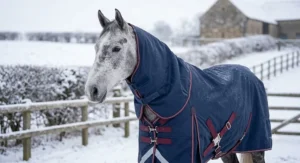
6. Premier Equine Buster Storm-Coat Combo — best premium dual-membrane protection
The standout is the dual-membrane construction: rather than a single waterproof coating, Premier Equine layers a breathable, waterproof outer membrane over a second hydrophilic membrane that actively draws moisture away from the coat.
The breathable and waterproof membrane, positioned just below the outer shell, contains millions of precision-sized microscopic holes that allow airflow while repelling water droplets, while a second hydrophilic membrane deeper in the construction draws and disperses moisture from the horse’s coat. On paper this means the rug is solving both halves of the waterproof-breathable equation with dedicated engineering rather than a single compromise coating, which explains why Premier Equine markets this as their flagship protection system rather than an entry-level option.
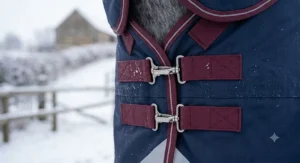
The 840 denier ballistic nylon outer, finished with a Teflon coating for stain resistance, sits below the toughest ballistic nylons on the market but comfortably above the 600D and 1200D crowd, and the high shoulder gusset added in recent design updates gives genuinely unrestricted movement, according to brand documentation. Reviewers consistently highlight the stainless steel hardware as a durability point that outlasts the galvanised or plastic fittings found on cheaper rugs, particularly around the surcingle buckles that see the most wear. What the spec sheet won’t tell you, but user reports suggest, is that the dual-membrane system’s extra layers add a small amount of stiffness compared with single-membrane rugs, which some owners notice in the first few wears before the fabric relaxes.
Pros:
✅ Dual-membrane system engineered for both waterproofing and moisture wicking
✅ Stainless steel hardware resists corrosion and wear
✅ High shoulder gusset design for genuine freedom of movement
Cons:
❌ Among the most expensive rugs in this roundup
❌ Slight initial stiffness reported before the fabric beds in
Prices generally range from £180-£240 depending on fill weight, positioning this as a considered investment for owners in genuinely harsh, wet regions rather than a first rug purchase.
7. Nikwax Rug Wash and Rug Proof Duo — best care system to extend any rug’s life
The standout feature isn’t a rug at all, it’s the product that keeps every rug on this list actually living up to its waterproof claims for years rather than months.
Nikwax Rug Proof is water-based, non-flammable, contains no volatile organic compounds and is PFC-free, specifically designed and optimised for breathable waterproof fabrics to provide durable water repellency while maintaining breathability. That last point matters enormously: solvent-based or PFC-heavy alternative proofers can restore water beading while quietly clogging the breathable membrane underneath, which defeats the entire purpose of buying a breathable rug in the first place. If the outer fabric absorbs water because dirt has compromised its water repellency, a rug can lose up to 70% of its breathability, so cleaning and reproofing isn’t cosmetic maintenance, it directly restores the technical performance you paid for.
Reviewers on retailer sites consistently note the ease of machine application, with Rug Wash used first to strip dirt and detergent residue without damaging the existing DWR coating, followed by Rug Proof to rebuild it. One verified buyer described using both products together on heavily muddy rugs at 40 degrees with excellent results, and noted the process is straightforward enough to repeat across a season without any specialist equipment. A 1 litre bottle of Rug Wash cleans approximately six horse rugs, and best results come from cleaning with Rug Wash before restoring waterproofing with Rug Proof.
Pros:
✅ PFC-free formula preserves breathability while restoring waterproofing
✅ One litre bottle treats roughly six rugs, excellent cost-per-use
✅ Machine-wash application requires no specialist equipment
Cons:
❌ Requires a genuinely clean rug first for the proofing step to work well
❌ Not a fix for physically worn-through or delaminating fabric
At roughly £15-£25 for both bottles, this is arguably the single best-value item on this list: it doesn’t replace a rug, but it can add one or two extra winters of genuine waterproof performance to whichever rug you already own.
How to Choose a Waterproof Breathable Horse Rug
Choosing well comes down to matching seven variables to your specific horse and yard, rather than chasing the single highest number on a spec sheet.
- Start with fill weight, not brand. Match grams of fill to your horse’s clip status and typical winter low, not to what looked good in a catalogue photo.
- Check the hydrostatic head rating. Anything above 1,500mm meets a reasonable UK waterproofing benchmark; anything above 3,000mm gives real headroom for sustained downpours.
- Weigh denier against your horse’s behaviour. A rug-ripper needs 1000D-plus; a quiet field companion can comfortably wear 600D for years.
- Prioritise breathability data if you can find it. Moisture vapour transmission figures (measured in g/m²) tell you whether sweat can actually escape, not just whether rain gets in.
- Measure before you buy, every time. Even within one brand, cut varies between ranges, as the Bucas Freedom’s slim fit demonstrates clearly.
- Factor in warranty length as a durability signal. Longer waterproof and hardware warranties usually reflect genuine manufacturer confidence, not just marketing.
- Budget for maintenance from day one. A £300 rug neglected for three years performs worse than a £90 rug reproofed annually.
Horse Rug Waterproof Rating Explained
The number that actually tells you how waterproof a rug is, hydrostatic head, gets buried in small print far too often, so it’s worth unpacking properly.
Hydrostatic head measures the water pressure a fabric can withstand, expressed in millimetres, before water begins to penetrate through to the other side. In practical terms, a rating of 1,500mm is generally treated as the minimum benchmark for British weather, with a rug tested to this figure expected to keep rain out under typical field conditions. Push that figure to 3,000mm or 5,000mm, as several rugs in this guide achieve, and you’re building in headroom for sustained, driving rain rather than just a light shower.
What the number doesn’t tell you is durability under mechanical stress. A high hydrostatic head fabric can still fail if seams aren’t taped, if the coating wears thin from repeated flexing at the shoulders, or if UV exposure degrades the outer over several summers left in bright sun. That’s why denier and hydrostatic head need reading together rather than separately; one measures resistance to water pressure, the other measures resistance to physical wear and tear. A rug can score brilliantly on one and poorly on the other, and the Bucas Freedom versus Rambo Original comparison earlier in this guide shows exactly that pattern in action.
Breathability gets measured differently again, typically in grams of moisture vapour transmitted per square metre over 24 hours (g/24h/m²). Higher numbers mean more sweat vapour escapes rather than condensing against the coat. As a rule of thumb, anything below 2,000g/m² will feel noticeably clammy on a working horse in mild, damp weather, while figures above 3,000g/m² tend to keep coats genuinely dry even after exertion.
Best Breathable Waterproof Turnout Rug by Horse Type
Not every horse needs the same rug, even in identical weather, because coat type, workload and turnout routine change what “adequate protection” actually means.
Native ponies and cobs with thick winter coats generally do best in a 600D-800D rug at 0g-100g fill, since their natural coat already provides substantial insulation and a heavier fill risks overheating and flattening the hair’s natural insulating loft. The Shires Tempest Original or StormX Original both suit this group well, prioritising breathability over maximum warmth.
Clipped competition horses need higher fill weights, typically 200g-300g depending on clip extent, paired with a higher denier outer since these horses are often turned out for shorter periods and benefit more from durability and warmth than from ultra-lightweight breathability. The Premier Equine Buster Storm-Coat or Rambo Original in a heavier fill both work well here.
Fine-coated or thin-skinned breeds, including many thoroughbred types, tend to react poorly to synthetic linings that trap heat or cause static, making the Bucas Freedom’s silk-feel lining a genuinely useful fit, alongside a mid-weight fill matched to individual sensitivity to cold.
Youngsters and playful field companions need higher denier outers regardless of fill weight, since their behaviour is the dominant factor in rug survival rather than the weather. Higher denier resists bites, brambles and rough play, cutting down on repairs, which makes the 1000D-plus rugs on this list a sensible long-term choice even if it means a bigger initial outlay.
Waterproof Breathable Rugs vs Traditional Canvas and Jute Rugs
Older canvas and jute rugs, still found in some tack rooms and occasionally sold second-hand, work on an entirely different principle to modern waterproof breathable fabrics, and the comparison explains why the technology shift happened.
| Factor | Modern Waterproof Breathable | Traditional Canvas/Jute |
|---|---|---|
| Waterproofing method | Coated/laminated membrane, measurable HH rating | Tightly woven natural fibre, wets through eventually |
| Weight | Lightweight, 600D-1000D typical | Heavy, often double the weight when wet |
| Breathability | Engineered vapour transmission | Poor once fabric is saturated |
| Drying time | Hours | Can take days |
| Typical lifespan with care | 3-10 years | Variable, prone to rot and mildew |
The core difference is that canvas relies on fibre density alone to resist water, which works reasonably well until the fabric becomes saturated, at which point it holds water against the horse rather than repelling it, and becomes significantly heavier in the process. Modern coated or laminated fabrics maintain their water resistance regardless of how long they’re exposed to rain, provided the coating itself remains intact, which is precisely why reproofing products like Nikwax exist and matter so much for longevity. Breathability is where the gap widens further: canvas offers essentially none once wet, trapping sweat against the coat, while engineered membranes are specifically designed to let vapour escape even during sustained rain. For anyone still using an inherited canvas rug, the case for upgrading isn’t sentimental, it’s a genuine welfare and practicality improvement.
Common Mistakes When Buying a Waterproof Breathable Horse Rug
Even experienced owners fall into a handful of predictable traps when shopping for turnout rugs, and most of them cost money or comfort down the line.
Buying on denier alone, ignoring hydrostatic head entirely, is probably the most common error; a tough 1000D fabric with a poor coating will still leak, it’ll just take longer to wear through first. Skipping proper measurement is a close second, particularly when switching brands, since cut varies enough between manufacturers that a “true to size” rug in one range can run a full size small in another, as the Bucas Freedom example demonstrates. Choosing fill weight based on personal comfort rather than the horse’s coat and clip status is another frequent misstep, and it’s precisely the pattern flagged in a study covered by Horse & Hound, which found unnecessary or excessive rugging can genuinely compromise a horse’s ability to self-regulate temperature.
Underestimating maintenance costs catches plenty of owners out too: budgeting for the rug itself but not for annual reproofing means even a premium rug will underperform within two or three seasons. Finally, prioritising price over warranty length on a rug intended for genuinely hard field use tends to backfire, since a cheaper rug that fails mid-winter often costs more in total once you’ve bought a replacement in a hurry at full retail price.
Practical Usage Guide: Setting Up and Caring for a New Rug
Getting a new rug’s first 30 days right sets the pattern for how well it performs over its full lifespan, and it’s a stage many owners rush through.
On first use, check the fit thoroughly with the horse standing square: two to three fingers should slide comfortably under the chest strap, belly straps should sit with roughly a hand’s gap of movement, and leg straps need to be secure without cutting into the thighs when the horse moves. Watch the shoulder area particularly closely during the first week, since rubbing tends to show up early if the cut doesn’t quite suit your horse’s shape, and catching it in week one is far easier than treating a established sore in week three.
For maintenance through the season, shake or brush off dried mud before it grinds into the fabric and compromises the coating, and avoid overusing a hose on a heavily soiled rug without proper detergent, since standing water and trapped dirt actively degrade water repellency over time. A midpoint clean and reproof, typically after six to eight weeks of regular wear, using a dedicated product like Nikwax Rug Wash followed by Rug Proof, keeps performance consistent rather than letting it degrade gradually until the rug suddenly seems to be leaking. Common first-30-days mistakes include over-tightening surcingles in an attempt to stop minor slipping, which usually indicates a fit problem rather than a fastening problem, and leaving a rug on through unexpected warm spells, which the British Horse Society specifically flags as a welfare risk since horses struggle to cool down once overheated far more than they struggle to warm up when cold.
Real-World Scenarios: Which Rug Suits Which Horse
Scenario one: the DIY livery owner with a native cob. Budget is tight, the horse lives out 24/7, and the coat is thick and naturally water-resistant already. A Shires Tempest Original or Hy StormX Original at 0g-50g fill, reproofed with Nikwax at the start of each winter, covers this situation comfortably without overspending on features the horse’s own coat is already providing.
Scenario two: the competition rider with a clipped warmblood. Turnout is limited to a few hours daily between training sessions, and the horse needs to look immaculate and stay genuinely warm. The Premier Equine Buster Storm-Coat at 300g-420g, or a Rambo Original in a similar fill, justifies the higher price through durability and the polished stainless steel hardware that survives daily use without corroding.
Scenario three: the owner of a fine-coated, older thoroughbred. This horse chills easily, reacts to synthetic linings with rubbing, and needs a rug that manages both temperature and skin sensitivity. The Bucas Freedom’s silk-feel lining, sized carefully according to the brand’s slim-fit guidance, handles this profile better than a bulkier, fleece-lined alternative would.
Horse Rug Losing Its Waterproofing? Problem → Solution Guide
A rug that used to keep a horse bone dry and now leaves damp patches hasn’t necessarily failed structurally, it’s usually one of a handful of fixable issues.
Problem: water no longer beads on the surface, it soaks straight in. This is classic durable water repellent breakdown, caused by accumulated dirt, oils and detergent residue masking the coating rather than the coating itself being gone. Solution: wash with a non-detergent cleaner such as Nikwax Rug Wash, since standard laundry detergent leaves a film that actively blocks water repellency, then reproof with a dedicated product like Nikwax Rug Proof.
Problem: the rug is dry on top but damp underneath after rain. This points to condensation from poor breathability rather than a leak, often because dirt has clogged the membrane’s pores. Solution: the same wash-then-proof cycle typically restores breathability alongside waterproofing, since a dirty outer fabric absorbing water can reduce a rug’s breathability by up to 70%.
Problem: specific patches leak, particularly at the shoulders or seams. This suggests localised wear rather than general coating breakdown, often from repeated flexing or a poorly fitted rug rubbing against a fence or gate. Solution: check taped seams for lifting or damage, and consider a localised reproofing spray for that area between full washes, though repeated shoulder wear is often better addressed by reassessing fit.
Problem: the rug feels heavier than usual and takes longer to dry. This is a strong sign the fabric itself is genuinely saturating rather than repelling water, which happens once a coating has worn through completely rather than simply become dirty. Solution: a full Nikwax treatment may still help, but if the rug is several seasons old and this persists after reproofing, it’s likely reaching the end of its practical waterproof life.
Problem: the rug was fine last season but leaks from the first wear this winter. Prolonged storage without cleaning can allow dirt and mildew to set into the fabric over summer. Solution: always wash and dry rugs fully before storing them for the off-season, ideally reproofing at the point of storage rather than waiting until the first cold snap reveals the problem.
Turnout Rug Maintenance and Long-Term Cost
Treating turnout rug maintenance as a genuine annual budget line, rather than an afterthought, changes the total cost of ownership dramatically over a rug’s lifespan.
A quality mid-range rug at roughly £120, reproofed annually at a cost of around £20 for Nikwax products, works out at approximately £140 across a first season and considerably less per season across a well-maintained three-to-five-year lifespan, since a properly cared-for rug rarely needs full replacement within that window. Compare that with buying a cheap £60 rug annually because maintenance was skipped and waterproofing failed within a single season: over three years, that’s £180 spent with no warranty protection and considerably more hassle replacing rugs mid-winter when they’re least easy to source. Regular reproofing of turnout rugs is essential for comfort and protection, especially during the UK’s wetter months, and rugs should generally be reproofed after a few washes to maintain their effectiveness, which is a maintenance rhythm worth building into a yard routine rather than leaving to memory.
Storage between seasons matters just as much as in-season care. Rugs should be fully clean and completely dry before folding away, ideally reproofed at that point rather than waiting for the following autumn, and stored somewhere free from damp and direct heat, both of which degrade coatings over time. Once dry, folding neatly into a breathable storage bag and keeping rugs in a cool, dry place away from moisture and excessive heat is standard manufacturer guidance across most premium rug brands. Hardware maintenance deserves a mention too: rinsing mud from buckles and surcingle fastenings prevents the kind of corrosion that eventually forces an otherwise sound rug into early retirement simply because a clip has seized or snapped. If you’re weighing up lighter-fill options once your current rug reaches the end of its serviceable life, Horse & Hound’s independently tested roundup of lightweight turnout rugs is a solid next stop for further comparison.
✨ Don’t Miss These Exclusive Deals!
🔍 Take your rugging routine to the next level with these carefully selected products. Click on any highlighted item to check current pricing and availability. These picks will help you keep your horse genuinely dry and comfortable through every UK season.
Features That Actually Matter (And Those That Don’t)
Marketing copy on rug listings tends to bury genuinely useful features under a pile of ones that sound impressive but add little practical value.
Features that matter: taped seams, since untaped stitching is a near-guaranteed leak point regardless of how impressive the fabric’s hydrostatic head rating is; a proper fit system with shoulder gussets or darts, since even a perfectly waterproof rug that rubs is a welfare problem, not a convenience one; and published, testable performance figures rather than vague marketing claims, since a brand willing to state an actual HH number and MVTR figure is generally more confident in its product. Warranty length also matters more than most owners realise, functioning as a genuine proxy for how long a manufacturer expects its own coating to last under real use.
Features that matter less than they appear: elaborate multi-buckle closure systems that look secure but are often fiddlier and more prone to failure than a simple, well-designed twin-buckle system; heavily branded reflective detailing beyond a basic safety strip, which adds cost without meaningful extra visibility; and headline “extreme” waterproof ratings well beyond 5,000mm, which offer diminishing real-world benefit for UK conditions and often trade away some breathability to achieve. A relevant welfare point sits underneath all of this: unnecessary or excessive rugging can genuinely compromise equine welfare, according to a study covered by Horse & Hound, which found that some rug types significantly raised horses’ surface temperature beyond comfortable levels. Choosing the right rug isn’t just about buying the most technically impressive option, it’s about matching genuine need to genuine feature, without over-specifying for the sake of it.
The gov.uk code of practice for the welfare of horses, ponies, donkeys and their hybrids reinforces this same principle from a regulatory angle, setting out that owners have a legal duty of care to provide a suitable environment, which includes appropriate protection from weather without tipping into the overheating risk that over-rugging creates.
FAQ
❓ What waterproof rating is good enough for a horse rug in the UK?
❓ Why is my horse rug waterproof but not breathable enough?
❓ How often should I reproof a turnout rug?
❓ Can I use normal laundry detergent on a waterproof breathable horse rug?
❓ What denier is best for a waterproof breathable horse rug?
Conclusion
The right waterproof breathable horse rug isn’t the one with the flashiest spec sheet, it’s the one whose hydrostatic head, denier and fill weight genuinely match your horse’s coat, clip and living conditions, backed by a maintenance routine that keeps those figures meaningful season after season. As this guide has shown, a modestly priced rug that’s cleaned and reproofed on schedule will often outperform a premium rug left to fend for itself, which makes products like Nikwax Rug Wash and Rug Proof arguably as important a purchase as the rug itself.
Start by being honest about your horse’s actual needs rather than what looks impressive in a catalogue: a hardy native rarely needs the same fill weight or denier as a clipped competition horse, and buying for the coat in front of you rather than an idealised worst-case scenario saves money without sacrificing welfare. Whichever rug you choose from the seven covered here, budget realistically for its ongoing care, check fit properly rather than trusting a size chart blindly, and reassess as the seasons change rather than leaving one rug on regardless of conditions. Get those fundamentals right, and a genuinely waterproof, genuinely breathable rug will earn its keep for years, not months.
Recommended for You
- 7 Best Waterproof Horse Rugs UK 2026
- Best High Neck Turnout Rug Horse: 7 Expert UK Picks for 2026
- Best Horse Turnout Rug Neck Piece UK 2026: 7 Expert Picks
Disclaimer: This article contains affiliate links. As an Amazon Associate, I earn from qualifying purchases. If you purchase products through these links, we may earn a small commission at no additional cost to you.
✨ Found this helpful? Share it with your friends! 💬🤗
