
In This Article
Here’s a truth that most horse owners find slightly uncomfortable: the horse standing in the field at 6°C, unclipped, with a thick native coat, is almost certainly warmer than you are in your gilet. Yet we reach for the heavyweight turnout rug anyway, because standing at a gate watching a horse shiver — even when it isn’t actually shivering — is the kind of thing that makes a British horse owner feel like a monster.
This winter horse rug guide exists to untangle that guilt from the science, and to help you make the right call for your horse, in this country’s very particular brand of weather. We’re not talking -20°C permafrost here. We’re talking wet. Wind. A week of 4°C drizzle followed by a surprisingly mild weekend. That’s British winter — and it demands a different rugging strategy than the catalogues often suggest.
So what exactly is a winter horse rug guide? Simply put, it’s a framework for understanding which rug your horse needs based on temperature, clip status, body condition, age, and coat type — and then which specific products available on Amazon.co.uk offer the best value, durability, and fit for British conditions. This guide covers turnout rugs and stable rugs from the budget end up to premium, with honest expert commentary on who each product genuinely suits. No fluff, no filler, just what you actually need to know before you click “add to basket.”
What you won’t find here is a one-size-fits-all answer. Because there isn’t one. A clipped Thoroughbred mare on a bleak Yorkshire moor needs something very different from an unclipped Welsh Section D in a sheltered Surrey paddock. Read on, and by the end of this guide you’ll know exactly where your horse sits on that spectrum.
Quick Comparison: Top 7 Winter Horse Rugs on Amazon.co.uk at a Glance
| Product | Fill Weight | Outer Denier | Neck Style | Best For | Price Range |
|---|---|---|---|---|---|
| Shires Tempest Plus 300g Combo | 300g | 1200D ShireTex | Fixed combo | Budget heavyweights | £60–£80 |
| WeatherBeeta ComFiTec Plus Dynamic II 300g | 300g | 1200D triple weave | Combo/High neck | Mid-range all-rounder | £80–£110 |
| Gallop Trojan X 1200D 300g Dual Set | 300g | 1200D ripstop | Detachable | Value-seekers | £70–£90 |
| Horseware Rambo Wug 400g Heavy | 400g | 1000D ballistic | High-cut neck | Premium/wither-rub prone | £200–£280 |
| Shires Highlander Plus 200g | 200g | 1200D ShireTex | Standard/combo | Milder winters, layering | £60–£80 |
| Gallop Trojan 300g Stable Rug Combo | 300g | 300D soft outer | Fixed combo | Overnight stabling | £40–£55 |
| WeatherBeeta ComFiTec Essential Combo 220g | 220g | 1200D Guard-Tec | Combo | Mediumweight workhorse | £70–£90 |
The table above tells you what’s what at a glance, but here’s the nuance the table can’t quite capture: fill weight is only one piece of the puzzle. A 300g rug on an unclipped native pony can cause more welfare problems than no rug at all. Conversely, a 220g rug on a trace-clipped older horse in February might leave him genuinely cold by midnight. The products that offer layering systems — like the Shires WarmaRug-compatible range — are, in my view, the smartest long-term purchase for the UK’s unpredictable winters.
✨ Don’t Miss These Exclusive Deals!
🔍 Take your horse’s winter wardrobe to the next level with these carefully selected rugs. Click on any highlighted product name to check current pricing and availability on Amazon.co.uk. All prices are subject to change — always check the listing for the latest figure.
💬 Just one click — help others make better buying decisions too! 😊
Top 7 Winter Horse Rugs for UK Conditions: Expert Analysis
1. Shires Tempest Plus 300g Combo Turnout Rug
If there’s one rug that shows up consistently across UK livery yards from the Scottish Borders to the Somerset Levels, it’s something from the Shires Tempest family. The Tempest Plus 300g Combo is the heavyweight end of that line-up — and it earns its place.
The ShireTex® 1200 denier ripstop outer is genuinely tough. Denier refers to the strength of the outer fabric thread, and 1200D is comfortably in “this horse is a rug-destroyer” territory without tipping into overkill. The 300g polyfill provides serious warmth, while the PFC-free waterproof coating is a thoughtful nod to environmental responsibility — these forever chemicals have been a growing concern in equestrian fabric manufacturing, and Shires has moved ahead of many competitors on this. The integrated contour neck cover fastens with double-sided touch-close straps, which in practice means no faffing about in the dark at 7am when it’s raining sideways.
What most UK buyers overlook about this rug: it’s WarmaRug compatible, meaning you can insert a Shires WarmaRug liner (sold separately on Amazon.co.uk in 100g or 200g) beneath it. That transforms this into a 400g or 500g system for brutal cold snaps without committing to buying an entirely different rug. Clever, and economical.
UK customer feedback is solid — buyers frequently mention durability after multiple seasons and reliable waterproofing through persistent rain. A few note the collar can be a touch stiff initially, which softens after a few washes.
✅ 1200D outer handles rough fields and rolling
✅ PFC-free sustainable waterproofing
✅ WarmaRug compatible for layering flexibility
❌ Fixed neck only — no detachable option in this style
❌ Runs slightly generous in the fit; size down if your horse is between sizes
In the £60–£80 range, this is hard to beat for a dependable, workhorse heavyweight turnout. Available on Amazon.co.uk with Prime next-day delivery eligible.
2. WeatherBeeta ComFiTec Plus Dynamic II Combo Neck 300g Turnout Rug
WeatherBeeta has been a trusted name in British equestrian circles for decades, and the ComFiTec Plus Dynamic II is where their engineering genuinely earns its keep. The 1200 denier triple-weave outer shell — rather than the standard single or double weave — means this rug handles sustained mechanical stress considerably better. If your horse rolls enthusiastically, or shares a field with a friend who fancies a nibble, that extra weave matters.
The feature that sets this apart from most competitors at a similar price is the memory foam wither relief pad. That pad contours to your horse’s shape and physically lifts the rug off the wither — reducing the most common cause of rug-related rubs without the need for separate padding or a lining underneath. In practice, for horses with prominent withers (typically Thoroughbreds, sport horses, older horses who’ve lost topline), this is the difference between a comfortable fit and a bald patch.
It’s also compatible with WeatherBeeta’s ComFiTec liner system, so you can add layers when January decides to get serious. The quick-clip front closure is genuinely faster to operate than traditional buckles, which sounds trivial until you’re doing turnout checks in the dark with numb fingers in November.
Horse & Hound confirmed this model is available on Amazon.co.uk, and UK buyers report strong waterproofing integrity over multiple seasons. WeatherBeeta backs it with a 3-year warranty on waterproofness and breathability — one of the better guarantees in this price bracket.
✅ Memory foam wither relief pad — excellent for high-withered horses
✅ 3-year WeatherBeeta warranty
✅ Quick-clip closure for cold-fingered winter mornings
❌ Slightly heavier than some alternatives — not ideal if you’re managing a rug alone
❌ Mid-range price; not the best option if budget is tight
Sitting in the £80–£110 range, this is mid-range money for a notably above-average rug.
3. Gallop Trojan X 1200D 300g Dual Rug & Neck Set
Gallop Equestrian doesn’t have the name recognition of WeatherBeeta or Horseware, but they’ve carved out a well-deserved reputation for producing rugs that outperform their price tag — and the Trojan X 300g Dual Set is the best illustration of that.
The 1200D ripstop outer is the same denier as you’d find on mid-premium competitors, and the 300g fill is genuine, well-distributed warmth. What makes this a “dual set” is the detachable neck cover, fastened with four Velcro touch points that are firm enough to stay put in field conditions. The flexibility this gives you — neck on for cold, neck off for mild spells — is genuinely useful in the UK’s changeable winter weather, where Tuesday might be miserable and Thursday suspiciously pleasant.
The shoulder pleat reduces rub at the point of the shoulder, and the breakaway elasticated leg straps are the safety-conscious design that every turnout rug should have. If a horse gets a leg caught, these will release rather than dragging the rug and causing injury — a feature that matters far more than the marketing materials of some budget competitors let on.
One honest caveat: the Velcro neck attachment isn’t quite as seamless as a properly integrated combo neck. In very heavy rain, some water can work its way into the join. For most UK winters — which are wet but not torrential — this is a non-issue. For horses turned out in particularly exposed locations through extended downpours, it’s worth knowing.
UK buyers on Amazon.co.uk rate this highly for value, and a number of reviewers note it’s held up well over multiple winters. ASIN B0BFX394QF confirmed available on Amazon.co.uk.
✅ 1200D outer at a budget price point
✅ Detachable neck gives seasonal flexibility
✅ Breakaway leg straps — a proper safety feature
❌ Velcro neck attachment less weatherproof than integrated combo options
❌ Limited colour range
In the £70–£90 range for the full set, this represents excellent value. A strong recommendation for budget-conscious owners who don’t want to compromise on build quality.
4. Horseware Rambo Wug 400g Heavy Turnout Rug
If the equestrian rug world has a cult classic, it’s the Rambo Wug. I’ve heard horse owners say they’d sooner give up their own coat than part with their Wug — and having seen the things survive nearly a decade of field abuse on some very opinionated horses, I’d say the loyalty is earned.
The Rambo Wug 400g Heavy is purpose-built for seriously cold weather and for horses with a narrow build or high withers. The signature high-cut neck design eliminates the wither pressure that conventional rug necks create, using a V-front closure with Horseware’s SureFit Neck Design to allow exceptional movement during grazing. This isn’t gimmickry — if you’ve ever seen a horse spend an entire day with his rug bunched up around his withers because he can’t get his head down comfortably, you’ll understand why the design exists.
The 400g thermobonded fibrefill is genuinely warm in a way that standard polyfill at 400g isn’t — thermobonding preserves loft better over time, meaning the rug doesn’t pancake flat after a season of washing. The 1000D ballistic nylon outer is tough enough to handle most horses. The anti-bacterial, anti-static lining wicks moisture, keeps the coat cleaner, and reduces static discharge when you’re taking the rug off in the dark — a small thing, but horses who startle easily will thank you for it.
The Wug comes with a 3-year waterproofing guarantee when registered with Horseware, and the design’s reputation for longevity is well-documented in the UK equestrian community. The Horseware Rambo Wug 200g is confirmed available on Amazon.co.uk (ASIN B09HYVN8RZ), and the 400g heavy is listed through UK equestrian retailers.
✅ Thermobonded 400g fill — exceptional warmth without excessive bulk
✅ High-cut neck ideal for wither-rub prone horses
✅ Cult durability reputation — known to last 10+ years
❌ Premium price in the £200–£280 range — a significant investment
❌ High-cut neck design not suited to all horse conformations
This is the rug for the horse who’s already ruined two cheaper rugs this autumn and whose owner has decided that, actually, buying quality once is cheaper than buying mediocre twice.
5. Shires Highlander Plus 200g Turnout Rug
The Shires Highlander Plus 200g occupies a quietly important niche: it’s the rug for the middle ground. Not cold enough for a full heavyweight, not mild enough to go without. In the UK, that describes roughly half of all winter days.
The ShireTex® 1200D ripstop outer runs at the same quality as the Tempest Plus above, but the Highlander Plus sits in a slightly more generous cut — designed for horses with a broader build or those who’ve told their previous rug exactly what they think of a snug fit. Deep shoulder gussets allow free movement at the shoulder, and the adjustable clip chest straps give you flexibility that buckle-only fastenings can’t match.
The PFC-free DWR (Durable Water Repellent) finish is waterproof to 3,000mm — that’s a meaningful waterproofing standard, not just marketing language. For context, a heavy shower typically exerts around 1,500mm of hydrostatic pressure on fabric, so 3,000mm gives you proper headroom. Breathability at 3,000g/m² means your horse’s sweat vapour can escape outward rather than condensing inside the rug.
The most important feature for versatile winter use: full WarmaRug compatibility. This rug works as a standalone medium-weight in October, and as a base layer under a WarmaRug liner in January. That two-in-one utility makes it one of the smartest buys per pound in the range.
Confirmed on Amazon.co.uk (ASIN B0D126746F), with Prime delivery available.
✅ WarmaRug compatible — transforms a 200g into a 300–400g system
✅ 3,000mm waterproofing with PFC-free outer
✅ Generous Highlander cut — ideal for broader builds
❌ Fixed or standard neck options only in some colourways (check listing)
❌ Medium weight only — needs a liner for serious cold
In the £60–£80 range, this is genuinely one of the best-value rugs in the Shires line-up.
6. Gallop Trojan 300g Stable Rug Combo
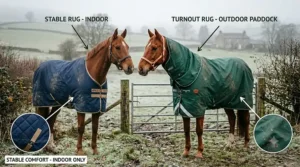
A turnout rug and a stable rug are not interchangeable. This is a point that gets quietly glossed over in many buying guides, but it matters: turnout rugs are designed to be waterproof and to withstand rolling, rubbing against fence posts, and being stood on. Stable rugs are designed for breathability, warmth, and comfort in a sheltered environment. Use a heavyweight turnout rug as your stable rug every night for a winter, and you’ll end up with a horse that’s too warm, sweating, and prone to skin issues.
The Gallop Trojan 300g Stable Rug Combo exists to fill that specific gap without spending a fortune. Its 300D soft breathable outer is not waterproof — nor should it be in a stable context — and the 300g fill is distributed evenly through channel quilting, which prevents the fill from bunching or migrating and ensures consistent warmth across the horse’s back and quarters. The cotton lining is smooth against the skin and easy to clean.
For clipped horses stabled overnight in draughty barns (and anyone who’s managed a horse through a British winter knows that “draughty barn” could describe about 80% of all UK stabling), this rug does exactly what it needs to do: keep the heat in without overheating, and take a nightly machine wash without disintegrating.
It’s not a glamorous piece of kit. But glamour is rarely what you need when you’re doing a 10pm check on a February evening. Confirmed available on Amazon.co.uk (ASIN B09H73RPTT).
✅ Purpose-built stable rug — not a turnout repurposed
✅ Channel-quilted fill distribution — no cold spots
✅ Cotton lining — breathable and kind to the coat
❌ Not waterproof — strictly stable use
❌ 300D outer not durable enough for outdoor use
At £40–£55, this is practical stable-night value.
7. WeatherBeeta ComFiTec Essential Combo Neck 220g Turnout Rug
The WeatherBeeta ComFiTec Essential Combo Neck 220g might be the most sensible purchase on this list for UK conditions — and that’s meant as a genuine compliment. In a climate where the temperature swing between a mild December and a cold February can be 10–12°C, a 220g rug hits a practical sweet spot that a 300g does not.
The 1200D Guard-Tec outer is WeatherBeeta’s proprietary waterproof/breathable coating, hydrostatic pressure tested to 2,000mm and breathability tested to 3,000g/m². In plain English: it keeps rain out while letting your horse’s body moisture escape. The 210T smooth lining reduces friction on the coat — important for horses who shed hair against rug linings, creating rubs over time. Traditional side gussets allow natural shoulder movement.
WeatherBeeta’s 3-year warranty on waterproofness, breathability, and hardware applies to this range — and that warranty matters. A rug that fails its waterproofing in year two is, effectively, not a waterproof rug. Having that manufacturer backing on a mid-weight rug in the £70–£90 range is genuinely reassuring for the long-term buyer.
This is the rug I’d recommend for horse owners buying their first “proper” winter turnout — it’s the right weight for the majority of UK winter days, built well enough to last, and backed by a warranty that gives you a safety net if it doesn’t.
Compatible with WeatherBeeta’s liner system, with combo neck style, available on Amazon.co.uk.
✅ 220g sweet spot for most UK winter days
✅ 3-year WeatherBeeta warranty
✅ 1200D Guard-Tec outer — durable for the price
❌ Not the warmest option for genuinely cold spells or clipped horses ❌ No memory foam wither pad — standard wither protection only
How to Choose a Winter Horse Rug in the UK: 7 Key Steps
Picking the right rug is less about the rug and more about reading the horse in front of you. Here’s a practical framework.
1. Assess coat and clip status first. An unclipped native pony in a good coat can often manage at 5°C without any rug — their thermoneutral zone extends considerably lower than we tend to assume. A fully clipped Thoroughbred at the same temperature needs significant insulation. The British Horse Society has comprehensive guidance on temperature thresholds by coat and clip type, and it’s well worth bookmarking.
2. Check body condition score. A horse with a body condition score of 3 or below (using the Henneke scale) has diminished fat reserves and will feel cold more acutely than a horse in good condition. Older horses and youngsters are similarly more vulnerable to cold stress.
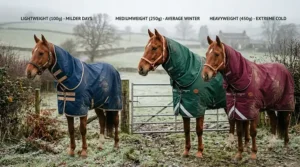
3. Match fill weight to temperature, not to anxiety. As a working guide: 0–100g for wet but mild (above 8°C), 200–250g for colder spells (0–7°C), 300g+ for frost and sub-zero conditions, or for clipped horses at lower temperatures. Resist the urge to add weight “just in case.”
4. Check under the rug twice daily. Feel the chest and girth area for sweat or raised temperature. A horse that’s too warm is a welfare concern just as much as one that’s cold.
5. Choose denier based on your horse’s habits. A horse that rolls vigorously, rubs on fence posts, or shares a field with a companion who chews rugs needs 1200D minimum. A well-mannered horse in a calm field can manage perfectly well with 600D.
6. Consider layering systems over multiple single rugs. Investing in a quality mid-weight turnout and a WarmaRug-style liner gives you a flexible system that covers multiple temperature scenarios without buying three separate rugs.
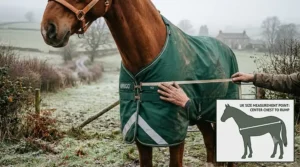
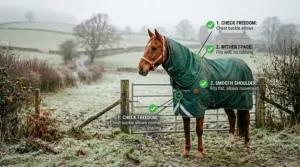
7. Fit correctly before purchase. Measure from the centre of the chest, around the side of the body, to the point of the rump — that’s your rug size in feet and inches. A rug that slides back will cause wither rubs regardless of how good the padding is.
The Shelter vs. Rug Debate: What UK Horse Owners Need to Know
There’s a growing conversation in UK equine welfare circles about over-rugging, and it’s one this guide would be remiss to ignore. Research from the University of Edinburgh’s Royal (Dick) School of Veterinary Studies and broader veterinary guidance consistently notes that horses have a robust thermoregulatory system — one that’s easily overwhelmed by excess insulation.
The reality is this: a horse with access to adequate shelter, fresh water, and sufficient forage (which generates internal heat during fermentation in the hindgut) is typically well-equipped to manage UK winter conditions without rugging, provided it has a natural coat and is in good body condition.
What rugs do exceptionally well: keep horses dry. Wet conditions in combination with wind are the genuinely dangerous combination in UK winter — not cold alone. A waterproof turnout rug isn’t primarily about warmth in many cases; it’s about maintaining the insulating properties of a natural coat that would otherwise collapse when saturated. A soaking wet coat loses roughly 60% of its insulating capacity. That’s where the rug earns its keep.
This is also why breathability matters as much as waterproofing. A rug that keeps rain out but traps sweat inside creates a damp microclimate against the skin that’s arguably worse than the rain itself. Every product reviewed in this guide balances both — look for hydrostatic head ratings of at least 1,500mm (the British Standard for waterproofness) and breathability ratings of at least 1,000g/m².
The shelter vs. rug question, then, isn’t a binary choice. It’s a sliding scale. Good shelter reduces the need for heavy rugging. Adequate rugging compensates for poor shelter. Ideally, you’d have both.
Common Mistakes When Buying a Winter Horse Rug in the UK
Buying heavyweight as the default. November isn’t February. Reaching straight for a 300g turnout when a 100g would do leaves your horse with nowhere to go when temperatures genuinely drop.
Ignoring breathability ratings. A rug with impressive waterproofing but poor breathability will cause your horse to sweat, and that sweat will condense inside the rug. Look for breathability above 3,000g/m² in UK conditions where horses are often both wet and working.
Buying US-voltage electric rug systems without checking UK compatibility. Some heated rug or therapy products sold online are designed for 110V US electrical standards. UK mains run at 230V/50Hz. Always verify compatibility before purchasing any electrically powered equestrian product, and check for UKCA marking where applicable.
Rugging based on what you feel, not what the horse shows. Human comfort is a terrible proxy for equine comfort. Horses run warmer than us. If you feel cold at the field gate, that’s information about you, not your horse.
Ignoring fit. A rug that fits poorly causes rubs within days, particularly at the withers and shoulders. Always measure before ordering, particularly if buying online where you can’t try before you buy. UK consumer rights under the Consumer Rights Act 2015 and Consumer Contracts Regulations give you a 14-day right to return goods purchased online — use it if the fit isn’t right.
Over-tightening leg straps. Cross surcingles should sit flat with a hand’s width of space. Leg straps should allow a hand through the loop. Tight straps cause pressure sores and restrict movement; loose straps create trip hazards.
UK Horse Owner Scenarios: Matching the Right Rug to the Right Horse
The Clipped Sport Horse on Full Livery in Surrey
Sarah has a 16.2hh KWPN mare who works four times a week and is given a full clip in October. The mare lives out during the day and stables overnight at a livery yard near Guildford. Surrey winters are wet rather than brutally cold — temperatures rarely drop below -3°C.
Recommendation: WeatherBeeta ComFiTec Plus Dynamic II 300g Combo for daytime turnout, plus the Gallop Trojan 300g Stable Rug Combo for overnight. The memory foam wither pad on the WeatherBeeta suits the mare’s Warmblood conformation, and the separate stable rug prevents the overnight condensation and warmth build-up that a turnout rug would cause in a stabled environment. Total investment: around £130–£165 for both rugs on Amazon.co.uk.
The Hardy Native Pony in a Scottish Field
Angus owns a 13.2hh Highland pony who lives out 24/7 near Perth. The pony has a full, dense winter coat and keeps excellent weight year-round. Temperatures regularly drop to -5°C in January.
Recommendation: A lightweight 0g or 100g waterproof turnout — not even listed in our top seven, because a good-doer with a Highland’s natural coat doesn’t need a heavyweight rug until temperatures drop severely and persistently. For genuinely harsh spells — prolonged frost, ice, and wind — the Shires Highlander Plus 200g with a WarmaRug liner provides flexibility without over-rugging on milder days. Most importantly: provide good hay ad lib and a proper field shelter.
The Older Thoroughbred on a Busy Yorkshire Livery Yard
Janet’s 22-year-old ex-racehorse gelding has a trace clip, lives in a draughty American barn, and struggles to maintain weight through winter. He’s also prone to wither rubs. Near Harrogate, February temperatures hit -8°C some nights.
Recommendation: This is exactly the horse the Horseware Rambo Wug 400g was designed for. The high-cut neck eliminates wither pressure, the thermobonded fill provides serious warmth without excessive bulk, and the 1000D outer handles the inevitable contact with stable doors and field fencing. Yes, it’s an investment at £200–£280. For a horse with this specific profile, it’s money well spent.
✨ Don’t Miss These Exclusive Deals!
🔍 The rugs above represent the best of what Amazon.co.uk currently stocks for UK winter conditions. Click any highlighted product name to check the latest pricing and availability. Remember: Prime members enjoy next-day delivery on eligible items — handy if the forecast just took a turn for the worse.
Rugging for Heavy Horses: What’s Different
Heavy horses — Clydesdales, Shires, Percherons, Draught crosses — are rarely mentioned in standard rug guides, but they present specific challenges. Their broader barrel, wider shoulders, and deeper girth mean standard horse rug sizing often falls short in the coverage department.
The “heavy horse rug waterproof” search category on Amazon.co.uk is growing, which reflects both the popularity of heavy breeds and the lack of suitable options in mainstream equestrian retail. What to look for:
Extended sizing. Many standard rugs max out at 7’3″. Heavy horses often need 7’6″ or 7’9″. Check sizing charts carefully — some brands like Shires offer extended sizing in the Highlander range.
Deeper shoulder gussets. A Clydesdale’s shoulder action during movement is substantially larger than a Thoroughbred’s. Deep gussets (as found in the Highlander Plus) prevent the rug from pulling back and creating pressure points.
Reinforced chest fastenings. A horse with a 200kg+ weight advantage over a standard horse puts more stress on chest clips when moving. Double-buckle fastenings or dual clip systems are preferable.
Temperature considerations for heavy horses. Despite their size, many heavy breeds are remarkably cold-adapted and don’t require the same fill weights as clipped sport horses. Don’t assume bigger horse = heavier rug. Assess the individual coat, condition, and clip status as you would for any horse.
Long-Term Value & Maintenance: Getting More from Your Winter Horse Rug
A good winter turnout rug is not a seasonal disposable. Treated properly, a quality rug like the Horseware Rambo Wug should last seven to ten years; even mid-range options like the Shires Tempest Plus routinely survive four or five seasons with correct care.
Washing. Most modern turnout rugs are machine washable — use a front-loader (not a top-loading agitator machine, which damages fill and stitching) on a gentle cycle with a specialist rug wash or a very small amount of non-biological powder. Reproof after every two or three washes using a product like Nikwax Rug Proof, available on Amazon.co.uk.
Drying. Hang outdoors or in a well-ventilated area — never in a tumble dryer. Heat damages waterproof membranes and can melt synthetic fill.
Storage. Clean, dry, and stored in a breathable bag (the Horseware “Bag for Life” is useful here) over summer. Damp storage is the primary cause of mildew and delamination of waterproof membranes.
Minor repairs. Small rips in the outer fabric can be repaired with specialist rug repair tape (Stormsure Horse Rug Repair Kit is available on Amazon.co.uk and works well on ripstop fabrics). Addressing a 2cm tear costs pennies; ignoring it until it’s 20cm costs you a new rug.
Annual reproof. Even high-quality DWR finishes degrade over time. A water repellency test is simple: sprinkle water on the outer fabric. If it beads and rolls off, the waterproofing is intact. If it absorbs, reproof before the season starts.
400g vs 300g vs 200g: What the Numbers Actually Mean for Your Horse in British Winter
This question — horse rug 400g vs 300g winter — generates more confusion than almost any other aspect of rugging. Let’s settle it.
The fill weight (100g, 200g, 300g, 400g) refers to the amount of polyfill or fibrefill per square metre inside the rug. More fill = more trapped warm air = more warmth. But the relationship isn’t linear, and fill weight alone doesn’t determine how warm a rug feels in practice — the quality of the fill (thermobonded vs. standard polyfill), the outer fabric’s breathability, and the fit all play significant roles.
As a practical guide for UK conditions:
- 0–100g: Rain sheet function. Keeps the natural coat dry so it retains its insulating properties. Suitable for unclipped horses in moderate cold (above 8°C).
- 200–250g: The UK sweet spot for much of October–November and March. Suitable for trace-clipped horses in field conditions above 2°C.
- 300g: The standard heavyweight. Suitable for clipped horses in field conditions, older or underweight horses, or any horse below 2°C for extended periods.
- 400g+: Serious cold-weather insulation. Most UK winters don’t demand this for the majority of horses; it’s most useful for very cold nights (below -5°C), horses who’ve been full-clipped, or horses with very limited fat reserves.
The thermogenic rugging principle — using rugs to actively maintain a horse’s body temperature rather than simply responding to weather — is relevant here. For horses doing significant work, the heat generated by exercise provides temperature maintenance during the day; it’s nightfall and early morning turnout where supplemental rugging earns its keep.
FAQ: Your Winter Horse Rug Questions Answered
❓ When should I start rugging my horse in the UK autumn?
❓ Do horses get cold in winter in the UK?
❓ How do I know if my horse is too warm in its rug?
❓ Can I use a turnout rug as a stable rug?
❓ What denier do I need for a horse that destroys rugs?
Conclusion: Rug Smart, Not Heavy
The best winter horse rug guide isn’t a list of the thickest, most expensive options available — it’s a framework for thinking clearly about what your individual horse actually needs. The UK’s climate is damp and variable, not arctic; most horses in this country need a good waterproof turnout far more than they need an extreme-warmth heavyweight rug.
Buy the right weight for your horse’s clip status and the actual temperature. Choose 1200D or above for horses who are rough on their kit. Invest in a layering-compatible system if your budget allows — the flexibility of a mid-weight rug with a liner beats buying three separate rugs for three temperature ranges. And check under the rug every day: a sweaty chest or a shivering spine are the signals that tell you to adjust.
All seven rugs reviewed in this guide are currently available on Amazon.co.uk, with Prime next-day delivery on most. Prices were correct at time of research — always check the listing for the latest figure, as Amazon.co.uk pricing fluctuates.
Your horse will tell you if you’ve got it wrong. Listen accordingly.
✨ Don’t Miss These Exclusive Deals!
🔍 Ready to kit your horse out for winter? Click any highlighted product above to check current pricing and availability on Amazon.co.uk. Prime members can get eligible items delivered next day — perfect if the weather forecast just changed.
- 7 Best Medium Weight Turnout Rugs for Horses UK (2026 Guide)
- Summer Turnout Rug Horse Owners Need: 7 Best UK Picks for 2026
- Best Lightweight Turnout Rug for Horses: Top 7 UK Picks (2026)
Disclaimer: This article contains affiliate links. As an Amazon Associate, I earn from qualifying purchases. If you purchase products through these links, we may earn a small commission at no additional cost to you.
✨ Found this helpful? Share it with your mates! 💬🤗
