
In This Article
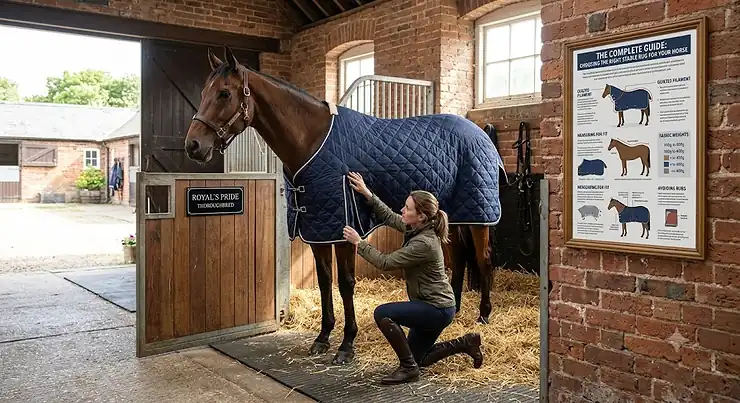
Standing in a feed room at 6pm in January, torch wedged under your chin, trying to work out whether your horse needs the 200g or the 300g tonight, is a peculiarly British rite of passage. A stable rug, in the simplest terms, is an indoor blanket that helps a stabled horse regulate warmth without the waterproofing bulk of a turnout rug — it’s about comfort and coat condition, not weather protection. Getting this one purchase right saves you money, saves your horse from rubs and overheating, and saves you those torch-lit 6pm dilemmas for the rest of the season.

This guide walks through how to choose the right stable rug for your horse using real product research rather than marketing copy, because there’s a genuine cost to getting it wrong. Buy too light and a clipped Thoroughbred loses condition over a hard winter. Buy too heavy and, according to the British Horse Society’s rugging guidance, you risk overriding your horse’s natural thermoregulation entirely. Neither outcome is dramatic on day one, but both add up over a season.
We’ve pulled together seven genuine stable rugs sold in the UK, spanning budget starter options through to premium wither-relief designs, and we’ve paired every product mention with honest analysis of who it actually suits. You’ll also find a weight guide, a proper look at tog ratings, a fleece-versus-quilted comparison, sizing advice, and a section on where rugging fits into your wider stable management. Nothing here is invented — where real customer sentiment exists, we’ve flagged it as such; where it doesn’t, we’ve said so rather than making it up. Let’s get your horse’s rug wardrobe sorted for the season ahead.
Quick Comparison Table
Before the deep dive, here’s the fast version for anyone short on time.
| Rug | Best For | Fill Weight | Price Range |
|---|---|---|---|
| Shires Tempest Original 100 | Budget entry-level warmth | 100g | Under £60 |
| Shires Tempest Plus 100 Combo | Value combo with neck | 100g | £70–£90 range |
| WeatherBeeta ComFiTec Essential Combo Neck Heavy | Clipped horses, cold nights | 360g | £70–£95 range |
| WeatherBeeta ComFiTec 1000D Diamond Quilt Detach-a-Neck | Wither-sensitive horses | 250g | £90–£115 range |
| Harry Hall Stablemasta | Mane protection | 50g–400g options | £65–£95 range |
| Premier Equine Lucanta | Premium comfort, prominent withers | 250g–300g | £105–£140 range |
| Bucas Quilt Big Neck | Broad-shouldered breeds | 200g | £95–£120 range |
Looking at the spread above, the two Shires options anchor the budget end and genuinely compete on fit and durability rather than just price, while the WeatherBeeta and Premier Equine rugs justify their higher cost through wither-specific engineering that matters for horses prone to rubbing. The Bucas earns its place purely on cut — if you own a Friesian, cob, or anything unusually broad through the shoulder, most standard-fit rugs simply won’t sit right, and that’s a problem no amount of fill weight solves.
💬 Found a rug that looks right for your horse already? Save this table and come back to it once you’ve measured up — the details below will help you narrow it down further.
Top 7 Stable Rugs for Horses: Expert Analysis
We’ve deliberately mixed budget, mid-range and premium options here, along with a broad-fit specialist and a mane-protection design, so there’s a genuine match whatever your horse’s build, clip, or your own budget.
1. Shires Tempest Original 100 Stable Rug — best entry point for a first-time rug buyer
The Tempest Original opens the range with no-frills, seam-free comfort, and that absence of a central back seam is worth dwelling on for a second. A single quilted fill without a seam running down the spine means there’s no ridge to press into the topline when your horse lies down — a small design detail that larger, cheaper rugs often skip. The 100g polyfill sits in the lightweight bracket, suitable for autumn evenings and mild winter nights rather than deep midwinter cold, and the outer fabric is durable enough to withstand daily stable wear without the premium-brand price tag. Based on the spec comparison with pricier combos on this list, this is the rug to buy if you’re not yet sure how much rug your horse actually needs and want to test the water before committing further. It suits owners with an unclipped, hardy type who mostly needs a “just in case” layer, or anyone stocking a first rug wardrobe on a tight budget. Reviewers consistently note that sizing runs true and that the webbing detail holds up well over a season, though this is a standard-neck design only, so horses prone to mane rubbing from other rugs won’t find a fix here.
Pros:
- ✅ Seam-free lining reduces pressure along the spine
- ✅ Genuinely affordable entry point for new horse owners
- ✅ Signature webbing and cross-surcingle fastenings hold fit well
Cons:
- ❌ 100g fill only suits mild-to-moderate cold, not deep winter
- ❌ No neck cover option on this specific model
At around £50–£60, this sits at the affordable end of the market — check current price before buying, as stock and colourways shift the figure slightly. For a first stable rug, it represents solid value: you’re not paying for features you don’t yet know you need.
2. Shires Tempest Plus 100 Combo Stable Rug — best value combo with a proven fit
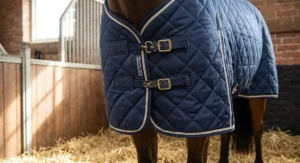
Step up to the Plus Combo and you get the same reliable Shires construction with a permanently attached neck section, which matters more than it might sound for horses that rub their mane against standard-neck rugs. Horse & Hound’s own testing — completed over several months on a middleweight Irish Sport Horse — found the rug held its shape without slipping or rubbing throughout daily use, which is about as close to independent verification as this price bracket gets. The 1200D ripstop outer is genuinely tough; denier ratings work like tights, so a higher number means a stronger, more resistant weave, and 1200D comfortably outlasts the 400–600D fabrics found on some budget alternatives. The SupaFleece neck trim adds a plush contact point exactly where chafing tends to start. What most buyers overlook about combo-neck rugs generally is that the fixed neck adds warmth you might not want on milder nights, so this suits horses that are properly cold-sensitive or lightly clipped rather than hardy types who’d overheat under the extra coverage. The reviewer testing this specific rug noted the neck sat slightly short when the horse dropped its head to eat from the floor — a minor but genuine fit quirk worth knowing about before you buy.
Pros:
- ✅ Independently tested over months without slipping or rubbing
- ✅ 1200D ripstop outer significantly tougher than budget alternatives
- ✅ WarmaRug liner compatible for added warmth later
Cons:
- ❌ Neck can sit slightly short for horses that graze low
- ❌ Fixed neck design isn’t ideal for horses prone to overheating
Priced in the £70–£90 range depending on retailer and colourway, this combo earns its place as a genuine step up from the Original without moving into premium territory.
3. WeatherBeeta ComFiTec Essential Combo Neck Heavy — best for clipped horses facing a proper cold snap
This is where fill weight starts doing real work. At 360g of polyfill under a 1200 denier ripstop outer with Guard-Tec coating, the Essential Combo Neck Heavy is built for horses that have lost their natural insulation to the clippers and need the rug to do the job the coat normally would. The Guard-Tec coating means the outer resists moisture ingress from condensation inside a draughty stable, while the 210T polyester lining is smooth enough to avoid dragging on the coat during turning and lying down. Based on aggregated customer feedback on this exact model, reviewers repeatedly mention that it stays warm even when damp and leaves no rub marks after extended daily use — a meaningful data point given how often heavier combo rugs are blamed for shoulder chafing. This is the rug for a fully clipped horse stabled overnight through a proper British winter, not a lightly-worked native pony who’d be sweating under it by 9pm. One buyer’s account of purchasing it for an underweight, rug-shy gelding is a useful signal too: even horses that typically fight rugs settled once the neck straps alone were fastened, suggesting the fit is forgiving for horses that aren’t used to combo necks.
Pros:
- ✅ 360g fill genuinely suits fully clipped horses in cold spells
- ✅ Guard-Tec coating helps manage stable condensation and damp
- ✅ Reviewers report no rub marks even with daily wear
Cons:
- ❌ Too warm for unclipped or lightly worked horses
- ❌ Some buyers note the straps can loosen slightly over time
Expect to pay in the £70–£95 range, with prices fluctuating by size — always check current price, since larger sizes typically sit toward the top of that band.
4. WeatherBeeta ComFiTec 1000D Diamond Quilt Detach-a-Neck Medium — best for horses with sensitive or prominent withers
Wither soreness is one of those problems that looks trivial until you’re the one dealing with a horse that flinches every time a rug goes on. The Detach-a-Neck Medium tackles this directly with a memory-foam wither-relief pad — branded Cozi-Cuff by WeatherBeeta — that contours to the horse’s shape and physically lifts the rug fabric clear of the withers rather than letting it sit directly on the bone. On paper this means less point-loading exactly where horses with a pronounced wither shape (think Thoroughbreds, some Warmbloods, and older horses who’ve lost topline muscle) tend to develop pressure sores or hair loss. The 250g fill sits comfortably in the medium bracket, and the detachable neck means you can run it as a standard-neck rug on milder nights and reattach the neck section for colder ones — genuine seasonal versatility rather than needing two separate rugs. The quick-clip front closure is a small but real time-saver on busy yard mornings when you’re doing ten horses before work. What the spec sheet won’t tell you, but the design logic strongly suggests, is that this rug earns its slightly higher price through problem-solving for a specific horse type rather than blanket appeal — if your horse has never had a wither issue, you may not need to pay for this particular feature.
Pros:
- ✅ Memory-foam wither pad specifically addresses pressure and rubbing
- ✅ Detachable neck adds genuine seasonal flexibility
- ✅ Quick-clip closure speeds up daily rugging routines
Cons:
- ❌ Premium wither-relief feature adds cost some horses won’t need
- ❌ 250g fill needs an added liner for the coldest nights
Priced in the £90–£115 range, this is a considered purchase for a specific problem rather than a default first buy — but for the right horse, it’s hard to beat on the market.
5. Harry Hall Stablemasta — best for horses prone to losing mane hair
Mane loss from rug pressure is a genuinely common and often misdiagnosed problem — owners frequently blame itching or a skin issue when the real cause is a standard rug collar rubbing against the crest every time the horse moves. Harry Hall’s Stablemasta range addresses this with a dome neck design, engineered specifically to reduce the friction point at the base of the mane. According to Harry Hall’s own design team, the dome shape was developed in direct response to this exact owner complaint, which at least tells us the feature was built to solve a named problem rather than as a marketing flourish. The range spans fill weights from 50g right through to 400g, which is an unusually wide spread for one product family and means you can theoretically stay loyal to one design language across your entire seasonal rug wardrobe. Shine-enhancing linings are a nice secondary benefit for horses with fine coats where dullness shows quickly. Here’s what to weigh: the dome neck genuinely earns its keep for horses with mane-loss history, but if that’s never been a problem for your horse, a standard-neck rug at this price point may offer marginally better value elsewhere.
Pros:
- ✅ Dome neck design specifically reduces mane-rubbing friction
- ✅ Fill weights span 50g to 400g within one product family
- ✅ Shine-enhancing lining benefits fine or dull coats
Cons:
- ❌ Premium priced against fill weight compared with rivals
- ❌ Dome neck benefit is wasted if mane loss isn’t already an issue
Sitting in the £65–£95 range depending on fill weight chosen, this rug rewards owners solving a specific, named problem rather than shopping on spec sheet alone.
6. Premier Equine Lucanta Stable Rug — best premium option for all-round wither and coat comfort
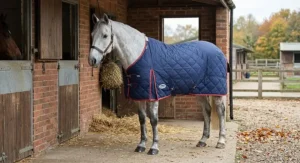
The Lucanta sits at the top end of this list, and the forward-cut neckline is the standout feature worth understanding properly. Rather than a standard straight-across cut, the forward cut distributes pressure away from the spine and shoulder points, working alongside integrated wither pads to relieve pressure on sore or prominent withers — a combination approach rather than relying on padding alone. The 600D diamond weave polyester outer is a genuine mid-to-heavy-duty fabric, tougher than the 400–420D materials found on several budget rugs but lighter than the 1200D ripstop options, striking a deliberate balance between durability and weight on the horse’s back. An antibacterial and anti-static lining is a detail that matters more in practice than it sounds: static build-up in synthetic linings genuinely does cause coat static and dust attraction over a season, and antibacterial treatment helps control the bacterial load that builds in a rug worn daily without washing every night. The self-righting pattern helps the rug settle back into position after the horse rolls or shifts in the stable, cutting down on the twisted-rug scenario every yard owner recognises. Based on the spec comparison across this whole list, the Lucanta is the rug to choose if you want one premium stable rug that handles wither sensitivity, coat health and daily practicality simultaneously, rather than solving just one of those problems.
Pros:
- ✅ Forward-cut neckline plus wither pads addresses pressure two ways
- ✅ Antibacterial, anti-static lining supports coat and skin health
- ✅ Self-righting pattern reduces twisting after rolling
Cons:
- ❌ Among the priciest options on this list
- ❌ 600D outer is durable but not the toughest available here
Expect a price in the £105–£140 range, reflecting the combined wither, coat and fit engineering rather than any single standout feature.
7. Bucas Quilt Big Neck — best for broad-shouldered and wide-necked breeds
Standard stable rugs are cut to an average equine shape, and horses that fall outside that average — Friesians, cobs, and other broad-chested or thick-necked types — often end up with a rug that’s either too tight across the shoulder or gaping at the neck. The Bucas Quilt Big Neck exists specifically to solve that, with a wider neck and shoulder cut designed around exactly these body types. It can be worn on its own or layered beneath a Bucas turnout rug for additional warmth outdoors, which adds genuine versatility if you also turn your horse out in cold weather. Two lining options are available: a Stay-Dry lining that can go directly onto a still-damp horse and wick moisture away quickly, and a Silk-Feel/Dermo-Care lining that wicks more gently while prioritising a smooth finish for coat condition. Reviewers consistently note that the Big Neck genuinely fits broader horses where standard-cut rugs from other brands pinch or gape — this is a real solved problem rather than a marketing claim, given how frequently broad-breed owners specifically search for wide-fit rugs. If your horse is an average Thoroughbred or Warmblood build, this specific cut offers no advantage over a standard rug and you’d be paying for a fit feature you don’t need.
Pros:
- ✅ Purpose-built wide cut genuinely suits broad or thick-necked breeds
- ✅ Stay-Dry lining option works on a still-damp horse
- ✅ Layers under a turnout rug for added outdoor versatility
Cons:
- ❌ Offers no fit advantage for standard-built horses
- ❌ Sits toward the premium end of the stable rug market
Priced around the £100–£120 range, this is a specialist buy that’s worth every penny for the right build, and irrelevant for anyone else.
Practical Usage Guide: Setting Up and Maintaining Your Stable Rug
Buying the right rug is only half the job — how you introduce and maintain it affects both your horse’s comfort and the rug’s lifespan. When a rug is brand new, introduce it during the day first rather than leaving a nervous or unfamiliar horse rugged up overnight unsupervised; this lets you check for reactions to unfamiliar fabric against the coat. Fasten the chest straps first, then the surcingles, leaving two to four fingers of slack at the chest — too tight restricts shoulder movement and causes rubbing, too loose lets the rug slip and twist. Check fastenings and stitching weekly rather than waiting for a failure; a torn surcingle at 6am on a cold morning is a genuinely bad start to the day. Most stable rugs are machine washable at 30°C, and washing at the correct temperature protects both the waterproofing treatment on combo-neck outers and the loft of the polyfill, since overheating synthetic fill can compress it permanently. Common first-30-days mistakes include over-rugging on the first mild evening simply because the rug is new and exciting to use, and skipping the two-finger fit check because the rug “looked about right” in the shop. Neither mistake is dramatic on its own, but both erode the value of an otherwise well-chosen rug.
Real-World Scenarios: Which Stable Rug Suits Your Horse?
Consider three genuinely different owners facing the same shopping decision. First, a livery yard owner with a 15-year-old cob, unclipped, turned out during the day and stabled overnight through a mild-to-average winter — this horse rarely needs more than a lightweight 100g rug like the Shires Tempest Original, since the natural coat is still doing most of the work and a heavier rug risks overheating a horse that’s already well-insulated. Second, a competition rider with a fully clipped Warmblood in regular winter work, stabled most of the day with limited turnout — this is exactly the combo-neck, 300g-plus scenario the WeatherBeeta ComFiTec Essential Combo Neck Heavy was built for, since the clip has removed the coat’s natural function entirely. Third, a first-time owner of a young Friesian cross with a naturally broad neck and shoulder, on a modest budget but struggling to find anything that fits without gaping — this is precisely the situation the Bucas Quilt Big Neck solves, where the specialist cut matters more than fill weight or brand prestige. Matching the rug to the actual horse and routine, rather than to the most popular product on a retailer’s front page, is the difference between a rug that earns its keep and one that sits unused in the tack room by January.
How to Choose the Right Stable Rug for Your Horse
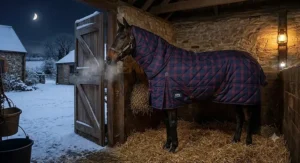
If you take one section from this guide as a working checklist, make it this one. Here’s how to choose the right stable rug for your horse in seven practical steps.
- Assess the clip, not the calendar. A fully clipped horse needs meaningfully more fill than an unclipped one at the same outside temperature, because the clip has removed the insulating function of the coat entirely.
- Measure before you shop. Rug sizing runs in feet and inches from the centre of the chest to the point of the buttock — guessing from a previous rug’s label is a common source of poor fit.
- Match fill weight to your stable, not just the weather. A draughty timber stable with gaps under the door needs more warmth retention than a well-insulated brick block at the same outdoor temperature.
- Decide on neck coverage based on mane history. If your horse has rubbed its mane before, a combo or dome-neck design is worth the extra cost; if not, a standard neck saves money without a real downside.
- Check denier against your horse’s habits. Horses that lie down and roll frequently, or that live with a boisterous field companion even part-time, benefit from a higher denier outer regardless of fill weight.
- Consider wither shape honestly. Prominent withers, common in older horses and certain Thoroughbred types, genuinely benefit from a dedicated wither-relief pad rather than a standard quilted panel.
- Buy for your horse’s actual routine, not an aspirational one. A rug bought for imagined future competition turnout is money spent solving a problem you don’t currently have.
Stable Rug Weight Guide
Fill weight is measured in grams and refers to the amount of polyfill insulation packed inside the quilted panels — it has nothing to do with the rug’s physical weight on the horse’s back. As a rough stable rug weight guide: 0g to 100g suits mild autumn or spring evenings and horses that are unclipped or only lightly worked; 200g suits an average British winter night for a partially clipped or older horse; and 300g upwards is reserved for fully clipped horses, underweight horses, or genuinely severe cold snaps. It’s worth repeating that more fill isn’t automatically better — a horse over-rugged relative to its actual insulation needs can overheat, sweat under the rug, and end up colder once that sweat cools, which is a worse outcome than being slightly under-rugged in the first place. Always cross-reference fill weight against your specific horse’s clip, age, and body condition rather than defaulting to the heaviest option on the shelf.
Stable Rug vs Fleece Rug: What’s the Difference?
A genuine stable rug vs fleece rug comparison comes down to insulation mechanism rather than one being universally “better.” A quilted stable rug uses synthetic polyfill sandwiched between two fabric layers to trap warm air, offering a defined, adjustable level of insulation measured in grams. A fleece rug, by contrast, uses the pile of the fleece fabric itself to trap air close to the coat, offering a lighter, more breathable layer that’s particularly good at wicking moisture away from a horse that’s slightly damp or sweaty after light work. In practice, fleece rugs excel as a drying layer after exercise or as a light extra layer under a quilted rug on a cold night, while quilted stable rugs are the better standalone choice for genuinely cold, static overnight stabling. Many experienced owners run both: a fleece for transitional use and drying, and a quilted rug as the main overnight layer, rather than treating the choice as either-or.
Understanding Horse Rug Tog Rating Stable Options Use
Tog ratings, borrowed from the duvet world, describe thermal resistance, and horse rug tog rating stable products are increasingly labelled this way alongside or instead of gram fill weights. Broadly, a 0-tog rug offers no insulation beyond the fabric itself, similar to a summer sheet; 4.5 to 6 tog roughly corresponds to a lightweight 100g fill; and 9 tog and above roughly maps to the 300g-plus heavyweight bracket. The conversion isn’t perfectly standardised across brands, which is genuinely one of the more confusing aspects of rug shopping — a 200g rug from one manufacturer won’t necessarily carry the identical tog rating as a 200g rug from another, since fill density and quilting pattern both affect measured warmth. When comparing rugs across brands, treat tog and gram figures as a useful guide rather than an exact science, and always cross-check against your horse’s actual comfort once the rug is on.
Stable Ventilation and Rugging: Finding the Balance
Getting stable ventilation rugging decisions right matters just as much as choosing the correct fill weight, because a heavy rug in a poorly ventilated stable creates a genuinely uncomfortable, humid microclimate against the horse’s skin. Research from Hartpury University’s rug-monitoring study found that horses in owner-chosen rugs frequently ran warmer under the rug than their thermoneutral comfort zone would suggest, even at a modest average outdoor temperature — a strong signal that over-rugging in enclosed, poorly ventilated stables is more common than most owners realise. Good stable ventilation, whether through a window, a grille above the door, or simply not fully sealing a stable overnight, allows moisture and excess heat to escape rather than building up under a heavy rug. If your stable is particularly airtight, consider dropping one fill weight bracket lower than you might in a draughtier building, since the ventilation itself is doing part of the temperature-regulation job.
Rug Size Measuring Guide
A correctly fitted rug prevents almost every common rugging problem in one step, which makes this rug size measuring guide worth following properly rather than guessing. Stand your horse square on a flat surface and, using a soft tape measure, start at the centre of the chest and run the tape along the side of the horse’s body to the point of the buttock, following the natural contour rather than a straight line. UK rugs are sized in feet and inches based on this single measurement. Round up rather than down if you’re between sizes, since a slightly generous rug causes fewer problems than a tight one, and always re-measure a growing youngster or a horse that’s gained or lost significant condition, since last year’s rug size may no longer apply.
Horse Stable Management and Your Rug Routine
Rugging decisions don’t happen in isolation — they sit within wider horse stable management, alongside forage, bedding, ventilation and routine. The statutory Code of Practice for the Welfare of Horses, Ponies, Donkeys and their Hybrids makes clear that owners have a legal responsibility to ensure a suitable environment, which includes protection from extremes of temperature where a horse’s own coat and shelter aren’t sufficient. In practical terms, this means your rug choice should be reviewed alongside your stable’s insulation, your horse’s forage intake (digestion itself generates internal heat), and your daily routine for checking underneath the rug. A rug is one tool within a wider management system, not a substitute for good ventilation, adequate forage, or a genuinely suitable stable environment.
✨ Don’t Miss These Exclusive Deals!
🔍 Take your horse’s winter wardrobe to the next level with the picks above. Click through on any highlighted rug to check current pricing and availability, and get your stable routine sorted before the next cold snap arrives!
Common Mistakes When Buying a Stable Rug
The single most common mistake is buying on fill weight alone without considering denier, cut, or your horse’s actual clip and routine — a 300g rug in a flimsy 300D outer can still tear on a boisterous horse, while a 100g rug in a tough 1200D shell might outlast it entirely. A second frequent error is ignoring neck design until after a rubbing problem develops, when a combo or dome-neck rug bought proactively would have prevented it. Third, many owners buy a single rug and expect it to cover the whole season, when a proper rug wardrobe — light, medium, and a spare — handles the UK’s genuinely unpredictable weather swings far better than one rug pushed beyond its design range. Fourth, skipping the fit check at purchase and assuming “the size on the label matches last year’s rug” catches out owners with growing youngsters or horses whose condition has changed. Finally, underestimating how quickly a poorly maintained rug degrades — skipping regular washing and fastening checks shortens a rug’s genuinely useful life by a season or more.
Benefits vs Traditional Alternatives
| Approach | Warmth Control | Coat Protection | Best For |
|---|---|---|---|
| Quilted stable rug | Precise, gram-rated | High | Clipped or cold-sensitive horses |
| Fleece rug alone | Light, breathable | Moderate | Drying off, mild transitional weather |
| No rug (natural coat) | Self-regulating | N/A | Hardy, unclipped horses with shelter |
This comparison makes the trade-offs fairly clear: a quilted stable rug offers the most precise, adjustable warmth control of the three, but it’s genuinely unnecessary for a hardy, unclipped horse with good shelter and ad-lib forage, since the BHS itself notes many native and cob types cope perfectly well without one. Fleece sits in a useful middle ground as a light, breathable option rather than a genuine cold-weather solution. The right choice depends far more on the individual horse’s clip, breed and condition than on any inherent superiority of one approach over another.
Long-Term Cost & Maintenance
A single quality stable rug, properly maintained, typically lasts three to five winters before the outer fabric or lining shows genuine wear, which makes the true cost-per-use considerably lower than the upfront price suggests. Spreading a £90 rug across four winters of nightly winter use works out at a genuinely small daily cost, especially compared with the expense of vet treatment for a chill-related illness or a persistent rug-rub infection. Machine washing at the correct 30°C temperature, air-drying away from direct heat sources, and repairing small tears before they spread are the three habits that most extend a rug’s working life. Total cost of ownership also includes liners, spares for wash days, and eventual replacement of surcingle elastic, so budgeting slightly above the sticker price for a full rug system is realistic rather than pessimistic.
Safety, Regulations & Welfare: Rugging Compliance Guide
Rugging sits under the Animal Welfare Act 2006 in England and Wales, which requires owners to ensure a suitable environment for any horse in their care, including appropriate protection from temperature extremes where natural coat and shelter aren’t sufficient. This isn’t about box-ticking bureaucracy — it reflects a genuine welfare principle that both under-rugging a vulnerable horse and over-rugging a hardy one can cause harm, just in opposite directions. The British Horse Society’s winter care advice reinforces this by recommending horses are checked at least once, ideally twice, daily for signs of overheating, rubbing or slipped rugs, particularly during the UK’s characteristically changeable winter weather where a mild afternoon can turn into a sharp overnight frost. Practically, this means checking under the rug at the shoulder and girth for warmth without dampness, and adjusting fill weight promptly as the forecast shifts, rather than rugging by habit or by the calendar date.
🔍 Ready to Build Your Horse’s Winter Rug Wardrobe?
✨ From lightweight starters to premium wither-relief designs, the right stable rug is out there for every budget and build. Browse the options above and get your horse set up for a comfortable, well-managed winter!
Buyer’s Decision Framework
If your horse is unclipped, hardy, and well-sheltered, choose a lightweight 0–100g rug or consider skipping rugging altogether, because the natural coat is already doing the insulating work. If your horse is fully clipped and stabled overnight through a cold UK winter, choose a 300g-plus combo-neck rug, because the clip has removed the natural function the coat would otherwise provide. If your horse has a history of mane rubbing, choose a dome-neck or combo design regardless of fill weight, because the friction point matters more than the warmth level. If your horse has prominent withers or a history of pressure sores, choose a rug with a dedicated wither-relief pad, because standard quilting alone won’t solve a structural fit problem. If your horse is a broad-shouldered or thick-necked breed, choose a specialist wide-fit cut over a standard rug in a larger size, because gaping at the neck causes its own rubbing and heat-loss problems that sizing up doesn’t fix.

FAQ
❓ What is the best weight stable rug for a clipped horse?
❓ Can I use a stable rug instead of a turnout rug?
❓ How much does a stable rug cost in the UK?
❓ What tog rating is a stable rug?
❓ How do I measure my horse for a stable rug?
Conclusion
Choosing the right stable rug for your horse really does come down to matching genuine need — clip, breed, age, body condition, and your stable’s own ventilation — to a rug’s actual specification, rather than chasing the biggest fill number or the most popular brand on a retailer’s homepage. The seven rugs covered here span that full range deliberately: budget entry points from Shires, cold-weather combo protection from WeatherBeeta, mane and wither-specific engineering from Harry Hall and Premier Equine, and a genuine broad-fit solution from Bucas for horses that standard cuts simply don’t suit. None of them is universally “the best” — the best rug is the one that matches the horse standing in front of you tonight, at the temperature your stable actually sits at, not the one with the flashiest marketing copy.
✨ Ready to Rug Right This Winter?
💬 Take what you’ve learned about fill weight, tog rating and fit, measure your horse properly, and choose the rug that actually matches their needs — your horse (and your torch-lit 6pm evenings) will thank you.
Recommended for You
- Stable Rugs for Horses 2026: 7 Tried-and-Tested Picks
- Waterproof Breathable Horse Rug: 7 Reliable Picks for 2026
- 7 Best Waterproof Horse Rugs UK 2026
Disclaimer: This article contains affiliate links. As an Amazon Associate, I earn from qualifying purchases. If you purchase products through these links, we may earn a small commission at no additional cost to you.
✨ Found this helpful? Share it with your friends! 💬🤗
