In This Article
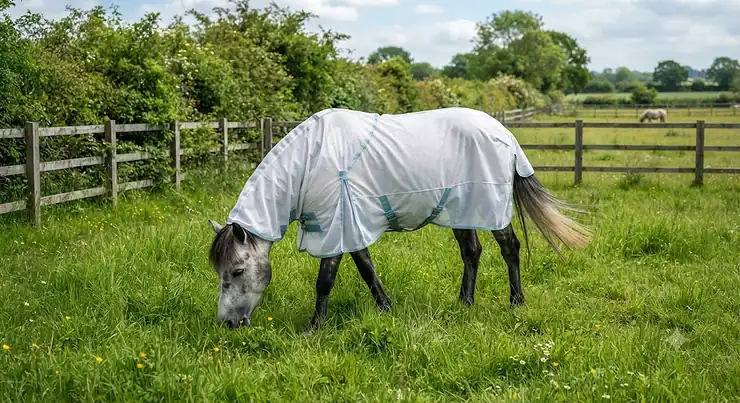
A pony fly rug is a lightweight, ventilated cover designed to shield a pony’s coat and skin from biting insects, harmful UV rays and, in some designs, light rain, while still allowing heat to escape through mesh or ripstop panelling. If you’ve ever watched a native pony stamp, swish and rub itself raw against a fence post in June, you already know why this bit of kit earns its keep every single summer.
Here’s the thing about ponies specifically: they’re not just small horses. Many native breeds — Welsh, Shetland, Dartmoor, New Forest — carry a genetic predisposition to sweet itch, and their compact, round-barrelled shape means a rug cut for a 16hh warmblood will gape at the chest, slip at the withers, or simply refuse to sit anywhere near correctly. Finding a pony fly rug that actually fits a 11.2hh cob or a 13hh riding pony is its own small art form, which is exactly what this guide is built to help with.
Below, we’ve dug into seven real fly rugs currently available to UK buyers, cross-checked their specs against manufacturer data and aggregated customer feedback, and worked through the buying questions that actually matter — sizing, fabric choice, sweet itch protection, and how much you should realistically expect to spend. None of this is going to read like a rewritten product listing; it’s the analysis a knowledgeable friend at the yard would give you if you cornered them by the tack room. Researchers at the University of Bristol have spent years studying exactly why some rug patterns work better than others against biting insects, and we’ll come back to that science later, because it genuinely changes which rug is worth your money.
Quick Comparison Table
Before we get into the detail, here’s the shortlist condensed into something you can actually scan on your phone while standing in a feed room.
| Fly Rug | Best For | Price Range | UV Protection |
|---|---|---|---|
| Shires Tempest Original Waterproof Fly Rug | Changeable British summers | £30-£45 | Around 80-90% |
| WeatherBeeta ComFiTec Essential Pony Fly Sheet | True pony-specific sizing | £35-£55 | 65-75%+ |
| Rhinegold Fly Rug with Neck Cover | Tightest budgets | £25-£35 | Not independently rated |
| Bucas Buzz-Off Full Neck Zebra Fly Rug for Ponies | Sweet-itch-prone natives | £55-£85 | 75%+ |
Looking at this table, the pattern that jumps out is that price correlates less with “how well it keeps flies off” and more with how many extra jobs the rug is being asked to do — waterproofing, UV blocking, sweet itch-grade coverage. A pony that’s out 24/7 on rough grazing with a sweet itch history needs a very different rug to a cob that’s stabled overnight and only fly-prone during turnout hours, and the mid-table price gap reflects that difference in specification rather than pure brand markup. We’ll unpack all seven contenders properly in the next section, including three we haven’t touched on yet.
💬 Found a pony fly rug you like the look of already? Scroll down to see how it stacks up against the full lineup below.
Top 7 Pony Fly Rugs: Expert Analysis
We’ve deliberately mixed budget mesh sheets, waterproof combos and sweet-itch-grade rugs here, because “best pony fly rug” genuinely depends on your pony’s coat sensitivity, your grazing setup, and how much rain you expect between now and September.
1. Shires Tempest Original Waterproof Fly Rug — best for unpredictable British summers
The standout here is the split personality of the fabric: a 600 denier ripstop waterproof top section paired with quick-dry mesh sides, which matters enormously if you’re the sort of owner who can’t get to the yard the second a shower rolls in. Rainwater sheds straight off the ripstop upper while the breathable side panels keep air moving so the pony doesn’t overheat underneath. Shires’ own testing (carried out to the BS EN 13758-1:2002+A1:2006 UV standard) puts the top section’s UV blocking at up to 90%, though third-party retailers list figures closer to 80%, so treat that as “very good” rather than an exact number. Based on the spec comparison with pure mesh sheets, this rug earns its place for owners whose ponies live out full-time and can’t be brought in every time the forecast changes; the ErgoFit neck cut and lined chest and spine sections also mean less friction rubbing than you’d get with a stiffer, unlined fabric. Reviewers consistently note that the adjustable belly flap is a genuine strength — several buyers specifically mention it stopping flies reaching the underside on cobbier pony shapes where a standard hem gapes. On the downside, aggregated feedback also flags that the waterproof top is noticeably warmer than an all-mesh design during a proper heatwave, so it’s not the rug for a pony that struggles in high temperatures.
Pros:
- ✅ Waterproof ripstop top handles sudden summer showers
- ✅ Lined neck, spine and chest reduce friction rubbing
- ✅ Adjustable belly flap suits rounder pony shapes
Cons:
- ❌ Warmer than pure mesh in genuine heatwaves
- ❌ Smallest size starts around 4’6″, so exceptionally tiny ponies may need an alternative
Expect to pay somewhere in the £30-£45 range depending on size and retailer stock levels; check current price before buying, as availability shifts through the season. For a pony turned out in a typical damp-then-sunny British June, this is genuinely solid value.
2. WeatherBeeta ComFiTec Essential Pony Fly Sheet — best for true pony-specific sizing
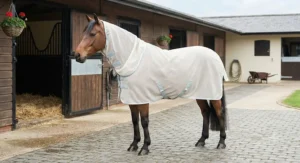
What most buyers overlook about pony fly rugs generally is that a huge proportion of the market is simply a horse rug scaled down, with the proportions never quite translating. The WeatherBeeta ComFiTec Essential Pony Fly Sheet avoids that trap by being built on a genuine pony last, sized in 3-inch increments from 48″ up through 69″ rather than the horse-size brackets crudely relabelled “pony.” The 210T nylon lining at the shoulders, mane and tail is a small but meaningful detail — it’s specifically there to stop the coarse mesh rubbing at the exact pressure points where sweet-itch-prone ponies already tend to be sore. Twin adjustable buckle closures with touch tape make day-to-day fitting quick, and the low cross surcingles plus removable leg straps are aimed squarely at keeping the sheet in place on round, narrow-shouldered native builds rather than sliding backwards, which is the single most common complaint with poorly-fitted fly sheets. WeatherBeeta’s ComFiTec range attracts consistently strong aggregated reviews for construction quality across its lineup, though it’s worth noting some owners of the wider ComFiTec family report the elasticated leg straps needing replacing after a season or two of daily wear — a fair trade-off for the improved fit, but worth budgeting for.
Pros:
- ✅ True pony-proportioned sizing in 3-inch increments
- ✅ 210T lining at key rub points protects coat and skin
- ✅ Low cross surcingles resist slipping on rounder shapes
Cons:
- ❌ Leg straps may need replacing after a season of heavy use
- ❌ UV blocking sits lower than the premium waterproof options
Prices generally sit in the £35-£55 range; as always, prices may vary by colour and size, so check the current price before ordering.
3. Rhinegold Fly Rug with Neck Cover — best for tight budgets
If you’re managing several ponies, or simply don’t want to gamble a premium price on a first-time fly rug purchase, the Rhinegold Fly Rug with Neck Cover is the entry point most UK yards eventually stock at least one of. It’s built from a fully breathable mesh with cross-over surcingles, double chest straps, a cotton towelling spine section for comfort, and a detachable neck cover, so you can strip it back to a body-only sheet on cooler days. Here’s what the spec sheet won’t tell you, but aggregated reviews do: fit and stitching quality on this rug appear to vary between batches. Several buyers report excellent longevity and a snug fit straight out of the bag, while others describe stitching failures after light use and shoulders that sit a touch too far back, causing rubbing. That inconsistency is the honest trade-off of buying at this price point — you’re not getting the manufacturing consistency of a premium range, but you are getting a genuinely useful barrier against flies for not much outlay. For an owner who wants a spare rug to rotate with a better one for washing, or a first fly rug to trial before committing to something pricier, it’s hard to argue with the value. The detachable neck cover is a particularly clever touch, since it means one rug effectively does the job of two designs.
Pros:
- ✅ Genuinely low price point for a first or spare rug
- ✅ Detachable neck cover adds versatility
- ✅ Cotton towelling spine reduces friction
Cons:
- ❌ Reported build quality varies between batches
- ❌ Shoulder fit can run tight on stockier native ponies
Realistically you’re looking at around £25-£35, making it one of the cheapest genuinely functional options covered here.
4. Rhinegold Mombasa Fly Rug with Neck Cover — best for a fleece-lined comfort fit
Stepping up a tier, the Rhinegold Mombasa Fly Rug with Neck Cover pairs a 600 denier waterproof topline with a robust but soft breathable mesh lower section, and the detail that actually separates it from cheaper mesh-only rugs is the fleece-lined chest strap and fleece wither pad. On paper this means less pressure-point rubbing at exactly the spot where badly-fitted rugs cause the most damage — the withers and chest, where skin is thin and constant friction leads to hair loss or sores. The multi-adjustable chest fittings are specifically designed to accommodate both broad and narrow-shouldered builds, which matters more on ponies than on horses given how much shape varies between, say, a stocky Fell and a finer Welsh Section B. Nylon lining through the topline and neck cover adds a smooth finish that won’t pull at the coat, and the elasticated leg straps are a sensible touch for keeping the whole rug anchored during a boisterous gallop round the field. Based on the wider Rhinegold Masai and Mombasa reviews we found, owners describe good stability over multiple days of wear without slipping, and specifically praise the waterproof topline for removing the daily “will it rain” guessing game. It sits above the basic Rhinegold rug in price, which buys real comfort engineering rather than just a bigger logo.
Pros:
- ✅ Fleece-lined chest strap and wither pad reduce pressure rubbing
- ✅ Waterproof topline removes daily weather guesswork
- ✅ Multi-adjustable fittings suit both broad and narrow shoulders
Cons:
- ❌ Heavier fabric can feel warm during peak midsummer heat
- ❌ Costs noticeably more than the entry-level Rhinegold rug
Expect a price in the £40-£60 range, positioning it as a sensible mid-tier step up.
5. LeMieux Arika Shower-Tek Fly Rug — best premium hybrid weather protection
The LeMieux Arika Shower-Tek Fly Rug takes the waterproof-top-plus-breathable-mesh formula and pushes it further, with a hybrid Shower-Tek topline engineered specifically for the on-off, sunshine-then-drizzle pattern that defines a typical British summer, alongside 85% UV protection — genuinely one of the higher blocking figures among the rugs in this guide. What most buyers overlook about this kind of hybrid construction is that it isn’t just about staying dry; the waterproof section also blocks more UV than an equivalent mesh panel would, which matters for grey or coloured ponies prone to sun bleaching and pink-skinned muzzles prone to sunburn. LeMieux’s reputation in the UK market is built on consistent fit engineering across its rug ranges, and the Arika line carries that same attention to shoulder and neck articulation through into its pony sizing. Here’s what the spec sheet won’t tell you: premium construction like this tends to hold its waterproofing and colour better over multiple seasons than budget mesh rugs, which is where the higher upfront cost starts to make long-term sense — you’re not necessarily replacing it every year. The trade-off is straightforward: you’re paying a premium price for a premium brand, and the smallest pony sizes can sell out quickly given how popular the range is across the wider LeMieux customer base.
Pros:
- ✅ 85% UV protection, among the highest in this comparison
- ✅ Hybrid Shower-Tek topline suits changeable weather well
- ✅ Strong reputation for holding fit and colour over seasons
Cons:
- ❌ Premium pricing compared with mesh-only alternatives
- ❌ Smallest pony sizes can sell out during peak season
Budget somewhere around £60-£90 for this one; as with all these rugs, check the current price and available sizes before committing.
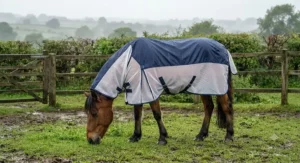
6. HKM Ride-On Fly Sheet — best for leading-rein and ridden ponies
Every rug so far has been a turnout design, but the HKM Ride-On Fly Sheet solves a different problem entirely: keeping flies off a pony during actual riding, hacking or lead-rein sessions, when a full turnout rug simply isn’t practical because it would interfere with the saddle and rider’s leg. It’s built from a super lightweight, rip-resistant polyester, attaches at the poll via touch-tape straps that loop under the bridle browband, and is cut away around the belly so the rider’s leg keeps normal contact with the pony’s side. A tail flap with a tie cord finishes the coverage. Reviewers consistently note that it’s genuinely light enough not to interfere with schooling, and several specifically mention it being a lifesaver for sensitive ponies that nap or fuss at flies mid-lesson. The honest limitation is scope: this isn’t trying to be a turnout rug, so there’s no belly protection or leg coverage, and it won’t do anything for a pony left out in the field overnight. Think of it as a specialist tool that solves one very specific, very common problem — the pony that’s fine until you get on, then spends the whole ride shaking its head and swishing at horseflies — rather than an all-purpose fly rug.
Pros:
- ✅ Purpose-built for exercise, not just turnout
- ✅ Lightweight enough not to hamper schooling or riding
- ✅ Quick bridle-attach system for fast fitting before hacking out
Cons:
- ❌ No belly or leg coverage, so it’s not a turnout substitute
- ❌ Fewer size gradations than dedicated pony turnout ranges
Prices typically sit in the £15-£25 range, making it one of the more affordable additions here — and arguably the one most owners of ridden ponies don’t realise they need until they’ve tried it.
7. Bucas Buzz-Off Full Neck Zebra Fly Rug for Ponies — best sweet-itch-conscious pick backed by real science
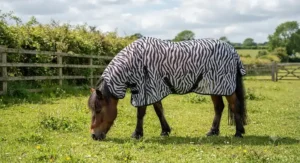
The Bucas Buzz-Off Full Neck Zebra Fly Rug for Ponies is sized specifically at 5’0″ for pony proportions rather than being a scaled-down horse cut, made from a specially developed fine mesh fabric in a bold zebra print, and — unusually for a fly rug feature — that print isn’t just decoration. It’s grounded in real research: scientists have documented that biting horseflies struggle to land accurately on striped patterns compared with solid colours, and it’s genuinely worth reading the primary science here rather than taking a marketing claim at face value. The rug blocks more than 75% of UV rays, and the innovative elasticated belly pad is specifically engineered to stop the sheet migrating backwards during turnout, a common failure point on cheaper full-neck designs. Based on the spec comparison with the other full-neck options in this guide, this is the rug that leans hardest into “does the science actually support this,” rather than relying purely on denier counts and buckle configurations. For a native pony with a genuine sweet itch diagnosis, or simply one that seems to attract more than its fair share of horseflies at the field gate, the combination of full neck coverage, secure belly anchoring and the stripe-pattern effect makes a reasonable case for the premium price tag.
Pros:
- ✅ Pony-specific 5’0″ sizing rather than a scaled-down horse cut
- ✅ Zebra pattern backed by published fly-behaviour research
- ✅ Elasticated belly pad resists rug migration during turnout
Cons:
- ❌ Among the pricier options in mesh-only form
- ❌ Fewer plain colour choices than more traditional ranges
Expect to pay in the £55-£85 range; as with the LeMieux option, popular sizes can sell through quickly during peak fly season.
At a Glance: All 7 Pony Fly Rugs Compared
| # | Rug | Type | Price Range | Best For |
|---|---|---|---|---|
| 1 | Shires Tempest Original Waterproof Fly Rug | Waterproof combo | £30-£45 | Changeable weather |
| 2 | WeatherBeeta ComFiTec Essential Pony Fly Sheet | Pony-specific mesh | £35-£55 | True pony proportions |
| 3 | Rhinegold Fly Rug with Neck Cover | Budget mesh | £25-£35 | Tight budgets, spare rug |
| 4 | Rhinegold Mombasa Fly Rug with Neck Cover | Waterproof + fleece comfort | £40-£60 | Pressure-point sensitivity |
| 5 | LeMieux Arika Shower-Tek Fly Rug | Premium hybrid | £60-£90 | Maximum UV and weather protection |
| 6 | HKM Ride-On Fly Sheet | Ride-on exercise sheet | £15-£25 | Ridden and lead-rein ponies |
| 7 | Bucas Buzz-Off Full Neck Zebra Fly Rug for Ponies | Sweet-itch-grade mesh | £55-£85 | Sweet itch and horsefly-prone ponies |
Read across this table and a clear budget-to-premium ladder emerges: the Rhinegold Fly Rug with Neck Cover and HKM Ride-On Fly Sheet anchor the affordable end for spare rugs and exercise use, the WeatherBeeta ComFiTec Essential Pony Fly Sheet and Rhinegold Mombasa Fly Rug with Neck Cover occupy sensible mid-ground for everyday turnout, and the LeMieux Arika Shower-Tek Fly Rug and Bucas Buzz-Off Full Neck Zebra Fly Rug for Ponies justify their higher price tags through UV performance and sweet-itch-specific engineering respectively. If your pony has no particular sensitivity and lives a fairly sheltered life, there’s genuinely no need to spend at the top of that ladder.
✨ Don’t miss these picks while sizes are in stock — check current availability before the fly season peak hits your area!😊
Practical Usage Guide: Fitting, Fastening and Looking After Your Pony Fly Rug
Buying the right rug is only half the job; fitting it correctly is what actually determines whether flies get kept off or not. Start by measuring from the centre of the pony’s chest, around the point of shoulder, along the body to the point of the buttock — this is the standard method used across UK sizing charts, and it’s worth redoing every spring, because ponies (especially youngsters and native breeds coming off winter grazing) change shape more than people expect. When you first put a new rug on, check for a flat hand’s width of clearance at the chest and make sure the surcingles cross under the belly rather than running straight across, since a straight surcingle concentrates pressure on the spine exactly where you don’t want it.
A common mistake in the first 30 days of ownership is leaving the same rug on day and night without checking underneath. Biting insects thrive in the warm, still microclimate under a poorly-ventilated rug just as much as in open air, so lift the rug and check the skin — particularly the belly, mane and tail base — every couple of days for the first few weeks while you confirm the fit is genuinely working. Wash mesh fly rugs on a cool, gentle cycle following the manufacturer’s care label; overheating synthetic mesh in a hot wash breaks down the fabric’s structure and shortens its working life considerably. If your pony wears a rug daily through a full fly season, having a second rug to rotate in while the first dries isn’t a luxury — it’s genuinely the single easiest way to extend the working life of both. World Horse Welfare’s advice on sweet itch management specifically recommends buying more than one rug precisely for this reason.
Real-World Scenarios: Which Pony Fly Rug Suits Your Situation?
The 24/7 field-kept native pony. If your pony lives out full-time on rough grazing near woodland or standing water — prime midge territory — and has any history of rubbing its mane or tail base, prioritise full-neck coverage and a secure belly pad over price. The Bucas Buzz-Off Full Neck Zebra Fly Rug for Ponies or a dedicated sweet itch rug earns its cost here because the alternative is a genuinely miserable, self-injuring pony.
The Pony Club all-rounder that’s stabled overnight. For a pony that comes in at night and is only exposed to flies during daytime turnout, a mid-range mesh sheet like the WeatherBeeta ComFiTec Essential Pony Fly Sheet covers the actual risk window without paying for round-the-clock protection you don’t need.
The leading-rein or first-ridden pony doing regular lessons. Here the priority shifts entirely to comfort during exercise rather than turnout endurance. The HKM Ride-On Fly Sheet solves the specific problem of a young pony being distracted or unsettled by flies mid-lesson, without the bulk of a full turnout rug getting in the rider’s way.
How to Choose a Pony Fly Rug
- Measure properly before you shop. Take the chest-to-buttock measurement fresh each spring; guessing a size based on last year’s rug or the pony’s height alone is the single biggest cause of poor fit.
- Decide whether you need waterproofing. If your pony is out in genuinely unpredictable weather and you can’t reliably bring it in, a waterproof-top combo like the Shires or LeMieux options saves you constant rug-swapping.
- Check for sweet itch history first. A pony with any rubbing history needs full neck and belly coverage as a baseline, not an optional extra — this should override budget considerations.
- Look at where the lining sits. Rugs lined specifically at the shoulders, mane and tail reduce friction exactly where sensitive ponies suffer most; a rug with no lining at all is a false economy for a rub-prone pony.
- Match the rug to how it’s actually used. A turnout rug and an exercise sheet solve different problems — don’t expect one to do the other’s job.
- Budget for a spare. Owning two rugs to rotate through washing dramatically extends the working life of both and keeps hygiene up during peak fly season.
- Check current pricing and sizing before ordering. Stock and prices shift through the season, so always verify availability rather than relying on last year’s figures.
Common Mistakes When Buying a Pony Fly Rug
The single most common mistake is buying by height alone rather than by an actual chest-to-buttock measurement — a 12hh pony with a stocky, round barrel and a 12hh pony with a finer, longer frame can need genuinely different rug lengths, and height tells you almost nothing about that. A close second is assuming a horse-sized rug simply “scaled down” will fit a pony’s proportions; the shoulder and neck angles are different enough that this rarely works well, which is precisely why the pony-specific sizing on rugs like the WeatherBeeta ComFiTec Essential Pony Fly Sheet matters more than it might seem on paper.
Another frequent misstep is buying the cheapest available rug for a pony with a known sweet itch history. Reviewers consistently note that basic mesh sheets simply don’t stop midges the way a dedicated sweet itch-grade rug does, because standard mesh gauge is fine enough to keep out flies but not the much smaller Culicoides midges responsible for the reaction. Finally, plenty of owners skip re-measuring year on year, assuming a pony’s proportions stay static — they don’t, particularly through growth spurts in younger ponies or weight changes in older ones coming off winter feed.
Pony Fly Rug vs Sweet Itch Rug: What’s the Real Difference?
It’s worth being precise here because the two terms get used almost interchangeably, and that confusion causes real welfare problems. A standard fly rug uses a mesh gauge fine enough to keep out flies and horseflies, but Culicoides midges — the specific culprits behind sweet itch — are small enough to bite straight through that mesh. A sweet itch rug uses a tighter weave, typically extends further down the neck with ear coverage options, and almost always includes a full belly flap, because midges specifically target the mane, tail base and belly. The British Horse Society’s guidance on sweet itch is unambiguous that fly rugs covering as much of the horse or pony as possible are one of the most effective non-medical interventions available, and specifically notes that certain native breeds carry a genetically elevated risk.
| Feature | Standard Fly Rug | Sweet Itch Rug |
|---|---|---|
| Mesh gauge | Keeps out flies | Keeps out fine biting midges |
| Belly coverage | Sometimes optional | Almost always included |
| Neck/ear coverage | Variable | Extended, often to ears |
| Typical price range | £25-£60 | £55-£90+ |
| Best for | General fly nuisance | Diagnosed sweet itch or high-risk breeds |
The practical takeaway from this comparison is that a pony without any sweet itch history is genuinely well served by a standard fly rug, and paying the premium for sweet itch-grade protection would be spending against a risk that doesn’t apply. But for native breeds with a family history of rubbing, or a pony that’s already shown early signs, the tighter weave and fuller coverage of a sweet itch rug isn’t an upgrade — it’s closer to a necessity.
What to Expect: Real-World Performance
Specs on a page rarely translate directly into what you’ll actually see at the field gate, so here’s the honest picture. A well-fitted waterproof combo rug like the Shires Tempest genuinely does shed a light shower without the pony needing to come in, but during a proper downpour, water will still find its way in around the neck seam over time — no fly rug is a substitute for field shelter in sustained heavy rain. Mesh-only sheets keep ponies noticeably cooler on hot days, which matters more than it sounds; overheating under a rug can be as much of a welfare issue as the flies it’s protecting against.
On the insect side, expect a well-fitted, correctly-sized fly rug to dramatically reduce — not eliminate — biting insect contact. Ponies in genuinely fly-heavy environments, near livestock or standing water, will still get bitten around uncovered areas like the face and lower legs unless paired with a fly mask and boots. The zebra-pattern science is a genuine performance edge rather than marketing fluff: University of Bristol researchers found that stark black-white contrast and thin stripes specifically disrupt a horsefly’s ability to judge landing distance, which is a mechanism you simply don’t get from a plain grey or navy mesh, however well-made it is.
Pony Fly Rugs for Sensitive and Small Equines
Insect protection for small equines carries its own particular challenges that don’t apply to full-sized horses. Miniature horse fly gear and rugs for the very smallest native ponies need proportionally shorter necks, tighter chest adjustment ranges, and often shallower belly drops than a standard “small pony” size accounts for — a rug built for an 11.2hh riding pony can still be genuinely too big through the neck and shoulder for a true miniature or a small Shetland. If you’re shopping specifically for a fly rug for small ponies at the bottom of the size charts, prioritise brands offering sizes starting below 4’6″, check the neck circumference measurement specifically rather than just overall length, and be prepared to use a chest extender if the smallest stock size is still slightly roomy.
Breathable pony summer wear matters even more for genuinely sensitive skin types — thin-skinned, pink-muzzled or coloured ponies with less natural pigment protection benefit disproportionately from higher UV-blocking fabrics, since sunburn and photosensitivity reactions compound on top of any existing skin irritation from bites. When you search for a pony fly sheet amazon buyers consistently favour listings with detailed pony-specific size charts over generic “one size” or “small/medium/large” bands, precisely because vague sizing is the most common source of returns in this category.
Features That Actually Matter (And Those That Don’t)
Genuinely important: accurate pony-specific sizing, lining at friction points, secure belly anchoring, and — for sweet itch-prone ponies — mesh gauge fine enough to exclude midges rather than just flies. These four features are doing almost all of the real protective work across every rug in this guide.
Genuinely overrated: elaborate colour patterns beyond the proven zebra-stripe effect, “designer” branding that doesn’t correspond to any functional difference, and marketing claims about denier count in isolation — a higher denier fabric is more tear-resistant, not automatically more protective against insects or UV, and pairing a high-denier top with poor lining can still cause rubbing. Don’t let denier numbers alone drive your decision; read past them to the actual fit engineering and lining detail underneath.
Safety, Regulations and Fit Compliance
UK rug manufacturers commonly test UV-blocking claims to the BS EN 13758-1:2002+A1:2006 standard, which is worth knowing when you see a specific UV percentage quoted, since it means the figure has been independently measured rather than estimated. Beyond fabric standards, general equine welfare — including the responsibility to protect a horse or pony from pain, suffering and disease, which extends to appropriate fly and midge protection during the biting season — falls under the Animal Welfare Act 2006, which applies across England and Wales, with equivalent legislation in Scotland and Northern Ireland. Beyond the legal baseline, World Horse Welfare’s practical advice on sweet itch management recommends stabling during peak midge activity at dawn and dusk as a complementary strategy alongside rugging, since no rug — however well fitted — offers 100% protection on its own.
From a pure safety standpoint, always check leg straps and surcingles for wear before turnout; a snapped or trailing strap is a genuine entanglement risk, and it’s worth building this into the same daily check as the fly rug’s fit and cleanliness.
Long-Term Cost & Maintenance
A single fly rug typically lasts two to four seasons with correct washing and storage, though sweet itch-grade rugs under daily heavy use may need replacing sooner if the mesh gauge starts to stretch. Cost-per-use drops sharply once you factor in a full fly season running roughly March through November in a mild year — even a premium £80 rug works out to under 30p a day across a six-month season, which reframes the upfront cost considerably.
| Rug Tier | Typical Price Range | Expected Lifespan | Approx. Cost Per Season |
|---|---|---|---|
| Budget mesh | £25-£35 | 1-2 seasons | £15-£30 |
| Mid-range pony-specific | £35-£60 | 2-3 seasons | £15-£25 |
| Premium/sweet itch-grade | £55-£90 | 3-4 seasons | £15-£25 |
What this table makes clear is that total cost of ownership narrows considerably once lifespan is factored in — the premium options aren’t necessarily more expensive per season than the budget tier, they simply ask for a bigger single outlay. For an owner buying one rug to last several years, that changes the calculation considerably compared with judging purely on sticker price.
FAQ
❓ What size fly rug does my pony need?
❓ Can a fly rug prevent sweet itch?
❓ How often should I wash a pony fly rug?
❓ Is a waterproof fly rug too hot for summer?
❓ Do zebra print fly rugs actually work better?
Conclusion
Choosing a pony fly rug ultimately comes down to three honest questions: does your pony have a sweet itch history, how exposed is it to weather and biting insects during the day, and what’s the fabric doing at the exact points where rubbing tends to start. Get those three answers right and the rest of the decision — waterproof or mesh, budget or premium — largely sorts itself out. For an unfussy pony with no particular sensitivities, a mid-range pick like the WeatherBeeta ComFiTec Essential Pony Fly Sheet covers the real-world risk without overspending. For a native breed with any rubbing history, the fuller coverage and research-backed pattern of the Bucas Buzz-Off Full Neck Zebra Fly Rug for Ponies is worth the higher price tag. And if you’re simply after a reliable spare or first-time trial rug, the Rhinegold Fly Rug with Neck Cover does the essential job without the essential price tag.
Whichever direction you go, remember that correct sizing and consistent daily checks matter more than any single feature on the spec sheet — the best fly rug in the world only works if it’s actually fitted properly and checked regularly through the season.
Recommended for You
- Pony Stable Rug Guide 2026: 7 Best Rugs Ranked & Reviewed
- Pony Turnout Rug: 7 Best Waterproof Picks Tested for 2026
- Fleece Exercise Sheet for Horses: 7 Best Warm-Up Rugs (2026)
Disclaimer: This article contains affiliate links. As an Amazon Associate, I earn from qualifying purchases. If you purchase products through these links, we may earn a small commission at no additional cost to you.
✨ Found this helpful? Share it with your friends! 💬🤗
