In This Article
Somewhere between “my horse needs a new girth” and actually buying one, most riders end up scrolling through forty near-identical black straps wondering why something so simple got so complicated. It shouldn’t be complicated. An affordable jumping girth just needs to do three things well: hold the saddle stable over a fence, stay out of the way of the elbow, and not turn your horse’s belly into a red, angry mess by the second week of use. Everything else is marketing.
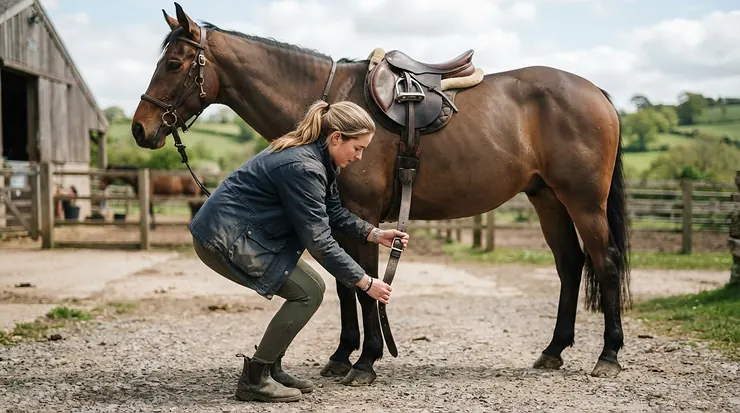
This guide cuts through that noise. We’ve researched seven real, currently available jumping girths sold through amazon.co.uk, spanning honest budget buys through to a genuinely premium shaped leather option, and we’ve looked at what actual owners report after months of use rather than what the packaging promises. According to the Society of Master Saddlers, correct girth fit is a welfare issue as much as a performance one, sitting directly over the pectoral and abdominal muscles that drive your horse’s every stride — which is exactly why “cheap” and “affordable” aren’t the same word, and why this piece treats the difference seriously.
Whether you’re kitting out a first pony with a modest budget or looking to upgrade a competition horse without remortgaging the yard, you’ll find a genuinely affordable jumping girth here that matches your situation — plus the comparison data, spec interpretation, and honest sourced review sentiment to make the decision yourself rather than take a shop assistant’s word for it.
Quick Comparison Table
Before the deep dive, here’s the shape of the market at a glance. All prices are approximate ranges checked at the time of research and will vary by retailer, size and colour — always confirm current pricing on the product page before buying.
| Girth | Material | Price Range | Best For |
|---|---|---|---|
| Rhinegold Cotton Padded Girth | Cotton/synthetic | £15–£25 | Absolute budget starter |
| Preto Synthetic Jumping Girth | Neoprene (shaped) | £15–£25 | Anti-chafe on a tight budget |
| T TEKE Contoured Chafeless Girth | Waffle PVC foam | Under £20 | Lightweight, breathable everyday use |
| Shires Neoprene Shaped Girth | Neoprene | £25–£35 | Wipe-clean, all-weather riding |
| Shires Memory Foam Girth | Memory foam/neoprene | £35–£50 | Sensitive horses, pressure relief |
| Rhinegold Softee Comfort Girth | Leather | £45–£55 | Budget-conscious leather upgrade |
| LeMieux Gel-Tek Anatomic Jumping Girth | Leather with gel | £100–£150 | Serious competition use |
Looking at the spread, the market genuinely does cater to every stage of a rider’s journey, and there’s no shame in starting at the top row and working up as your needs (or your horse’s sensitivity) change. What stands out is that price doesn’t map neatly onto quality here — the Preto Synthetic Jumping Girth punches well above its budget price point on shape alone, while the jump from mid-range neoprene to entry-level leather is smaller than most riders assume. If you’re buying for a horse with no history of rubbing, the top three rows will likely serve you fine; if galls are already a recurring issue, skip straight to the shaped or leather options further down the table.
💬 Just one click — help others make better buying decisions too!😊
Top 7 Affordable Jumping Girths: Expert Analysis
We’ve grouped these across genuine budget, mid-range and premium tiers so you can see exactly where your money goes at each level, and what you’re actually paying for when you move up a bracket.
1. Rhinegold Cotton Padded Girth — best rock-bottom budget starter
The Rhinegold Cotton Padded Girth is about as no-frills as girths get, and that’s precisely its appeal. It’s a straight, softly padded cotton-and-synthetic girth available across an enormous size range from 16″ right up to 56″, which matters more than it sounds — a girth that doesn’t fit your saddle’s girth straps properly will rub regardless of material. The padding is basic rather than contoured, so don’t expect elbow clearance or anatomical shaping at this price.
What you do get is a lightweight, easy-to-wash strap that’s genuinely comfortable for horses with no history of sensitivity, and Amazon listing data shows it as a long-running best seller in the Tack Girths category, which is a decent proxy for how many riders keep coming back to it. Reviewers consistently describe it as good value for everyday schooling use, though a handful note the lack of shaping compared with pricier alternatives. It suits first ponies, RDA centres kitting out multiple horses on a tight budget, or as a genuinely useful spare to keep in the lorry.
Pros:
- ✅ Extremely wide size range for almost any horse or pony
- ✅ Machine washable and dries quickly after wet rides
- ✅ Consistently one of the best-selling girths on Amazon UK
Cons:
- ❌ No anatomical shaping or elbow clearance built in
- ❌ Padding thins with heavy use faster than neoprene rivals
Priced in the £15–£25 range depending on size, this is about as affordable a jumping girth as you’ll find that isn’t a false economy — for unfussy horses, it’s genuinely good value.

2. Preto Synthetic Jumping Girth — best shaped anti-chafe pick under £25
This is where “affordable” and “shaped jumping girth” start to overlap properly. The Preto Synthetic Jumping Girth is built from waffle-embossed neoprene with an anatomical, contoured cut specifically designed to sit away from the elbow during the folding motion of a jump. That contouring matters more over a fence than on the flat, because the horse’s foreleg action compresses dramatically tighter to the body on take-off, and a straight-edged girth simply has nowhere to go but into soft tissue.
Elasticated ends at both sides absorb the expansion and contraction of the ribcage during exertion, which is a proper piece of design thinking rather than a gimmick — it’s the same principle used in girths costing three times as much. Reviewers report that the neoprene washes down easily after muddy cross-country schooling and that the shaping genuinely reduces rub marks compared with older straight girths they’d previously used, though a minority found the neoprene retained heat and sweat more than they’d like in summer. It’s a smart pick for anyone jumping regularly on a budget who’s started noticing early rub marks and wants to nip the problem before it becomes a full girth gall.
Pros:
- ✅ Genuine anatomical shaping for elbow clearance over fences
- ✅ Elasticated both ends for comfortable expansion
- ✅ Anti-chafe waffle lining reduces friction hotspots
Cons:
- ❌ Neoprene retains heat and sweat in warm weather
- ❌ Buckle hardware feels less premium than metal-fitted rivals
Sitting in the £15–£25 range, this is arguably the single best value entry point if elbow clearance and rubbing are your main concerns.
3. T TEKE Contoured Chafeless Girth — lightest breathable budget option
The T TEKE Contoured Chafeless Girth takes a slightly different engineering approach: an airflow waffle PVC foam construction designed to let heat and moisture escape rather than trap it, paired with double-sided heavy-duty cotton elastic and stainless steel buckles. On paper this means better breathability than solid neoprene competitors, which matters most for horses that sweat heavily or for summer competition seasons where a hot, clammy girth becomes its own source of irritation.
What most buyers overlook about this style of construction is that the perforated waffle pattern isn’t just about airflow — it also reduces the total surface area gripping the skin, which lowers friction even before you factor in the contoured shape. Stainless steel buckles are a small but genuinely useful upgrade over the painted or plastic-coated hardware found on some rivals at this price, since they won’t rust or seize after repeated washing. Feedback on this style of budget contoured girth tends to note good initial comfort but a shorter lifespan for the elastic inserts under heavy daily use, a fairly typical trade-off at this price bracket.
Pros:
- ✅ Waffle PVC foam construction improves breathability
- ✅ Stainless steel buckles resist rust and wear
- ✅ Double-sided elastic on both ends for even give
Cons:
- ❌ Elastic inserts wear faster under daily heavy use
- ❌ Sizing runs slightly generous — measure carefully first
At under £20, this is one of the cheapest genuinely contoured options on the market, and a sensible pick for anyone prioritising airflow over long-term durability.
4. Shires Neoprene Shaped Girth — best all-weather wipe-clean choice
Shires is one of the UK’s most established equestrian brands, and the Shires Neoprene Shaped Girth reflects that with a step up in build consistency over the sub-£20 options above it. The shaped neoprene body curves away from the elbow, and the closed-cell foam core resists water absorption almost entirely — a genuinely useful property for riders who hack, hunt or cross-country school in filthy conditions and don’t fancy a girth that stays damp for two days afterwards.
Reviewers on Amazon consistently mention how easy it is to hose down and wipe clean compared with fabric or leather alternatives, and several specifically praise it as good value for money that “looks and feels more expensive than it is.” Based on the spec comparison with budget neoprene rivals, the main upgrade here is consistency of stitching and buckle placement rather than a radical design leap — this is a girth built by a company with decades of saddlery experience behind it, and that shows in the small details like reinforced stitching around the buckle holes. It’s the sensible middle-ground pick for anyone who wants a low-maintenance, all-weather jumping girth without stretching to leather.
Pros:
- ✅ Fully wipe-clean and water-resistant closed-cell neoprene
- ✅ Reinforced stitching from an established UK saddlery brand
- ✅ Shaped design for genuine elbow clearance
Cons:
- ❌ Can feel stiffer out of the box than fabric girths
- ❌ Limited colour options compared with fashion-led rivals
Priced in the £25–£35 range, this sits right at the point where brand reliability starts to justify the extra spend over unbranded neoprene.
5. Shires Memory Foam Girth — best pressure-relief for sensitive horses
Moving further up Shires’ own range, the Shires Memory Foam Girth swaps the closed-cell neoprene core for a temperature-responsive memory foam that moulds to the horse’s individual shape as it warms up during a ride. What that means in practice is genuinely even pressure distribution rather than the girth relying purely on shape alone — the foam actively fills small conformational gaps and hollows that a moulded neoprene girth can’t adapt to.
This matters enormously for horses with prominent sternums, unusual girth grooves, or a documented history of pinching, since the foam reduces the concentrated pressure points that typically trigger a gall in the first place. Double-layer elastic inserts at both ends and nylon webbing beneath the foam prevent the whole assembly from overstretching with repeated use, which is a smart bit of engineering most buyers won’t notice until they compare it with a girth that’s stretched out of shape after a season.
Aggregated review sentiment is strongly positive, with multiple reviewers specifically calling out comfort and easy cleaning, and one recurring theme is riders switching to it after a horse developed rubbing on a previous synthetic girth and seeing the problem resolve. If your horse has ever objected sharply to being girthed up, this is worth the jump.
Pros:
- ✅ Memory foam moulds to individual horse conformation
- ✅ Double-layer elastic prevents overstretching over time
- ✅ Strong track record for resolving existing rubbing issues
Cons:
- ❌ Noticeably pricier than standard neoprene Shires girths
- ❌ Foam can compress permanently if stored folded long-term
In the £35–£50 range depending on retailer and size, this is the mid-range pick we’d point a sensitive or previously-rubbed horse towards first.
6. Rhinegold Softee Comfort Girth — best budget leather upgrade
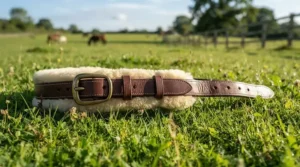
Leather has always carried a premium reputation in tack, and the Rhinegold Softee Comfort Girth is proof that a genuine leather jumping girth doesn’t have to mean premium pricing. Handcrafted from German leather with stainless steel fittings, it’s anatomically shaped and fully padded with soft leather along its length, with elasticated ends built in for the same expansion-and-contraction comfort you’d expect from a synthetic equivalent.
What most buyers overlook about girth material more broadly is that leather isn’t automatically superior to neoprene on comfort — it’s superior on how it ages and how it feels once broken in, softening and moulding to the horse over repeated use in a way synthetic materials simply can’t replicate. Reviewers are candid about this: one specifically noted it’s “comfortable, if like me you cannot afford leather” elsewhere, framing it correctly as an accessible route into leather rather than a corner-cut version of it.
D-rings for training aids are a genuinely practical inclusion for anyone schooling with a martingale or running reins, a feature often reserved for pricier girths. The trade-off, as with any leather product, is maintenance — this needs regular cleaning and conditioning to stay supple, unlike the wipe-and-forget neoprene options above it.
Pros:
- ✅ Genuine German leather at a below-average leather price
- ✅ Fully padded and anatomically shaped throughout
- ✅ D-rings included for training aid attachment
Cons:
- ❌ Requires regular cleaning and conditioning, unlike neoprene
- ❌ Heavier to carry and store than synthetic alternatives
Sitting in the £45–£55 range, this is the tier where “affordable jumping girth” and “leather jumping girth” genuinely meet in the middle without compromise.
7. LeMieux Gel-Tek Anatomic Jumping Girth — best premium shaped leather girth
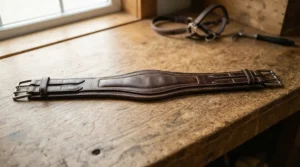
If budget stretches far enough, the LeMieux Gel-Tek Anatomic Jumping Girth represents the ceiling of what a jumping girth can realistically do. Built from ultra-soft oiled leather with gel-impregnated pockets along the leading edge, the design allows the muscle beneath to move freely rather than feeling blocked or restricted — a real consideration for horses jumping at speed or over larger courses where every degree of shoulder freedom translates into a cleaner front-leg fold.
The contoured shape and cut-back design maximise space behind the elbow more aggressively than any of the six products above it, and thinner tapered ends spread pressure evenly right to the girth’s edge rather than concentrating it at a hard boundary. Strong double elastic straps at both ends minimise stretch while still allowing genuine flexibility, and an integrated clip for a breastplate or martingale attachment is a thoughtful touch that saves buying separate connector straps.
Reviewers and saddle fitters alike consistently rate LeMieux’s Gel-Tek range highly for horses competing regularly, with feedback pointing to noticeably improved stride freedom and a marked reduction in rubbing versus older leather girths. It isn’t cheap, and it’s arguably overkill for a happy hacker — but for a horse jumping a full season of competitions, the cost-per-use case is genuinely strong.
Pros:
- ✅ Gel-impregnated pockets allow unrestricted shoulder movement
- ✅ Maximum elbow clearance from an aggressive cut-back shape
- ✅ Integrated breastplate/martingale attachment clip included
Cons:
- ❌ Significant price jump over every other pick here
- ❌ Overkill for occasional hacking or leisure riding
At around £100–£150, this sits firmly at the premium end, but for serious competition horses it’s the closest thing on this list to a long-term investment rather than a purchase.
Practical Usage Guide: Fitting, Care and the First 30 Days
Buying the right girth solves half the problem — fitting it properly solves the rest. Start by positioning the saddle slightly forward of where it will sit, then sliding it back into place so the coat lies flat rather than being pushed against its grain; do the same lightly with the girth itself before buckling up. Tighten in stages: a hole or two before mounting, another once you’re on and the horse has settled, and a final check a few minutes into your warm-up once muscles have relaxed and any trapped air has settled out.
In the first 30 days with any new affordable jumping girth, check the skin behind the elbow after every single ride, not just when something looks obviously wrong — early galls start as small hairless patches rather than open sores. New leather needs conditioning within the first week to prevent it drying stiff and abrasive, while neoprene and synthetic girths should be rinsed after sweaty sessions to stop salt crystallising into the lining and turning abrasive itself. A common mistake in the first month is over-tightening to compensate for a saddle that doesn’t quite fit — if you’re routinely doing up more holes than the girth’s designed range comfortably allows, the problem usually sits with the saddle, not the girth.
✨ Don’t Miss These Exclusive Deals!
🔍 Take your jumping girth shortlist to the next level with these carefully researched picks. Click through to check current pricing and availability before your next yard visit — the right girth now saves vet bills and lost schooling time later!
Real-World Scenarios: Which Girth Suits Which Rider
Picture three very different yards on a Saturday morning. First, a Pony Club family on a genuinely tight budget, riding three or four times a week with no history of skin issues — the Rhinegold Cotton Padded Girth or T TEKE Contoured Chafeless Girth covers this comfortably, and there’s little sense spending more until a specific problem appears.
Second, an amateur eventer competing most weekends through spring and summer, whose horse has started showing faint rub marks after cross-country schooling. This is precisely the profile the Preto Synthetic Jumping Girth or Shires Neoprene Shaped Girth was designed for — genuine anatomical shaping at a price that doesn’t demand a leap of faith, with the option to step up to the Shires Memory Foam Girth if the rubbing persists.
Third, a rider producing young horses to sell on or campaigning at affiliated level, jumping several horses a week and needing kit that holds up to daily use without compromising performance. Here, the Rhinegold Softee Comfort Girth offers accessible leather, while the LeMieux Gel-Tek Anatomic Jumping Girth is the sensible long-term buy given the frequency of use spreads that higher upfront cost across hundreds of rides.
Problem → Solution: Fixing Common Girth Rubbing Issues
Problem: Persistent rubbing despite a “comfort” girth. Often the girth isn’t the actual issue — it’s girthing technique. Pulling the forelegs forward after tacking up smooths any trapped skin folds before they get pinched; skipping this step is one of the most common causes of ongoing irritation regardless of how expensive the girth is.
Problem: A horse that’s become “girthy” or reactive to being tacked up. This usually points to prior discomfort rather than temperament. Switching to a shaped, elasticated option like the Preto Synthetic Jumping Girth and tacking up more gradually, tightening in stages rather than all at once, resolves the majority of cases within a few weeks.
Problem: Sweat-related soreness in summer. A material with genuine breathability, like the waffle construction of the T TEKE Contoured Chafeless Girth, addresses this more effectively than simply buying a softer-looking girth, since trapped moisture is often the actual irritant rather than pressure alone.
Problem: A girth that’s stretched out of shape after a season. This is a durability issue rather than a fit issue — look for double-layer elastic and reinforced webbing, both present on the Shires Memory Foam Girth, which resist this kind of long-term deformation far better than single-elastic budget alternatives.
Problem: Struggling to judge the right size. Measure with the saddle already in place, from one girth strap billet across to the other under the belly, and always check against the specific product’s size chart rather than assuming sizing is universal across brands.
What is an Affordable Jumping Girth?
An affordable jumping girth is a budget-to-mid-priced strap that secures a jumping or general-purpose saddle in place, typically shaped or contoured to clear the elbow during a fence, made from neoprene, synthetic waffle material or entry-level leather, and priced to deliver genuine comfort and shaping without the cost of premium competition-grade tack.
The key word here is “affordable” rather than simply “cheap” — a genuinely good affordable jumping girth still needs elasticated ends, some form of anti-chafe lining or shaping, and consistent stitching, even if it skips the gel pockets and hand-finished leather of a £150 option. As the Society of Master Saddlers notes, girth choice sits directly over muscle groups responsible for the horse’s foreleg movement and breathing, so even entry-level buying decisions genuinely affect comfort and performance, not just aesthetics.
How to Choose an Affordable Jumping Girth
- Measure your saddle’s girth strap length first. Buying the wrong length is the single most common and easily avoided mistake — a too-short girth over-stretches the elastic and a too-long one buckles awkwardly against the leg.
- Prioritise shape over branding. A genuinely contoured, elbow-clearing shape at a budget price beats a well-known brand name on a straight-cut design, especially for jumping specifically.
- Check for elastic on at least one end. Full expansion capacity during exertion reduces pinching far more than padding alone ever will.
- Match material to your climate and workload. Neoprene suits muddy, wet UK winters; leather suits riders willing to condition it regularly for a softer long-term feel.
- Read aggregated review sentiment, not star ratings alone. A 4.5-star average hides a lot — look specifically for repeated mentions of rubbing, stretching or sizing issues across many reviews.
- Budget for a spare. Owning two affordable girths to rotate between washes is often better value than one expensive girth ridden in daily without a break.
- Factor in your horse’s individual history. A horse with no prior rubbing issues can usually start budget; one with a known sensitivity should skip straight to a shaped, memory-foam or leather option.
Shaped Jumping Girth vs Straight Girth: What’s the Real Difference
A shaped jumping girth curves inward behind the elbow rather than running in a straight line across the belly, and the difference is far more than cosmetic. During the fold phase of a jump, a horse’s foreleg draws up tightly against the body, and a straight-cut girth has no give in that exact spot — it either digs in or forces the horse to compensate its technique to avoid the discomfort. According to Horse & Hound’s anatomical girth buyers guide, contoured shapes are specifically designed to maximise freedom and space behind the elbow while improving saddle stability at the same time — two benefits that used to be considered a trade-off against each other.
| Feature | Straight Girth | Shaped Jumping Girth |
|---|---|---|
| Elbow clearance | Minimal | Significant |
| Rubbing risk over fences | Higher | Lower |
| Typical price premium | None | Small to moderate |
| Best For | Flatwork, hacking | Jumping, cross-country |
The data here makes a fairly compelling case for most active jumping riders: the price premium for a shaped design, as seen comparing the Rhinegold Cotton Padded Girth against the similarly-priced Preto Synthetic Jumping Girth, is often negligible. Given that rubbing risk drops noticeably for a cost difference measured in single pounds rather than tens of pounds, there’s rarely a strong argument for buying straight over shaped once jumping becomes a regular activity rather than an occasional pop over a pole.
Leather Jumping Girth vs Synthetic: Material Analysis
Girth material is arguably the most emotionally-charged decision in this whole category, and honestly, both camps have a point. A leather jumping girth like the Rhinegold Softee Comfort Girth or LeMieux Gel-Tek Anatomic Jumping Girth ages beautifully, softening and moulding to the individual horse over months of use in a way no synthetic material replicates — but it demands regular cleaning and conditioning, and performs poorly if neglected, cracking and hardening into something actively abrasive.
Synthetic options — neoprene, waffle PVC or padded cotton — trade that long-term character for consistency and low maintenance. A neoprene girth performs identically on day one and day two hundred provided it’s rinsed clean, and it shrugs off a filthy winter hack in a way leather simply can’t. The honest verdict: leather rewards riders who’ll actually maintain it and suits horses whose skin responds well to a naturally breathable material; synthetic suits riders who want reliable performance without the upkeep, and horses in consistently wet or muddy environments where leather would need near-daily attention.
Elastic Jumping Girth Inserts: Do They Actually Matter
Every genuinely good affordable jumping girth on this list includes elastic somewhere in its construction, and that’s not a coincidence — it’s arguably the single most functionally important feature after shape itself. An elastic jumping girth insert allows the strap to expand and contract as the horse’s ribcage moves with each breath and each stride, rather than staying rigid and creating a fixed pressure band that the horse has to work against constantly.
Single-elastic designs, found on budget options like the T TEKE Contoured Chafeless Girth, give some flexibility on one side. Double-elastic designs, as used on the Shires Memory Foam Girth and premium leather picks, balance that give across both sides evenly, which matters more than it sounds for saddle stability — a girth pulling unevenly to one side over time can subtly twist the saddle’s central position. What the spec sheet won’t tell you, but reviewers note repeatedly, is that elastic quality degrades at different rates: budget elastic can lose its stretch within a season of heavy use, while reinforced double-layer elastic on pricier girths tends to hold its recoil for considerably longer.
Girth Rubbing and Elbow Clearance: Preventing Galls
Girth rubbing — properly known as a girth gall once the skin breaks — happens when friction between tack and skin outpaces the skin’s ability to recover between rides. According to detailed vet guidance published by Horse & Hound, once the thin skin behind the elbow is damaged, scar tissue replaces the original collagen and the area may never regain quite the same elasticity, which is exactly why prevention matters so much more than treatment after the fact.
Elbow clearance is the practical fix. The further a girth’s shaping keeps material away from the natural fold point behind the elbow, the less repetitive friction that specific patch of skin absorbs on every stride. Combine that shaping with genuine daily grooming before tacking up — removing the small bits of dried mud and sweat salt that act like sandpaper under pressure — and the majority of rubbing cases resolve without ever needing veterinary intervention. For horses with an existing history of galls, a soft leather option or a shaped memory-foam design consistently outperforms a straight budget girth on this specific measure, even if the straight girth otherwise fits the saddle correctly.
Long-Term Cost & Maintenance
| Tier | Example | Typical Lifespan | Ongoing Cost |
|---|---|---|---|
| Budget | Rhinegold Cotton Padded Girth | 1–2 seasons | Minimal — occasional wash |
| Mid-range | Shires Memory Foam Girth | 2–4 seasons | Low — rinse after use |
| Premium | LeMieux Gel-Tek Anatomic Jumping Girth | 5+ seasons | Moderate — leather conditioner |
Interpreting this table honestly, the cost-per-use maths often favours mid-range and premium options for anyone riding several times a week, since a budget girth replaced every season can quietly cost more over three years than one durable purchase upfront. That said, for genuinely occasional riders, the budget tier remains the rational choice — there’s little point paying a durability premium on a girth that will barely see enough use to test its lifespan either way.
Common Mistakes When Buying a Jumping Girth
The most frequent error is buying on brand recognition alone rather than checking actual shaping and elastic construction — a well-known name on a poorly designed budget line won’t outperform a lesser-known but genuinely well-engineered option like the Preto Synthetic Jumping Girth. A close second is guessing size rather than measuring, which either strains the elastic permanently or leaves buckles sitting in an uncomfortable position relative to the elbow. Riders also frequently skip reading aggregated review sentiment for sizing and durability complaints, focusing purely on the star rating average, which hides exactly the pattern-level detail that actually predicts whether a girth will suit their own horse.
Frequently Asked Questions
❓ What is the best affordable jumping girth for a horse prone to rubbing?
❓ How much should I pay for a decent jumping girth?
❓ Is a shaped jumping girth worth the extra cost?
❓ Can I use a dressage girth for jumping?
❓ How do I stop my horse's girth from rubbing behind the elbow?
Conclusion
There’s no single “best” affordable jumping girth, and honestly, anyone claiming otherwise is selling you something rather than advising you. What matters is matching the girth to your actual situation: an unfussy pony and a tight budget point squarely at the Rhinegold Cotton Padded Girth; early signs of rubbing point at shaped synthetic options like the Preto Synthetic Jumping Girth or the Shires Neoprene Shaped Girth; a genuinely sensitive horse justifies the step up to the Shires Memory Foam Girth; and a rider wanting the accessible feel of real leather without premium pricing lands on the Rhinegold Softee Comfort Girth. For serious competition horses jumping week in, week out, the LeMieux Gel-Tek Anatomic Jumping Girth earns its higher price through genuinely superior shaping and elastic performance that pays for itself in reduced vet visits and lost schooling days.
Whichever tier you land on, the underlying principles hold true across all seven: prioritise shape over branding, don’t skip elastic, match material to your climate and your willingness to maintain it, and always measure before you buy rather than after. Do that, and even the most modestly priced option on this list will do right by your horse.
✨ Don’t Miss These Exclusive Deals!
🔍 Take your jumping girth shortlist to the next level with these carefully selected products. Click on any highlighted item to check current pricing and availability. The right choice today means happier, more comfortable jumping for seasons to come!
Recommended for You
- 7 Best Affordable Dressage Girths for 2026: Expert Buying Guide
- Affordable Sheepskin Numnah: 7 Best Value Picks for 2026
- Affordable Half Pad: 7 Best Budget-Friendly Picks (2026)
Disclaimer: This article contains affiliate links. As an Amazon Associate, I earn from qualifying purchases. If you purchase products through these links, we may earn a small commission at no additional cost to you.
✨ Found this helpful? Share it with your friends! 💬🤗
