In This Article
Somewhere between “I fancy trying western riding” and “I’ve actually bought the saddle” lies a swamp of jargon, wildly inconsistent pricing, and forum threads warning you off dodgy knock-offs. A western saddle under £600 sits in a strange sweet spot in the UK market — genuinely capable kit lives here, but so does some questionable stitching dressed up in a nice photo. This guide exists to help you tell the two apart.
Britain isn’t exactly overflowing with western tack shops on the high street, which is precisely why so many riders turn to Amazon and specialist online sellers to find a horn saddle without driving three counties over. Whether you’re after a synthetic western saddle for easy upkeep, kitting out a first horse for trail riding, or simply comparing western tack because your current setup no longer fits, the products below have been chosen for real specs, honest trade-offs, and genuine UK availability — not marketing fluff.
We’ve deliberately spread the seven picks across budget, mid-range, and premium territory, all comfortably inside that £600 ceiling. Some are full synthetic builds built for grab-and-go convenience; others blend leather and synthetic components for a saddle that looks the part at a yard open day. Along the way we’ll cover fitting, maintenance, common buying mistakes, and who each saddle actually suits — because a saddle for beginners and a saddle for a seasoned trail rider are rarely the same object wearing different price tags.
What Is a Western Saddle?
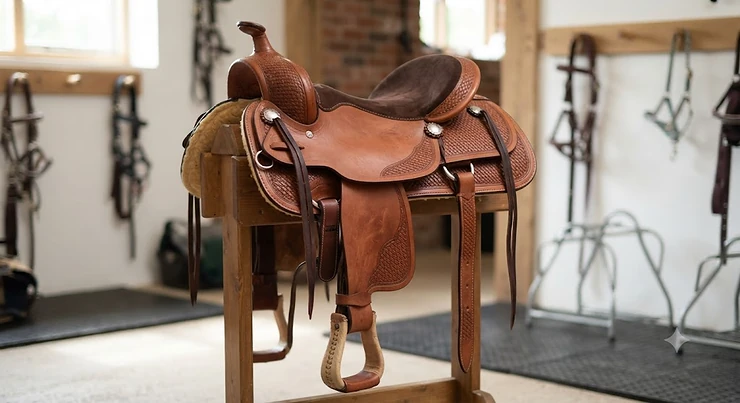
A western saddle is the deep-seated, horn-equipped saddle developed from Mexican vaquero designs, built to spread a rider’s weight over a wider area of the horse’s back for long hours in the saddle. Unlike an English saddle, it typically weighs 15-25kg, features a raised pommel and cantle, and was originally designed for working cattle rather than jumping fences.
A western saddle is larger and heavier than an English saddle, spreading the rider’s weight over a larger area of the horse’s back, which makes it more comfortable especially for long days in the saddle. The design traces back to the saddles used by Mexican vaqueros working cattle across the American Southwest, and that single design choice explains almost everything about why trail riders gravitate toward western tack today: it was built for endurance, not agility, from day one.
Quick Comparison Table
| Saddle | Build | Weight | Best For | Price Range |
|---|---|---|---|---|
| Wintec Western Saddle With Full Quarter Horse Bar | Synthetic Equileather | Approx. 8-9kg | Wide-backed horses, all-weather use | £400-£550 range |
| Wintec Semi-Quarter Western Saddle | Synthetic Equileather | Approx. 8-9kg | Narrower, finer-boned horses | £400-£550 range |
| ADB Creations Freemax Treeless Synthetic Saddle | Synthetic, treeless | Approx. 4-5kg | Absolute beginners, budget buyers | Under £250 |
| ADB Creations Freemax Endurance Saddle (Long Flap) | Synthetic, treeless | Approx. 4-5kg | Long-legged trail riders | Under £250 |
| HILASON American Leather Flex Tree Trail & Pleasure Saddle | Leather, flex tree | Approx. 13-15kg | Riders wanting a traditional look with flex | £450-£600 range |
| HILASON GEN X-II Treeless Leather Trail Saddle | Full-grain leather, treeless | Approx. 11-13kg | Sensitive-backed horses, showground use | £500-£600 range |
| Challenger Western Cordura Trail & Pleasure Saddle (49102BK) | Cordura synthetic + leather trim | Approx. 9-10kg | Riders who want a full tack set in one purchase | £350-£500 range |
Looking at the spread above, the two ADB Creations models undercut everything else here by a wide margin, which makes sense given their fully synthetic, treeless build — you’re paying for lightness and convenience, not longevity under heavy use. The HILASON pair sits at the top of the range because genuine leather components cost more to produce and simply last longer with proper care. If you’re weighing horn saddle designs against a set budget, the Wintec models and the Challenger 49102BK occupy the sensible middle ground: enough durability for regular riding without tipping into premium leather pricing.
💬 Found a saddle that catches your eye already? Scroll down for the full breakdown before you commit.
Top 7 Western Saddles Under £600: Expert Analysis
1. Wintec Western Saddle With Full Quarter Horse Bar — best all-rounder for wider horses
The standout here is the full quarter horse bar, which is Wintec’s way of saying “built for stockier, broader-backed horses” straight out of the box. If your cob or quarter horse type has ever looked uncomfortable in a narrower fit, this is the bar width to try first.
Specs worth knowing: it’s built on Wintec’s synthetic Equileather construction, paired with an Equisuede seat for grip, and finished with a Cheyenne roll on a square skirt with double fenders. In practice, that combination means you get a saddle that shrugs off British drizzle without needing the oiling regime a full-leather saddle demands, while the suede seat keeps you anchored on a spooky day out hacking.
Based on the spec comparison against pricier leather horn saddles, what most buyers overlook about synthetic Equileather is that it doesn’t need conditioning or waterproofing — it’s genuinely wipe-clean, which matters enormously if your tack room doubles as a windswept lean-to. This is the saddle for riders who want western styling without adding “leather maintenance” to their weekly yard chores.
Reviewers consistently report that Wintec’s synthetic saddles hold their shape well over years of use and that the quick-change buckle system makes girthing up noticeably faster than traditional leather rigging — a small but real convenience on cold mornings.
Pros:
- ✅ Full quarter horse bar suits broader-backed horses
- ✅ Weatherproof synthetic build needs no conditioning
- ✅ Quick-change buckles speed up tacking-up time
Cons:
- ❌ Less traditional look than a full-leather horn saddle
- ❌ Narrower resale market than leather equivalents
At around £400-£550 depending on size and colourway, the Wintec Western Saddle With Full Quarter Horse Bar represents strong value if your horse actually has the build it’s designed for — check current price before assuming it’ll fit a narrower type.
2. Wintec Semi-Quarter Western Saddle — best for narrower, finer-boned horses
This is essentially the sibling saddle to our first pick, and the standout feature is right there in the name: a semi-quarter bar width designed for horses with less pronounced wither and rib spring than the full quarter horse bar accommodates.
The build shares the same Equileather shell and Equisuede seat as the Full Quarter Horse Bar version, which means the practical benefits carry over directly — low maintenance, weather resistance, and that quick-buckle rigging. Where it diverges is fit: the semi-quarter tree sits closer to the horse’s spine, which on the wrong horse causes bridging (pressure concentrated at the front and back of the saddle rather than spread evenly) but on the right horse gives a noticeably closer, more secure contact.
Here’s what to weigh before buying blind online: bar width genuinely is the single biggest factor in western saddle fit, more important than seat size for most first-time buyers. A semi-quarter tree on a broad native pony will pinch; a full quarter tree on a lean Arab-type will rock side to side. If you’re at all unsure which your horse needs, a fitting check from a qualified saddler before committing to either Wintec model will save you a returns headache.
Aggregated review sentiment for the Wintec Western range tends to praise consistency between units — buyers report that what arrives matches what’s described, which isn’t always guaranteed with cheaper synthetic imports.
Pros:
- ✅ Closer contact fit for narrower, finer horse types
- ✅ Shares Wintec’s low-maintenance synthetic construction
- ✅ Consistent sizing between individual units
Cons:
- ❌ Wrong choice entirely for broad, cob-type horses
- ❌ Requires accurate bar-width assessment before purchase
Priced in the same £400-£550 range as its full-quarter sibling, the Wintec Semi-Quarter Western Saddle only earns its price tag if the tree width actually matches your horse — don’t buy on brand reputation alone here.
3. ADB Creations Freemax Treeless Synthetic Saddle — best budget entry point for beginners
The standout feature is the treeless design, meaning there’s no rigid wooden or fibreglass frame inside — just flexible padding that moves with the horse. For a first western saddle where you’re not yet sure this discipline is a long-term commitment, that’s a genuinely sensible way to keep costs down.
Built from synthetic material with a padded seat, matching girth, and aluminium stirrups included in the box, this is very much a complete starter package rather than a saddle you’ll need to accessorise separately. The treeless construction also keeps total weight to roughly a third of a full leather horn saddle, which matters if you’re lifting tack onto a horse solo every day.
On paper this means beginners get a genuinely usable setup for well under £250, but the honest trade-off is fit range: treeless saddles distribute rider weight less precisely than treed designs, and most saddlers recommend them primarily for lighter riders and shorter sessions rather than all-day ranch work. What the spec sheet won’t tell you, but the wider synthetic-saddle market consistently shows, is that treeless designs suit sensitive-backed or unusually shaped horses particularly well, since there’s no fixed tree geometry to clash with an atypical spine.
Pros:
- ✅ Complete kit — girth and stirrups included
- ✅ Roughly a third the weight of leather saddles
- ✅ Treeless fit adapts to unusual horse shapes
Cons:
- ❌ Less structured support for heavier riders
- ❌ Not ideal for full-day working sessions
At well under £250, the ADB Creations Freemax Treeless Synthetic Saddle is arguably the lowest-risk way to trial western riding before committing serious money.
4. ADB Creations Freemax Synthetic Endurance Saddle (Long Flap) — best for long-legged trail riders
The extended flap is the whole story here — it’s a small design tweak with an outsized practical benefit for taller riders whose lower leg otherwise hangs below a standard-length flap on smaller saddles.
Underneath that long flap sits the same treeless synthetic build as our previous pick: soft, tack-free material that needs no oiling, plus free stirrups included at purchase. Endurance-focused Western saddles like this one typically prioritise rider comfort over long distances rather than security for roping or cattle work, and this model leans firmly into that trail-riding brief.
Reviewers consistently note the soft flap design as noticeably kinder to the inner leg on multi-hour rides compared with stiffer leather equivalents, echoing a broader theme across synthetic saddle reviews — comfort over the first few hours of a ride tends to be where synthetic materials genuinely outperform stiff, unbroken-in leather. What most buyers overlook about long-flap variants specifically is that they can look slightly disproportionate on a shorter horse, so it’s worth checking your horse’s length as well as your own before ordering.
Pros:
- ✅ Extended flap suits taller riders comfortably
- ✅ No oiling or conditioning required
- ✅ Genuinely light for long trail days
Cons:
- ❌ Long flap can look oversized on shorter horses
- ❌ Treeless design still limits heavier-rider suitability
Also priced under £250, the ADB Creations Freemax Synthetic Endurance Saddle is a smart, low-cost pick specifically for taller riders who’ve struggled with standard flap lengths elsewhere.
5. HILASON American Leather Flex Tree Trail & Pleasure Saddle — best blend of tradition and flexibility
The flex tree is the standout: a semi-rigid internal structure that pivots with the horse’s movement rather than sitting perfectly rigid like a traditional wooden tree, while still giving more structured support than a fully treeless design.
Built from genuine American leather rather than synthetic material, this saddle sits closer to the classic horn saddle silhouette that most people picture when they think “western saddle” — full skirt, defined horn, and tooling detail rather than the plainer look of budget synthetics. The four-way flex movement is specifically engineered to reduce pressure points across varied terrain, which matters if your idea of trail riding includes hills, uneven bridleways, and the odd river crossing rather than flat arena laps.
What the spec sheet won’t tell you, but user reports across the flex-tree category consistently suggest, is that this hybrid design tends to suit a wider range of horse shapes than either a rigid tree or a fully treeless saddle — you get some of the shock-absorbing benefit of treeless designs alongside genuine structural support for longer rides. Leather also means an ongoing (if modest) maintenance routine that synthetic buyers can skip entirely.
Pros:
- ✅ Flex tree adapts across varied horse shapes
- ✅ Traditional full-leather horn saddle appearance
- ✅ Four-way flex reduces pressure on hilly terrain
Cons:
- ❌ Requires regular leather conditioning
- ❌ Heavier than the synthetic saddles on this list
Sitting toward the top of our range at £450-£600, the HILASON American Leather Flex Tree Trail & Pleasure Saddle earns its price through genuine leather construction and adaptable fit, provided you’re willing to keep up basic leather care.
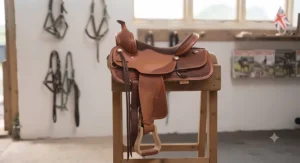
6. HILASON GEN X-II Treeless Leather Trail Saddle — best premium pick near the £600 ceiling
The standout is combining full-grain harness leather with a completely treeless build — a combination that’s harder to find than either feature on its own, since most treeless saddles default to synthetic materials to keep costs down.
This model pairs woolskin-lined underside panels, which cushion impact and wick moisture on long trail days, with silver concho detailing on the fenders and skirt for a show-ready finish that plainer synthetic saddles simply can’t match. Because there’s no internal tree at all, contact between horse and rider is as direct as western saddle design allows, making it a strong option for sensitive-backed horses that have struggled under rigid-tree saddles in the past.
Based on the spec comparison with our other treeless pick (the ADB Creations Freemax), the GEN X-II sits in an entirely different weight class — genuine leather adds structural durability and resale value that synthetic treeless saddles simply don’t retain over years of use. Reviewers within the wider Hilason range consistently highlight the brand’s leather quality as punching above its price point relative to premium American saddlers, though as with any handcrafted leather item, individual units can show natural grain variation.
Pros:
- ✅ Full-grain leather with treeless flexibility
- ✅ Woolskin panels wick moisture on long rides
- ✅ Show-ready silver concho detailing
Cons:
- ❌ Sits at the very top of the £600 budget
- ❌ Leather care routine required for longevity
At £500-£600, the HILASON GEN X-II Treeless Leather Trail Saddle is the closest thing on this list to a genuine premium western saddle without stepping outside a £600 budget entirely.
7. Challenger Western Cordura Trail & Pleasure Saddle (49102BK) — best complete package for new owners
The standout is straightforward: this model ships with a matching bridle included, which means new owners aren’t left scrambling to source separate western tack in the right colourway before their first ride out.
Constructed from Cordura synthetic fabric with leather trim accents, the 49102BK splits the difference between the fully synthetic Wintec and ADB Creations options and the full-leather HILASON models above — you get a more traditional visual finish than plain synthetic, without full-leather pricing or maintenance. It’s built specifically with trail and pleasure riding in mind rather than competition disciplines, which shows in the more generous seat padding compared with show-oriented saddles.
Here’s what to weigh if you’re a genuinely new owner: buying saddle and bridle as a matched set removes one whole category of buying decisions and colour-matching stress from your first western tack purchase, which is exactly the kind of simplification a beginner setup benefits from. The trade-off, as with most bundled sets, is that the included bridle is unlikely to match the quality of a bridle bought separately at the same overall price point — you’re paying for convenience, not necessarily for the best possible bridle on its own merits.
Pros:
- ✅ Includes matching bridle in the box
- ✅ Cordura build blends durability with lighter weight
- ✅ Generous seat padding for trail comfort
Cons:
- ❌ Bundled bridle rarely matches standalone bridle quality
- ❌ Less structured than full-leather competition saddles
Typically priced in the £350-£500 range as a set, the Challenger Western Cordura Trail & Pleasure Saddle (49102BK) offers genuine value for riders who’d rather buy once than piece together separate tack.
Practical Usage Guide: Setting Up Your New Western Saddle
Getting a new saddle right in the first month matters more than most buyers expect — early mistakes in fit checking or girthing habits tend to compound rather than correct themselves. Start by placing the saddle on your horse’s back without a pad first, checking that it sits level and doesn’t rock front-to-back or side-to-side; rocking is the clearest early sign of a tree-width mismatch, whether you’ve bought the Wintec Semi-Quarter Western Saddle, a HILASON flex-tree model, or anything in between.
Once you’ve confirmed a reasonable static fit, introduce a quality pad and girth up gradually — snug enough to prevent slipping, loose enough that you can comfortably fit two fingers under the cinch. Over-tightening on day one is one of the most common early mistakes, and it teaches horses to associate girthing with discomfort, which can create long-term behavioural issues under saddle.
For synthetic saddles like the ADB Creations and Wintec models, maintenance is refreshingly simple: a wipe-down with a damp cloth after muddy rides, and an occasional check of stitching and buckle hardware for wear. Leather saddles such as the HILASON American Leather Flex Tree and HILASON GEN X-II need a genuine care routine — clean off dirt and sweat after each ride, condition every few weeks depending on riding frequency and storage humidity, and never leave leather to dry out fully near direct heat sources, which causes cracking.
The most common first-30-days mistake, regardless of saddle type, is skipping a professional fit check entirely because the saddle “looks about right.” A quick session with a qualified saddler in the first few weeks — even an informal check rather than a full fitting appointment — catches problems while they’re still cheap and easy to fix.
Real-World Scenarios: Which Saddle Suits You?
The absolute beginner on a budget. You’ve booked your first few western lessons, you’re not yet certain this will become a long-term hobby, and £600 feels like a lot to commit before you know you’ll stick with it. The ADB Creations Freemax Treeless Synthetic Saddle makes sense here — low upfront cost, minimal maintenance burden, and a treeless design forgiving enough to work across more than one horse if you’re riding at a shared yard.
The regular trail rider covering serious mileage. You’re out three or four times a week, often for two-plus hours at a stretch, on a mix of bridleways and open ground. Comfort over distance matters more than show-ring polish. Either the HILASON American Leather Flex Tree Trail & Pleasure Saddle or the ADB Creations Freemax Synthetic Endurance Saddle (Long Flap) earns its keep here, depending on whether you’d rather carry the weight of genuine leather or the lightness of synthetic.
The new horse owner building a full kit from scratch. You need a saddle and matching tack in one go, without piecing together separate purchases from three different sellers. The Challenger Western Cordura Trail & Pleasure Saddle (49102BK) is built precisely for this scenario, bundling a bridle alongside the saddle itself.
How to Choose a Western Saddle Under £600
- Measure your horse’s back shape before anything else. Bar width (full quarter horse vs semi-quarter) determines fit far more than seat size, and getting this wrong causes the majority of early saddle-return requests.
- Decide synthetic vs leather vs treeless honestly. Synthetic suits low-maintenance, all-weather riders; leather suits those willing to condition regularly for a traditional finish; treeless suits sensitive-backed horses and lighter riders.
- Match seat size to your actual measurements, not your English saddle size — western seat sizing runs differently and is typically measured from the base of the horn to the centre of the cantle.
- Check what’s included in the price. Some listings, like the Challenger 49102BK, bundle a bridle; others require you to buy a girth and stirrups separately.
- Factor in weight if you’re saddling up solo daily. A full leather horn saddle can weigh two to three times what a treeless synthetic model weighs — a real consideration for smaller riders or those with back problems.
- Budget for a fit check, not just the saddle itself. A qualified saddler’s assessment typically costs a fraction of the saddle price and can save you from an expensive fitting mistake.
- Read aggregated review themes, not individual star ratings. A handful of five-star reviews tells you little; recurring complaints about a specific stitching point or buckle across dozens of reviews tell you a great deal.
Common Mistakes When Buying Western Tack
The single most frequent mistake is buying on seat size alone while ignoring bar width entirely — a comfortable-looking 16-inch seat means nothing if the tree underneath pinches your horse’s withers. A close second is assuming all synthetic saddles are interchangeable; construction quality varies enormously between budget imports and established brands like Wintec, and cheaper stitching genuinely does fail sooner under regular use.
Buyers also frequently underestimate ongoing costs. A leather saddle at the lower end of our range still needs conditioner, a decent saddle soap, and eventually re-flocking or panel adjustment as your horse’s shape changes with the seasons — costs that don’t show up on the initial price tag but add up over a saddle’s working life. The British Horse Society’s guidance on tack affordability is worth reading in full if you’re weighing new against second-hand, since fit and safety checks matter just as much either way. Finally, plenty of new owners skip trying a saddle on their actual horse before finalising a purchase, relying instead on generic sizing charts; charts are a useful starting point, never a substitute for seeing how a saddle actually sits.
Western Saddle vs English Saddle: What Actually Differs
The two designs solve genuinely different problems, and understanding why helps explain some of the trade-offs above. A western saddle’s larger tree and horn were built for cattle work and long working days, spreading rider weight across a wider surface area of the horse’s back for comfort over many hours. This style of saddle allowed riders to control cattle by use of a rope tied or wrapped around the horn, a functional origin still visible in every horn saddle on this list even though almost none of our seven picks will ever see actual cattle work.
An English saddle, by contrast, prioritises closer contact and freedom of movement for jumping and dressage disciplines, at the cost of the weight-spreading comfort a western tree provides on a six-hour trail ride. For UK riders coming from a purely English background, the biggest adjustment isn’t the horn — it’s the seat position and leg contact, which sit noticeably differently once you’re in a deep western seat rather than a close-contact English one.
Neither design is objectively “better”; they’re built for different jobs. If your riding is genuinely mixed — some arena schooling, plenty of hacking — it’s worth being honest about which activity dominates your week before committing budget to a dedicated western saddle at all.
Long-Term Cost and Maintenance: What £600 Actually Buys
A synthetic saddle under £250, like either ADB Creations Freemax model, effectively has near-zero ongoing maintenance cost — no conditioner, no specialist soap, just occasional cleaning with water and a cloth. Over five years of regular use, that’s a genuine saving worth factoring against the higher upfront cost of leather.
A leather saddle in the £450-£600 bracket, such as either HILASON model, carries a modest but real ongoing cost: leather conditioner and saddle soap typically run to a small annual spend, plus the occasional cost of professional re-flocking or panel adjustment as your horse’s shape changes. In exchange, well-maintained leather retains resale value that synthetic saddles simply don’t — a leather horn saddle cared for properly can realistically outlast several horses’ worth of use, while synthetic saddles tend to be treated (and priced) as more disposable, shorter-lifespan purchases.
The total cost of ownership question, then, isn’t really “which saddle is cheapest to buy” but “how many years of use am I actually planning, and how much am I willing to spend maintaining rather than replacing.” Riders testing the waters with western riding are usually better served by the lower upfront cost of synthetic; riders committing to the discipline long-term often find leather pays for itself in longevity.
Features That Actually Matter (And Those That Don’t)
Bar width and tree type matter enormously — they determine whether the saddle fits your specific horse at all, and no amount of aesthetic polish compensates for a genuinely poor fit. Stirrup and rigging quality matter too, since these are the components under constant mechanical load every time you mount, dismount, and ride.
Tooling detail and decorative conchos, by contrast, are almost entirely cosmetic. They look good in listing photos and contribute nothing to fit, comfort, or durability — worth factoring into your decision only after fit and construction quality have been satisfied, never before. Similarly, brand recognition alone shouldn’t override actual spec comparison; a lesser-known name with genuinely solid stitching and an appropriate tree width will always outperform a famous name in the wrong size for your horse.
Safety and Fitting Guidance
Poor saddle fit isn’t just a comfort issue — it has genuine welfare and safety implications for both horse and rider. The British Horse Society notes that poorly fitted tack can negatively affect the welfare, comfort, and performance of ridden horses, and recommends having any saddle checked by a qualified fitter roughly every six months, since horses change shape throughout the year with fitness and condition.
This applies just as much to a budget synthetic saddle as to a premium leather one — a £200 treeless saddle that’s genuinely well-fitted will serve your horse far better than a £550 leather saddle sitting slightly wrong. If you’re buying second-hand or importing tack, the Society of Master Saddlers is the recognised UK body for saddle fitting qualifications, and their directory is a sensible first stop before your new saddle’s first proper ride.
FAQ
❓ Can you get a decent western saddle for under £600 in the UK?
❓ Is a synthetic western saddle as good as leather?
❓ What's the best western saddle for a beginner?
❓ How do I know if a western saddle fits my horse?
❓ Do western saddles need a horn?
Conclusion
A western saddle under £600 doesn’t have to mean compromise, but it does mean being deliberate about what you’re actually trading off. Synthetic picks like the Wintec Western Saddle With Full Quarter Horse Bar and both ADB Creations Freemax models earn their place through low maintenance and accessible pricing, while the HILASON leather and flex-tree options and the Challenger 49102BK deliver a more traditional feel and, in the Challenger’s case, a genuinely useful bundled bridle.
None of these seven saddles is universally “the best” — the right choice depends entirely on your horse’s back shape, how many hours a week you’re realistically riding, and how much ongoing maintenance you’re willing to commit to. What matters more than any single spec sheet is getting the fit checked properly once your saddle arrives; every genuine improvement in comfort and safety starts there, not with the saddle itself.
Whichever of these seven you land on, buying with clear eyes about bar width, material trade-offs, and realistic long-term costs puts you well ahead of an impulse purchase based on photos alone — and that’s really the whole point of a guide like this one.
Recommended for You
- Jumping Saddle Under £400: 7 Brilliant Picks for 2026
- 7 Best Dressage Saddles Under £500 in 2026 (Honest UK Guide)
- Affordable General Purpose Saddle: 7 Brilliant Picks for 2026
Disclaimer: This article contains affiliate links. As an Amazon Associate, I earn from qualifying purchases. If you purchase products through these links, we may earn a small commission at no additional cost to you.
✨ Found this helpful? Share it with your friends! 💬🤗
