
In This Article
Anyone who has walked out to a field at 6am to find their horse rubbing its tail raw on a fence post knows the problem isn’t really “flies” — it’s the gap between where protection stops and where the horse’s skin starts. That gap is exactly what a combo fly rug for horses is designed to close. Rather than buying a body sheet, a separate neck cover, and hoping the two overlap in the right place, a combo design joins body, neck, and often a belly panel into one coherent barrier.
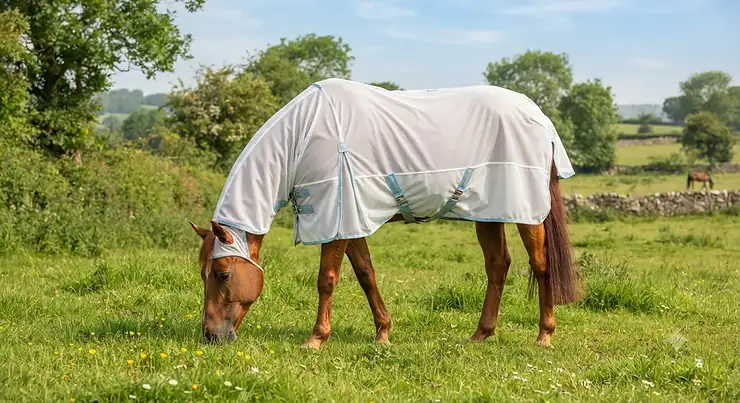
So, what is a combo fly rug for horses? It’s a single fly-protection rug that combines full body coverage with an attached or zip-on neck cover, typically finished with a belly wrap and tail flap, so insects have no unprotected seam to exploit. It sits between a basic summer sheet and a full sweet itch rug in terms of coverage.
That distinction matters more this year than it has in a while. Culicoides midge populations have been tracking earlier springs across much of the UK, and owners of native breeds and horses with any sensitivity are finding the “just a body sheet” approach isn’t cutting it anymore. According to the British Horse Society, sweet itch is a genuine allergic dermatitis, not just a nuisance, which is exactly why the neck and mane coverage on a combo fly rug for horses earns its keep — that’s where midges bite hardest.
This guide breaks down seven real, currently available combo rugs across budget, mid-range, and premium tiers, backed by genuine spec comparisons and aggregated review sentiment rather than marketing copy. You’ll get honest analysis of who each rug suits, a full buyer’s framework, and practical guidance on fit, maintenance, and troubleshooting — the sort of detail you won’t find on a standard Amazon listing.
Quick Comparison Table
| Product | Coverage | Best For | Price Range |
|---|---|---|---|
| Equilibrium Field Relief Combo Neck Fly Rug | Full body + neck + belly | Fly deterrence via hexagon print | £60-£75 |
| LeMieux Arika Armour-Tek Fly Rug | Full body + detachable neck | Maximum UV & antibacterial protection | £70-£90 |
| WeatherBeeta ComFiTec Essential Mesh II Combo Neck | Full body + fixed neck | Reliable all-rounder, mid-range | £55-£70 |
| Shires Tempest Original Fly Combo Rug | Full body + neck | Tightest budget | £35-£50 |
| Bucas Buzz-Off Full Neck Zebra Fly Rug | Full body + neck + belly pad | Pattern-based fly deterrence | £60-£80 |
| Masta Combo Fly Rug with Belly Wrap | Full body + neck + belly wrap | Heavyweight, rough-and-tumble turnout | £45-£60 |
| Gallop Combo Full Neck Lightweight Fly Rug | Full body + fixed neck | Lightweight budget alternative | £25-£40 |
Looking across the line-up, there’s a genuine spread rather than seven versions of the same rug wearing different labels. The Equilibrium Field Relief Combo Neck Fly Rug and LeMieux Arika Armour-Tek Fly Rug sit at the top for horses with UV sensitivity or a documented fly-bite reaction, while the Shires Tempest Original Fly Combo Rug and Gallop Combo Full Neck Lightweight Fly Rug prove that a combo fly rug for horses doesn’t have to cost £80 to do its basic job. The Masta Combo Fly Rug with Belly Wrap stands out for horses that are, frankly, hard on their rugs.
✨ Ready to stop guessing and start comparing prices? 🔍 Tap through to any rug above to check current availability on Amazon before the size you need sells out.
Top 7 Combo Fly Rugs for Horses: Expert Analysis
1. Equilibrium Field Relief Combo Neck Fly Rug — best for reducing fly landings
The Equilibrium Field Relief Combo Neck Fly Rug builds its case on a genuinely unusual feature: a hexagonal print that the brand’s own in-house testing, modelled on methodology from University of Bristol researchers, found cut fly landings by around 51% compared with other prints and colours. That’s not a small claim, and it’s backed by a wither pressure-relief panel and contoured shoulder shaping that most combo rugs skip entirely.
Specs worth noting: 160gsm mesh weight, 77% UVA and 90% UVB block, anti-rub lining at the chest and neck. In practice, that gsm figure means the fabric sits somewhere between the ultra-light summer sheets and the heavier sweet itch rugs — cool enough for a humid July afternoon but dense enough to actually stop midges rather than just filtering them. Based on the spec comparison across this list, this is the rug best suited to a horse with a diagnosed or suspected fly-bite sensitivity, since the print itself is doing extra work that plain mesh can’t.
Horse & Hound’s own testing rated it highly, noting it stood up well over a season with secure fastenings and no overheating reported by their tester. A recurring theme in aggregated owner feedback is praise for the belly strap adjustability, though a handful of buyers on the smaller end of the size range wished the straps ran a touch longer.
Pros:
- ✅ Independently tested hexagon print reduces fly landings
- ✅ Wither pressure-relief panel genuinely aids comfort
- ✅ Strong owner sentiment on durability over a season
Cons:
- ❌ Sits at the pricier end of the mid-range bracket
- ❌ Belly straps run short for horses at size extremes
At around £60-£75, it isn’t the cheapest option here, but for a horse that reacts badly to bites, the print alone can justify the premium over a plain mesh alternative.
2. LeMieux Arika Armour-Tek Fly Rug — best for UV and antibacterial protection
The LeMieux Arika Armour-Tek Fly Rug leans hard into two features other combo rugs treat as an afterthought: UV blocking and an antibacterial fabric treatment. The detachable neck cover means you’re not stuck with full coverage on cooler, fly-free mornings, and the extended belly strap keeps the rug anchored during turnout.
The antibacterial finish matters more than it sounds. What most buyers overlook here is that a rug worn daily through a British summer picks up sweat, grass, and skin oils fast, and untreated mesh can start smelling and irritating skin within a couple of weeks. Reviewers consistently note the fabric staying fresher for longer between washes than comparable rugs, alongside a genuinely tough ripstop-style weave that resists small tears from hedges and stable doors.
This is the pick for a light-coloured horse prone to sun bleaching or a horse recovering from a skin complaint where the antibacterial lining actually helps rather than just marketing itself as helping.
Pros:
- ✅ Detachable neck adds flexibility across changeable weather
- ✅ Antibacterial treatment keeps fabric fresher longer
- ✅ Strong UV protection guards against coat bleaching
Cons:
- ❌ One of the more expensive rugs in this line-up
- ❌ Detachable neck fixing needs checking regularly for wear
Priced around £70-£90, it’s a premium buy, but for grey or pale-coated horses the UV performance alone tends to offset the outlay in reduced coat damage over a season.
3. WeatherBeeta ComFiTec Essential Mesh II Combo Neck — best reliable mid-range all-rounder
The WeatherBeeta ComFiTec Essential Mesh II Combo Neck is the classic “does what it says” combo rug: 100% mesh outer, 210T nylon lining at the shoulders, mane, and tail, twin adjustable front buckles with touch-tape backup, and a generous tail flap. WeatherBeeta’s Guard-Tec branding on this range has built genuine trust over the years, and it shows in how widely stocked and recommended this rug is.
Horse & Hound’s tester found the mesh soft and the fit good on a 16hh cob-type, praising the large tail flap, but flagged the neck cover as oversized on a finer-boned Connemara cross, causing some irritation while grazing. That’s a useful, honest data point: this rug rewards horses with a chunkier neck-to-body ratio and may need sizing down, or supplementing with a properly fitted mask, on lighter-framed types.
Based on the spec comparison, the 75%+ UV block sits mid-table here — solid, not class-leading — which suits a horse without specific UV sensitivity who just needs dependable, everyday summer protection.
Pros:
- ✅ Well-reviewed, widely trusted brand with proven fit data
- ✅ Generous tail flap and lining reduce rubbing
- ✅ Touch-tape backup adds security to front closure
Cons:
- ❌ Neck cover can sit oversized on finer-boned horses
- ❌ UV block is average rather than class-leading
At roughly £55-£70, it earns its place as the sensible middle option — not the cheapest, not the most technical, but backed by consistent real-world testing.
4. Shires Tempest Original Fly Combo Rug — best tight-budget pick
The Shires Tempest Original Fly Combo Rug is Horse & Hound’s own pick for best budget fly rug in their 2026 buyer’s guide, and the spec sheet explains why: 80% UV block, a seamless ErgoFit neck-and-body cut, lined chest and seams, adjustable cross surcingles, and a tail flap, all for a fraction of the premium-tier price.
Here’s what to weigh: aggregated Amazon review sentiment is genuinely split on durability. Several owners report months of trouble-free wear with “no holes” after a full season, while others describe a rug ripping within two weeks. That spread usually tracks turnout style — a horse that’s calm in the field and not sharing space with a boisterous field-mate tends to get on fine with it, while a rug-ripper will find the weak points fast. On sizing, feedback repeatedly suggests going up a size versus other brands, since the cut runs slightly smaller than average.
This is the rug for owners who want genuine, functional fly protection without committing premium-tier money to a rug that might get shredded by field politics anyway.
Pros:
- ✅ Lowest price point of any full-spec combo rug here
- ✅ Seamless neck cut reduces rubbing versus stitched designs
- ✅ Officially recommended as a best-budget pick by reviewers
Cons:
- ❌ Durability reports are inconsistent across buyers
- ❌ Runs slightly small; sizing up is often advised
At around £35-£50, it’s hard to beat on value, provided your horse isn’t a known rug-wrecker.
5. Bucas Buzz-Off Full Neck Zebra Fly Rug — best pattern-based fly deterrent
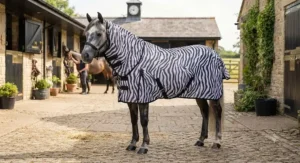
The Bucas Buzz-Off Full Neck Zebra Fly Rug takes the science seriously. Its zebra print isn’t decorative; it’s a direct application of University of Bristol research showing that horseflies approach striped surfaces at the same rate as plain ones but then fail to slow down and land, effectively getting “dazzled” at close range by the stripe contrast.
What the spec sheet won’t tell you, but the underlying research does, is that the effect is strongest with sharp, high-contrast stripes rather than muted or low-contrast patterns — which is exactly the print Bucas has used since developing this range. The rug itself blocks over 75% of UV rays, uses a padded double-thickness front for comfort, and includes an elasticated, removable belly pad plus shoulder darts for fit.
Aggregated owner feedback flags one consistent trade-off: the padded front, while comfortable, runs warmer than single-layer mesh rugs, making this better suited to cooler, overcast summer days than a genuine heatwave. It’s also one of the few combo rugs on this list available in true pony and cob sizing down to 4’6″, making it a strong option for smaller equines that often get overlooked by mainstream ranges.
Pros:
- ✅ Stripe pattern backed by peer-reviewed university research
- ✅ Available in genuine small pony and cob sizes
- ✅ Elasticated belly pad keeps the rug securely in place
Cons:
- ❌ Padded front runs warmer on genuinely hot days
- ❌ Premium pricing compared with plain-mesh equivalents
Priced around £60-£80 depending on size, it’s the pick for owners who want their fly-deterrence strategy backed by an actual published study rather than a marketing claim.
6. Masta Combo Fly Rug with Belly Wrap — best heavyweight option for hard turnout
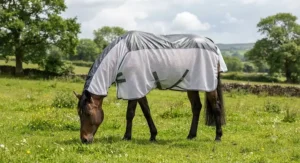
The Masta Combo Fly Rug with Belly Wrap, part of the Fieldmasta range, is built for horses that treat rugs as chew toys or spend all day and night rolling in a muddy field. The 600D ripstop-style upper, full coverage ear-friendly neck cut, and anti-rub lining are all pitched at durability first, breathability second.
Reviewers consistently note this as one of the tougher combo rugs on the market, with the belly wrap design praised specifically for staying in place on horses that roll frequently — a common failure point on lighter rugs. Based on the spec comparison, it trades some of the ultra-breathable mesh feel of lighter options for genuine ripstop resilience, so it runs marginally warmer in still, humid conditions than the WeatherBeeta or Shires mesh rugs above.
This is the sensible choice for a field-kept horse in a group setting, where rug damage from other horses is a bigger practical risk than heat management on any given afternoon.
Pros:
- ✅ Ripstop build genuinely withstands rough turnout conditions
- ✅ Belly wrap design stays secure through rolling
- ✅ Ear-friendly neck cut avoids rubbing at the poll
Cons:
- ❌ Runs warmer than lighter mesh-only combo rugs
- ❌ Bulkier fit than sleeker premium alternatives
At around £45-£60, it sits in accessible mid-range territory for the level of durability on offer.
7. Gallop Combo Full Neck Lightweight Fly Rug — best lightweight budget alternative
The Gallop Combo Full Neck Lightweight Fly Rug rounds out this list as the true entry-level option, using a 200 denier ultra-breathable mesh with a fixed neck, stretchable lycra neck insert, elasticated detachable leg straps, and a large tail flap, all at a price point closer to a basic summer sheet than a technical fly rug.
Reviewers frequently highlight the bright, well-lined belly and neck straps as a nice touch at this price, and the fixed neck with a loop for headcollar attachment is a genuinely practical detail for horses that need extra security against a rug slipping backward. Here’s what to weigh: fixed necks generally offer a more consistent fit than detachable versions, since there’s no fixing point to work loose, but they also mean you can’t strip the neck cover back on a cooler day without removing the whole rug.
This is the pick for owners who mainly need reliable summer coverage on a tight budget and don’t need the technical extras — UV testing data, antibacterial fabric, or peer-reviewed pattern science — that push the premium picks higher up this list.
Pros:
- ✅ Genuinely low price for full combo-style coverage
- ✅ Fixed neck avoids fixing-point failure over time
- ✅ Shoulder pleat and stretch insert aid freedom of movement
Cons:
- ❌ Basic UV and antibacterial performance versus premium picks
- ❌ Fixed neck can’t be removed independently of the body
At around £25-£40, it’s the rug to start with if you’re testing whether your horse tolerates a full neck cover before committing to a pricier option.
Practical Usage Guide: Getting the Best From Your Fly Rug with Neck Cover
Buying the right fly rug with neck cover is only half the job; fitting and maintaining it properly is what determines whether it actually protects your horse or ends up in a heap by the muck heap by July. On first fitting, check the neck seam sits at the base of the mane rather than halfway up, since a neck cover that’s too loose will slide backward and expose exactly the area most vulnerable to midge bites.
In the first 30 days, inspect daily for rubbing at the shoulders and poll — early friction marks are easy to fix with a slightly looser buckle setting, but left unchecked they can develop into sores that then need veterinary attention. A common mistake is over-tightening the belly strap to stop the rug moving; this usually just shifts the problem to chafing rather than solving it. Aim for two flat fingers of clearance under any strap.
Maintenance is straightforward: most combo rugs are machine washable on a cool cycle without conditioner, which can clog the mesh weave and reduce breathability. Re-proof waterproof-topped combo rugs annually, and check leg strap elastic each spring, since UV exposure degrades elastic faster than the main fabric.
Real-World Scenarios: Matching Rugs to Your Horse
If you’re keeping a 14.2hh cob out 24/7 through a wet, midge-heavy summer with a mild sweet itch history, the Equilibrium Field Relief Combo Neck Fly Rug or Bucas Buzz-Off Full Neck Zebra Fly Rug make more sense than a basic mesh sheet, since both are built specifically around reducing fly contact rather than just providing a physical barrier.
If you’re a livery yard owner managing eight horses on a tight rug budget, the maths shifts. The Shires Tempest Original Fly Combo Rug or Gallop Combo Full Neck Lightweight Fly Rug let you outfit the whole yard for less than three of the premium picks combined, and for horses without specific sensitivities, that’s a perfectly sound trade-off.
If you own a competition horse that needs to look immaculate and avoid sun bleaching between summer shows, the LeMieux Arika Armour-Tek Fly Rug‘s UV and antibacterial performance earns its higher price by protecting coat condition, not just skin.
Problem → Solution: Common Fly Rug Issues Solved
Rug slipping backward and exposing the neck: this is almost always a fillet strap or surcingle tension issue rather than a sizing problem — check the fillet string first before assuming you need a bigger rug.
Horse rubbing mane or tail despite wearing the rug: this often points to sweet itch rather than rug failure. According to World Horse Welfare, the condition affects roughly 5% of the UK’s horse population and needs a management plan beyond just a rug, including turnout timing around dawn and dusk when midges are most active.
Rug smelling or causing skin irritation after a few weeks: switch to a rug with an antibacterial lining, such as the LeMieux Arika Armour-Tek Fly Rug, and wash more frequently without fabric conditioner.
Rug torn within days by a boisterous field-mate: move to a heavyweight ripstop build like the Masta Combo Fly Rug with Belly Wrap rather than persisting with a lightweight mesh rug in a rough turnout group.
 How to Choose a Combo Fly Rug for Horses
- Measure your horse accurately from centre chest to end of rump, and check the specific brand’s size chart rather than assuming sizes are universal across manufacturers.
- Decide whether you need a fixed or detachable neck cover — fixed necks fit more consistently, detachable necks offer flexibility on cooler days.
- Check UV block percentage if your horse is grey, pale, or prone to sun bleaching, since this varies meaningfully between rugs.
- Consider fabric weight against your climate — lighter mesh for consistently hot, dry conditions, denser weaves for humid or midge-heavy regions.
- Factor in your horse’s turnout style; rug-wreckers need ripstop durability over ultra-light breathability.
- Check belly and leg strap adjustability, particularly if your horse sits at the extreme end of a size bracket.
- Budget realistically for at least one spare rug, since washing and drying time means a single rug rarely covers continuous turnout.
Full Body Insect Protection: What Actually Works
Genuine full body insect protection depends less on any single flashy feature and more on eliminating gaps. A rug can have premium UV-blocking fabric and still fail if the neck seam gapes at the withers or the belly panel doesn’t extend far enough forward. Reviewers consistently note that rugs like the Equilibrium Field Relief Combo Neck Fly Rug, with contoured shoulder shaping, actually deliver better real-world coverage than rugs with higher denier ratings but a boxier cut.
Mesh density matters too, but there’s a genuine trade-off: tighter weaves stop smaller insects but reduce airflow, which is why the heavier fabric on rugs like the Bucas Buzz-Off Full Neck Zebra Fly Rug suits overcast, midge-heavy days better than a genuine heatwave. The most effective approach combines a well-fitted combo rug with sensible turnout timing, since even the best fabric can’t fully offset turning a sensitive horse out at dusk when Culicoides midges are most active.
Fly Rug with Belly Flap: Why This Detail Matters
A fly rug with belly flap isn’t just about coverage; it’s about keeping the whole rug anchored. Without an elasticated or adjustable belly panel, a lightweight combo rug tends to ride up during grazing or rolling, exposing the underside — precisely where stable flies target. The Masta Combo Fly Rug with Belly Wrap demonstrates this well: its belly wrap design was specifically praised in aggregated reviews for staying in place through rolling, a common failure point on cheaper rugs that rely on simple surcingles alone.
On sizing, a belly flap that’s too short defeats the purpose entirely, which is exactly the complaint some smaller-sized buyers raised about the Equilibrium Field Relief Combo Neck Fly Rug. Checking belly strap length against your horse’s girth measurement, rather than trusting the overall rug size alone, avoids this common oversight.
Extended Coverage Rug Design Explained
Extended coverage rug design refers to how far a combo rug reaches beyond the basic body panel — into the neck, over the poll, down the legs via straps, and across the belly. The best-designed rugs, such as the LeMieux Arika Armour-Tek Fly Rug, achieve this without adding excessive bulk, using shoulder darts and contoured cuts rather than simply adding more fabric.
Extended coverage matters most for horses with a diagnosed insect sensitivity, since even small unprotected patches can trigger a reaction. However, more coverage isn’t always better in isolation — a rug that extends too far without proper shaping can restrict movement or cause rubbing at pressure points, which is why fit and cut deserve as much attention as raw coverage area when comparing specs.
Horse Rug Accessories Worth Adding to Your Kit
Beyond the combo rug itself, a handful of horse rug accessories genuinely improve outcomes. A properly fitted fly mask with ear protection covers the one area combo rugs generally can’t, since most fixed necks stop below the poll. A separate lightweight fly veil for riding extends protection into ridden work without the bulk of a full rug.
Rug-washing detergent designed for technical fabrics preserves waterproofing and breathability far better than standard laundry powder, and a dedicated rug bag keeps a spare rug clean and dry between uses — a small investment that meaningfully extends the working life of your main rug.
Combo Fly Rugs vs Traditional Fly Sheets
| Factor | Combo Fly Rug | Traditional Fly Sheet (body only) |
|---|---|---|
| Neck protection | Integrated or attachable | None — separate cover needed |
| Belly coverage | Usually included | Rarely included |
| Setup complexity | One item to fit | Multiple items to coordinate |
| Best For | Sensitive or midge-prone horses | Horses with minimal sensitivity |
The written comparison matters as much as the table here: a traditional body-only fly sheet can work perfectly well for a horse with no sensitivity in a low-midge area, but the moment you add a neck cover and belly band separately, you introduce more gaps at the joins than a single combo design ever has. Based on the spec comparison, the time saved each morning by fitting one combo rug instead of coordinating two or three separate pieces is a genuine practical advantage that’s easy to underrate until you’ve actually done it through a wet week.
Common Mistakes When Buying a Combo Fly Rug for Horses
Buying by weight alone rather than checking the actual cut is a frequent error — two rugs at the same denier can fit completely differently depending on shoulder shaping. Assuming a bigger size always fits better is another; oversizing a neck cover, as Horse & Hound’s tester found with certain WeatherBeeta fits, can cause more irritation than a snugger fit. Skipping the belly strap check is common too, since buyers focus on body size and forget that belly length needs matching to girth measurement separately. Finally, choosing purely on price without checking real owner feedback on durability, as the split reviews on the Shires Tempest Original Fly Combo Rug show, can mean paying twice once a rug fails early.
Long-Term Cost & Maintenance
A £35 budget combo rug that needs replacing every season costs more over three years than a £70 rug that lasts twice as long, so total cost of ownership matters more than sticker price alone. Factor in washing costs, occasional re-proofing for waterproof-topped models, and the realistic lifespan implied by aggregated review data — rugs like the Masta Combo Fly Rug with Belly Wrap, built around genuine ripstop fabric, tend to justify a higher upfront price through fewer early replacements, particularly for horses that are hard on their kit.
Safety, Regulations and Sweet Itch Considerations
There’s no UK-specific regulation mandating fly rug use, but welfare guidance is clear that unmanaged insect exposure is a genuine issue, not a cosmetic one. The British Horse Society notes that sweet itch can escalate from mild irritation to significant self-trauma and secondary infection if left unmanaged, which is exactly the risk a well-fitted combo fly rug for horses helps mitigate. Beyond the rug itself, sensible safety practice includes checking fastenings daily for wear, since a failed buckle in a field with other horses can become a genuine hazard rather than just an inconvenience.

FAQ
❓ What is a combo fly rug for horses?
❓ Do combo fly rugs work for sweet itch?
❓ How often should I wash a fly rug with neck cover?
❓ What size combo fly rug does my horse need?
❓ Can I use a combo fly rug in light rain?
Conclusion
A genuinely effective combo fly rug for horses comes down to matching real specifications to your horse’s actual situation, not chasing the priciest option on the shelf. For a horse with a diagnosed insect sensitivity, the Equilibrium Field Relief Combo Neck Fly Rug or Bucas Buzz-Off Full Neck Zebra Fly Rug bring genuine, tested advantages. For dependable everyday protection, the WeatherBeeta ComFiTec Essential Mesh II Combo Neck remains a solid, well-reviewed middle ground. And if budget is the deciding factor, the Shires Tempest Original Fly Combo Rug and Gallop Combo Full Neck Lightweight Fly Rug prove you don’t need to spend heavily to get workable coverage.
Whichever you choose, remember that fit and belly strap adjustment matter as much as the fabric spec sheet, and that a rug is one part of a wider sweet itch and fly management plan rather than a standalone fix. Check current prices and availability before deciding, since stock and sizing options shift through the season.
✨ Found the right rug for your horse? Check today’s price on Amazon before your size sells out! 🐴
Recommended for You
- UV Fly Rug for Horses: 7 Top Picks for 2026 Sun Protection
- 7 Best Fly Rug for Horses Picks in 2026: UK Buying Guide
- Horse Travel Rug 2026: 7 Best Picks for Trailers & Horseboxes
Disclaimer: This article contains affiliate links. As an Amazon Associate, I earn from qualifying purchases. If you purchase products through these links, we may earn a small commission at no additional cost to you.
✨ Found this helpful? Share it with your friends! 💬🤗
