In This Article
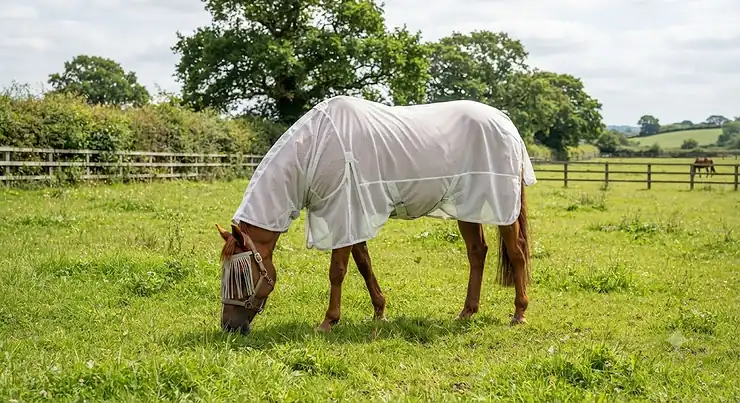
Somewhere out in a sun-baked paddock right now, a pink-nosed cob is standing nose-first into a hedge, doing his best impression of an ostrich. He’s not being dramatic. He’s burning. A uv fly rug for horses is, at its core, a mesh or woven turnout sheet treated or constructed to block a percentage of ultraviolet radiation while also keeping biting insects off the skin — think of it as sun cream and a fly net rolled into one garment. For horses with pink skin, thin coats, or a habit of standing in full sun from May to September, that combination isn’t a luxury. It’s closer to a medical necessity, and the British weather’s odd habit of delivering a scorching week sandwiched between two grey ones makes the decision about when to rug up genuinely tricky.
This guide cuts through the marketing fluff that clutters most fly rug listings. We’ve dug into real specifications, aggregated genuine reviewer sentiment, and cross-referenced veterinary guidance from the British Horse Society’s hot weather advice to bring you seven genuinely different rugs — not seven versions of the same white mesh sheet with different logos stitched on. Whether you’re chasing a fly rug with uv protection for a nervous grey mare, hunting a sun protection rug for horses who’s already showing the tell-tale orange tinge of coat bleaching, or simply trying to work out what “UPF 50+” actually means on a swing tag, you’ll find the honest answer below. Prices throughout are given as ranges rather than exact figures, since Amazon and independent retailers both adjust pricing constantly — always check current price at checkout.
Quick Comparison Table
For readers in a hurry, here’s the snapshot before we go deep. Each of these seven earns its place for a different reason — some for raw UV numbers, some for durability, one specifically for ponies.
| Product | Best For | UV Protection | Price Range |
|---|---|---|---|
| LeMieux Arika Armour-Tek | Overall premium pick | 85% | £95-£125 |
| Weatherbeeta ComFiTec Hexi Shield Combo Neck | Rug-rippers & durability | 77% UVA / 90% UVB | £110-£140 |
| Equilibrium Field Relief | Fly-shy, insect-sensitive horses | Reflective mesh | £70-£95 |
| Masta Fieldmasta Combo Fly Rug | Broad-chested, mid-range value | UPF 50+ (98% block) | £55-£75 |
| Leberna Miniature Fly Rug Combo | Shetlands, ponies & donkeys | Standard UV mesh | £20-£35 |
Look at that spread and a pattern jumps out immediately: the highest lab-tested UV numbers (the Masta Fieldmasta’s UPF 50+, blocking upwards of 98%) don’t automatically sit at the top of the price ladder — they sit in the middle. What you’re actually paying the premium for with the LeMieux is closer-fitting mesh, antibacterial treatment, and a more sophisticated closure system, not necessarily a bigger UV number. Meanwhile, budget doesn’t have to mean “no protection at all,” as the Leberna pony option proves.
💬 Already narrowing down your shortlist? Scroll to your horse’s size and skin type below — the right rug is rarely the most expensive one on the page.
Top 7 UV Fly Rugs for Horses: Expert Analysis
Before the individual write-ups, here’s how all seven stack up side by side on the numbers that actually matter for a buying decision.
| Product | Neck Style | UV Rating | Key Feature | Price Range | Best For |
|---|---|---|---|---|---|
| LeMieux Arika Armour-Tek | Detachable | 85% | Antibacterial micro mesh | £95-£125 | Sensitive-skinned, competition yards |
| Weatherbeeta ComFiTec Hexi Shield Combo Neck | Fixed | 77-90% | Snag-resistant hexagon weave | £110-£140 | Turnout with fencing/hedges |
| Equilibrium Field Relief | Fixed | Reflective mesh | Fewer fly landings | £70-£95 | Insect-reactive, sweet-itch-prone |
| Masta Fieldmasta Combo Fly Rug | Fixed | UPF 50+ | Dual-fabric top-line panel | £55-£75 | Broad-chested, all-round use |
| Masta Flymasta UV Protection Fly Rug | Detachable | UV-treated | Lycra wither, reflective badge | £45-£65 | Everyday summer turnout |
| Shires Tempest Original Combo | Fixed | UV-reflective | Built-in neck, budget entry | £35-£50 | First-time buyers, tight budgets |
| Leberna Miniature Fly Rug Combo | Combo | Standard UV mesh | Shetland/pony/donkey sizing | £20-£35 | Small breeds and native ponies |
Reading across this table, the real story is fit-for-purpose rather than a single “best” rug. The LeMieux Arika Armour-Tek and Weatherbeeta ComFiTec Hexi Shield Combo Neck both justify their higher price brackets through construction quality rather than UV numbers alone, while the Masta Fieldmasta Combo Fly Rug quietly delivers the highest lab-verified UV block in this entire line-up for roughly half the premium-tier price. If you own a Shetland or a miniature, note that most “one-size-fits-all” marketing photography on Amazon features a 16hh warmblood — the Leberna Miniature Fly Rug Combo exists precisely because pony proportions genuinely need their own pattern block, not a scaled-down horse rug.
💬 Just one click — help others make better buying decisions too! 😊
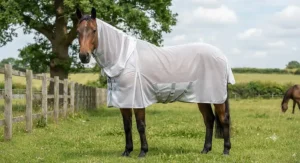
1. LeMieux Arika Armour-Tek — highest lab-verified UV block in this line-up
The standout here is the 85% UV protection rating, which puts the LeMieux Arika Armour-Tek near the top of what’s commercially available in a breathable mesh fly rug rather than a heavy waterproof turnout. The micro mesh fabric is genuinely fine-gauge, giving what LeMieux describe as a “second skin” fit that also happens to make it much harder for biting flies to reach the skin underneath. Layered onto that is an antibacterial treatment, a patented two-part hemline skirt that flexes with the horse’s natural stride, and the brand’s signature 45-degree T-bar front closure, which spreads pressure across the chest rather than concentrating it at one point — a detail that matters enormously if your horse has ever rubbed a fly rug raw at the shoulder. Based on the spec comparison against the rest of this list, this is the rug built for horses whose owners have already tried a budget option and been disappointed by early rubbing or premature UV fade.
Reviewers consistently report that the fit is noticeably closer than mesh rugs from other brands, though several note it runs slightly generous and recommend sizing down, echoing what several UK retailers advise for the wider Arika range. A recurring theme in aggregated feedback is that the detachable neck genuinely detaches cleanly without wrestling — a small thing that saves real frustration on a hot morning.
Pros:
- ✅ Highest verified UV block (85%) in this comparison
- ✅ Antibacterial micro mesh limits skin irritation
- ✅ Pressure-distributing T-bar closure reduces rubbing
Cons:
- ❌ Sits at the top of the price bracket for this category
- ❌ Sizing runs generous — going down a size is often needed
At around £95-£125 depending on retailer and size, the LeMieux Arika Armour-Tek earns its premium tag through construction rather than gimmicks, making it the strongest all-round pick if UV protection and shoulder comfort both matter to you.
2. Weatherbeeta ComFiTec Hexi Shield Combo Neck — built to survive the horse who destroys everything
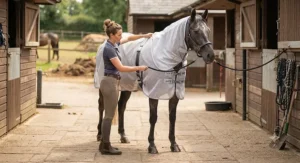
What most buyers overlook about this model is that its standout hexagon-weave mesh wasn’t chosen for looks — it’s a snag-resistant construction specifically engineered to resist tearing on gate latches, fence wire, and the general chaos of a busy field. UV protection sits at 77% UVA and 90% UVB, figures that place it comfortably mid-table for raw sun-blocking power, but the rug compensates with genuinely tough hardware: a memory foam wither pad, shoulder gussets, and a full wrap tail flap designed for horses who spend serious hours out at grass rather than popping out for an afternoon. On paper this means it’s less about squeezing out the last percentage point of UV block and more about a rug that’s still intact in September.
Reviewers consistently note that this is the rug of choice for owners who’ve previously gone through two or three cheaper fly rugs a season due to tearing, and the reflective heat properties get repeated praise for keeping horses visibly cooler on bright days. A common complaint in user reviews is that the fixed-neck design (rather than fully detachable) makes washing slightly more awkward than rivals.
Pros:
- ✅ Snag-resistant hexagon weave built for rough turnout
- ✅ Memory foam wither pad prevents pressure rubbing
- ✅ Strong 77-90% UVA/UVB protection combination
Cons:
- ❌ Fixed neck design is less convenient to wash
- ❌ Among the pricier options in this seven
Priced around £110-£140, the Weatherbeeta ComFiTec Hexi Shield Combo Neck is the one to buy if your horse treats fly rugs as a personal challenge to destroy.
3. Equilibrium Field Relief — best for horses who genuinely hate flies
The standout advantage of the Equilibrium Field Relief is its distinctive patterned mesh, developed following field trials that reportedly recorded roughly half the fly landings of plain or brightly coloured rugs — a detail that matters far more than it sounds for horses who stamp, kick, and work themselves into a lather at the first buzz of a horsefly. Here’s what to weigh: the fabric is genuinely lightweight and breathable, described repeatedly as staying cool even through humid British summer afternoons, and it dries quickly after a shower, which matters given how often “dry” and “British summer” don’t belong in the same sentence. UV protection comes from a reflective mesh construction rather than a headline percentage figure, so buyers chasing a specific UPF number for veterinary reasons should compare directly against the Masta Fieldmasta below.
Reviewers consistently describe this as the rug that finally calmed down an insect-reactive horse, with several long-term owners noting it launders well without losing shape after a full season of weekly washes. A recurring theme in feedback is that colour options are more limited than some rivals, and stock of specific sizes can run low mid-summer when demand peaks.
Pros:
- ✅ Pattern shown to reduce fly landings substantially
- ✅ Lightweight, quick-drying, breathable mesh
- ✅ Holds shape well after repeated washing
Cons:
- ❌ Limited colour choice compared with rivals
- ❌ Popular sizes can sell out during peak summer
At roughly £70-£95, the Equilibrium Field Relief is the pick for insect-reactive horses first and sun-sensitive horses second — though it still delivers useful UV coverage along the way.
4. Masta Fieldmasta Combo Fly Rug — the UV number-crunchers’ favourite
Here’s a spec worth pausing on: the Masta Fieldmasta Combo Fly Rug‘s fabric is lab-tested to EN13758-1:2002+A1:2006 with a UPF rating of 50+, blocking more than 98% of UV radiation — genuinely the highest verified figure in this entire round-up, premium rugs included. What most buyers overlook about this model is that it achieves that number through a clever two-fabric build: heavyweight close-weave mesh at the sides for airflow and insect protection, with tighter-woven polyester specifically over the top-line, where sun exposure is heaviest and where coat bleaching typically starts first. A large tri-vent shoulder gusset lets the horse move freely without the rug pulling or rubbing across the point of shoulder, which the brand pitches specifically at broader-chested, heavier-boned types who often struggle with off-the-peg fits.
Aggregated reviewer sentiment consistently praises the UV performance specifically, with several owners of previously sunburnt or photosensitive horses reporting visibly less nose and muzzle damage after switching. A common complaint is that the anti-rub lining, while effective, promotes a slightly “waxy” coat feel some owners find unusual at first.
Pros:
- ✅ Lab-verified UPF 50+, blocking over 98% of UV
- ✅ Dual-fabric build targets the sun-exposed top-line
- ✅ Roomy gusset suits broad-chested horse types
Cons:
- ❌ Anti-rub lining feels unusual to some on first use
- ❌ Fixed neck limits customisation versus detachable rivals
At around £55-£75, the Masta Fieldmasta Combo Fly Rug offers the strongest pure UV science on this list for a genuinely mid-range price.
5. Masta Flymasta UV Protection Fly Rug — everyday sun cover without the premium price tag
The standout feature on the Masta Flymasta UV Protection Fly Rug is its specially treated fabric aimed squarely at everyday UV defence rather than chasing a headline lab percentage, paired with a lycra wither panel that lets the neck section stay put while the horse grazes — a small design touch that solves the constant “rug’s slipped back again” problem owners of grazing-obsessed horses know well. Reinforced ripstop panels sit at the chest and neck specifically to survive fence and wall snags, and fleece-bound ear holes are a thoughtful detail on the detachable neck piece that reduces rubbing around a genuinely sensitive area.
Reviewers consistently note that this rug runs generously sized — Masta themselves recommend sizing down — and that it holds up well through a full season of daily wear, with the reflective badge helping with visibility in low light. A recurring theme in feedback is that, while breathable, it isn’t the coolest option here on the very hottest days, making it better suited to typical UK summer heat than a genuine heatwave.
Pros:
- ✅ Lycra wither panel keeps neck cover in place while grazing
- ✅ Reinforced ripstop chest and neck panels resist snagging
- ✅ Strong value for genuinely daily, all-season wear
Cons:
- ❌ Runs generously large — sizing down is usually needed
- ❌ Less breathable than mesh-first rivals in peak heat
Sitting around £45-£65, the Masta Flymasta UV Protection Fly Rug is the sensible everyday choice for owners who want reliable sun cover without stretching to premium pricing.
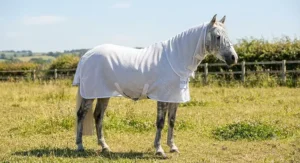
6. Shires Tempest Original Combo — the honest budget entry point
There’s no pretending the Shires Tempest Original Combo competes on lab-tested UV percentages with the Masta Fieldmasta above — it doesn’t, and its own marketing leans on “UV-reflective properties” rather than a specific verified figure. What it does deliver, honestly, is a built-in neck cover as standard (rather than a costly detachable add-on), UV-reflective fabric that genuinely helps keep a horse cooler than an unprotected coat, and a construction that’s held up well enough in independent buyer’s guides to be repeatedly named a top budget pick. Based on the spec comparison, this is the rug for owners who need something today, on a tight budget, rather than the rug for a horse recovering from photosensitisation or genuine sunburn.
Aggregated review sentiment is consistently positive for the price point specifically, with owners noting it’s “good enough” for a first fly rug or a spare for muddy days when the good rug is in the wash. A common complaint is that the fixed neck and simpler surcingle fastenings feel noticeably less premium than pricier rivals, and colour fastness fades a touch faster under constant sun.
Pros:
- ✅ Built-in neck cover included as standard, not an add-on
- ✅ Genuinely affordable entry point into UV-reflective rugs
- ✅ Repeatedly named a top budget pick in independent guides
Cons:
- ❌ No specific lab-tested UV percentage published
- ❌ Colour fastness fades faster than premium alternatives
At roughly £35-£50, the Shires Tempest Original Combo is the rug to start with if you’re testing whether your horse will even tolerate a fly rug before investing further.
7. Leberna Miniature Fly Rug Combo — finally, a rug built for pony proportions
The standout advantage here is simply fit: the Leberna Miniature Fly Rug Combo is patterned specifically for Shetlands, donkeys, Section A ponies, and miniature horses, rather than being a scaled-down draft of a full-size rug that leaves a stumpy, gaping neck seam. Key specs include a soft mesh body with UV and insect protection, a detachable neck cover, and belly wrap coverage sized to actually reach a pony’s rounder barrel — a fitting problem that plagues native breed owners trying to squeeze a cob-sized rug onto a 11hh pony. What most buyers overlook about pony rugs generally is that smaller, native-type animals are frequently just as sun-sensitive as their full-size cousins, particularly piebald and skewbald ponies with large patches of pink skin, so treating a pony’s sun protection as an afterthought is a genuine oversight.
Reviewers consistently describe this as a rare “actually fits” option among affordable pony fly rugs, with several noting it’s held up well through a summer of paddock life despite the modest price. A recurring theme is that colour and pattern choice is more limited than adult-horse ranges, and very tiny miniatures at the bottom of the size chart may still need minor strap adjustment.
Pros:
- ✅ Genuinely pony-proportioned fit, not a scaled-down horse rug
- ✅ Detachable neck and belly wrap included
- ✅ Strong value for native breed and miniature owners
Cons:
- ❌ Limited colour and pattern range versus adult rugs
- ❌ Very small miniatures may need extra strap adjustment
At around £20-£35, the Leberna Miniature Fly Rug Combo fills a genuine gap for pony and donkey owners who’ve struggled to find proper UV coverage in native sizing.
Setting Up and Caring for Your UV Fly Rug
Getting a new fly rug right in the first 30 days prevents most of the problems owners report later. Start by fitting it on a still day — wind flapping mesh spooks even settled horses on a first wear, and a bad first impression can make a horse rug-shy for months. Check that the wither and shoulder sit flush without pinching, and that the tail flap sits over rather than under the dock. Introduce it in short stints of two to three hours before leaving it on for a full day or overnight, watching carefully for rub marks at the shoulder, chest, and inside the back legs during that settling-in period.
Maintenance is where most rugs live or die early. Brush off dried mud and hair daily rather than letting it bake into the mesh, since compacted debris is what actually breaks down UV-treated fabric fastest — not the sun itself. Most manufacturers, including Masta, recommend spot-cleaning with a warm soapy cloth rather than repeated full machine washes, since over-washing strips both the UV treatment and the colour that helps with fly deterrence. A common first-30-days mistake is over-tightening the belly wrap “to be safe,” which restricts movement and causes rubbing far more often than a properly loose fit ever would.
✨ Ready to gear up for summer? Check current prices on your shortlisted rug before stock runs low.
Real-World Scenarios: Which Rug Suits Your Horse
Picture three very different yards on the same sunny June morning. First, there’s the grey cob living out 24/7 on a livery yard with minimal shelter and a habit of standing nose-first in full sun — pink skin, thin mane, prone to nose and muzzle burn every year without fail. For this horse, the UV percentage matters more than anything else, making the Masta Fieldmasta Combo Fly Rug or LeMieux Arika Armour-Tek the sensible starting points, both offering lab-backed or independently rated high UV blocks.
Second, there’s the fly-phobic cob at a busy competition yard who kicks and stamps himself into a lather at the first buzz of an insect, working himself hotter and sweatier than the actual weather justifies. Here, insect deterrence outranks raw UV numbers, which is exactly the case the Equilibrium Field Relief was built for, with its documented reduction in fly landings taking priority over chasing an extra five percentage points of sun protection.
Third, picture the 11hh Shetland at a family smallholding, turned out with minimal shelter, budget tight, and every “one size” rug on the market clearly designed for a horse three times his size. That’s precisely the gap the Leberna Miniature Fly Rug Combo exists to fill — proper native pony proportions at a genuinely accessible price, rather than a compromise fit that gaps at the neck and drags at the belly.
Common Sun and Fly Problems, Solved
Problem: coat bleaching along the topline every summer. This happens when UV radiation breaks down the pigment in hair shafts, most visibly on chestnuts, bays, and darker coats where bleaching shows up as an orange or rusty tinge. The solution is UV-blocking fabric specifically over the top-line — the Masta Fieldmasta Combo Fly Rug‘s dual-fabric design targets exactly this zone, while consistent daily wear during peak UV months (rather than occasional use) is what actually prevents the fade, since a rug left in the tack room on the sunniest days does nothing.
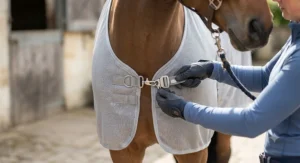
Problem: rubbing at the shoulder and chest. This is almost always a fit issue rather than a fabric one. Check that surcingles cross correctly at the belly and that the front closure sits flat rather than bunching; the LeMieux Arika Armour-Tek‘s angled T-bar closure was specifically engineered to spread this pressure.
Problem: rug tears within weeks on a busy field. Fine mesh fabrics are genuinely more fragile around fence lines, gates, and boisterous field companions. Snag-resistant hexagon-weave constructions like the Weatherbeeta ComFiTec Hexi Shield Combo Neck exist specifically for this scenario.
Problem: horse overheats in the rug on genuinely hot days. Charity guidance on hot weather horse care notes that some fly rugs can contribute to overheating in extreme heat, particularly heavier styles, and recommends reassessing rug use altogether during genuine heatwaves rather than assuming more coverage is always better.
Problem: photosensitivity symptoms mistaken for simple sunburn. Blistering, oozing, or crusting on white or pink skin can indicate true photosensitisation rather than ordinary sun exposure, and this warrants veterinary attention rather than just a heavier rug — see the safety section below.
How to Choose a UV Fly Rug for Horses
Choosing the right fly rug with uv protection comes down to seven practical criteria, best worked through in this order:
- Assess your horse’s actual risk first. Pink skin, white markings, thin coats, and clipped areas all raise sunburn risk considerably more than a solid-coloured, thick-coated cob.
- Decide whether UV percentage or insect deterrence matters more. A horse who’s never bothered by flies but burns easily needs a different rug to one who’s insect-reactive but rarely sunburnt.
- Measure properly, not by guesswork. Nose to tail along the body’s natural curve, and compare against the specific brand’s size chart rather than assuming sizing is universal across manufacturers.
- Check neck cover style. Detachable necks add flexibility for changeable weather; fixed necks are typically more durable but harder to wash separately.
- Weigh durability against your turnout conditions. A quiet paddock with no other horses needs less snag-resistance than a busy mixed-sex field with fencing and hedges.
- Factor in genuine budget, not just sticker price. A £35 rug replaced twice a season can cost more over three years than one £110 rug that lasts.
- Confirm return and sizing policies before buying. Reviewers across every brand in this guide mention sizing running generous or snug — a flexible returns policy removes most of that risk.
Sun-Sensitive Horse Breeds: Why Some Horses Need More Protection
Not every horse faces equal sunburn risk, and understanding why matters more than most buying guides admit. Paints, Appaloosas, and any piebald or skewbald horse with extensive pink, unpigmented skin are particularly vulnerable, since that skin lacks the natural melanin protection that darker-pigmented areas provide. Thoroughbreds and other thin-coated breeds face a related but distinct risk — less hair coverage means UV rays reach the skin more directly, even where pigmentation itself is normal. Greys deserve a specific mention too, since their muzzles and eye areas often lose pigment with age, becoming progressively more sun-sensitive year on year rather than staying constant.
It’s worth separating ordinary sunburn from photosensitisation, a genuinely different and more serious condition. As the Met Office’s UV and sun health guidance explains for the human equivalent, UV radiation intensity varies significantly by time of day and season even under cloud cover — a factor that catches many horse owners out during the “it’s not even that sunny” days of a British spring. In horses specifically, photosensitisation occurs when photodynamic compounds — sometimes from certain pasture plants, sometimes from liver dysfunction — react with UV light on non-pigmented skin, causing a reaction far more severe than typical sunburn. Blue Cross’s summer horse care advice specifically flags unpigmented, white, and pink skin areas like the muzzle as needing daily protective attention through the sunniest months. If you own a genuinely sun-sensitive breed or individual, a UV fly rug isn’t an optional accessory — it’s a core part of annual welfare planning, alongside shade provision and, where advised, veterinary-approved sun cream on exposed pink areas.
Fly Rug With UV Protection vs Standard Fly Sheet
It’s tempting to assume any mesh sheet marketed as a “fly rug” offers meaningful sun protection, but that’s not automatically true. A standard fly sheet is engineered primarily as a barrier against biting insects — its mesh density is optimised to stop flies landing and midges reaching the skin, with sun protection, if present at all, an incidental side effect of the fabric simply existing between horse and sky. A genuine fly rug with uv protection, by contrast, uses fabric specifically treated or woven to block a stated, and ideally lab-tested, percentage of UV radiation, as seen with the Masta Fieldmasta’s EN13758-1 certification in this guide.
| Feature | Standard Fly Sheet | UV-Rated Fly Rug |
|---|---|---|
| Primary purpose | Insect barrier | Insect barrier + UV block |
| UV testing | Rarely stated | Often lab-certified (e.g. UPF 50+) |
| Coat bleaching prevention | Minimal, incidental | Directly targeted |
| Typical price range | £20-£45 | £45-£125 |
The practical upshot: if your only concern is flies and your horse is dark-coated, fully pigmented, and thick-haired, a basic fly sheet may genuinely suffice. But for pink-skinned, thin-coated, or previously sunburnt horses, paying the extra for a verified UV rating — as the Masta Fieldmasta Combo Fly Rug and LeMieux Arika Armour-Tek both offer — is the difference between a rug that happens to block some sun and one engineered to do it deliberately.
Coat Bleaching Prevention: What Actually Works
Coat bleaching is essentially cosmetic UV damage to the hair shaft’s pigment, and it’s most visible on bay, chestnut, and black coats, where a healthy dark coat gradually turns rusty orange or dull brown across the topline and quarters through a full summer of unprotected exposure. What most buyers overlook is that prevention is almost entirely about consistency rather than fabric quality alone — a top-tier UV rug worn only on the sunniest afternoons prevents far less bleaching than a modest one worn daily throughout the season, simply because cumulative UV exposure is what causes the damage.
Reviewers across several of the rugs in this guide, particularly the Masta Fieldmasta Combo Fly Rug with its topline-targeted fabric panel, report visibly reduced bleaching compared with previous summers once daily wear became the routine rather than the exception. Diet plays a supporting role too — a balanced coat supplement with adequate biotin and omega oils can help hair resilience generally, though it’s not a substitute for physical UV blocking. The honest takeaway: no fabric, however well-rated, prevents bleaching if it stays folded in the tack room during the two weeks of proper sunshine the UK usually gets.
UV Rated Horse Fabric Explained: What the Numbers Actually Mean
Marketing copy throws around UPF ratings and UV percentages fairly loosely, so it’s worth being precise. UPF, or Ultraviolet Protection Factor, measures how much UV radiation passes through a fabric — UPF 50 means roughly 1/50th of UV rays get through, translating to the “blocks 98%” figure Masta cite for their Fieldmasta range, and it’s tested to a recognised standard (EN13758-1:2002+A1:2006 in the Masta case) rather than simply asserted. A rug quoting “85% UV protection,” as with the LeMieux Arika, is describing the same underlying concept using a slightly different convention, so direct percentage comparisons between brands using different measurement conventions should be treated with some caution rather than taken as gospel.
Features that actually matter: independently stated UV percentages or UPF ratings backed by a named testing standard, fabric density (finer, tighter weaves generally block more UV), and colour — darker or more saturated dyes typically absorb more UV than pale, washed-out tones, which is part of why some manufacturers favour navy or charcoal fly rugs over white. Features that matter considerably less than the marketing suggests: vague claims like “sun protective properties” with no percentage or standard attached, which tells a buyer almost nothing verifiable, and elaborate pattern claims without any independent testing behind them.
Common Mistakes When Buying a Sun Protection Rug for Horses
The most frequent mistake is buying purely on price without checking whether the horse in question actually needs strong UV protection at all — a thick-coated, fully pigmented cob doesn’t need the same investment as a pink-skinned Paint. A close second is ignoring the neck and belly coverage entirely, focusing purely on the body panel, when unpigmented noses, eyelids, and white leg markings are frequently where sunburn and photosensitisation actually start. Sizing is another recurring pitfall — several rugs in this guide, including the Masta Flymasta and LeMieux Arika, run generously large, and buying “true to horse height” without checking brand-specific size charts leads to a gaping, ineffective fit. Finally, many owners simply stop wearing the rug once the initial sunny spell passes, forgetting that UV exposure remains meaningfully high even under British cloud cover well into September. One last mistake worth flagging: assuming any sun-related skin reaction is “just sunburn.” As the MSD Veterinary Manual’s guidance on photosensitization explains, this condition can look similar to sunburn but stems from photodynamic compounds reacting with UV light in the skin, and it warrants a vet’s opinion rather than simply reaching for a heavier rug.
Long-Term Cost & Maintenance: Is a UV Fly Rug Worth It?
Looking at total cost of ownership rather than sticker price alone tells a different story than the price ranges above suggest on their own.
| Rug | Price Range | Typical Lifespan | Approx. Cost Per Season |
|---|---|---|---|
| Shires Tempest Original Combo | £35-£50 | 1-2 seasons | £25-£40 |
| Masta Fieldmasta Combo Fly Rug | £55-£75 | 2-3 seasons | £22-£30 |
| LeMieux Arika Armour-Tek | £95-£125 | 3-5 seasons | £22-£35 |
Once lifespan enters the equation, the apparent gap between budget and premium rugs narrows considerably — the LeMieux Arika Armour-Tek, despite the highest upfront cost, often works out cheaper per season than a budget rug replaced annually due to torn mesh or faded UV treatment. Maintenance costs stay modest across the board provided owners follow spot-cleaning guidance rather than aggressive machine washing, which is the single factor most likely to shorten any fly rug’s working life regardless of brand.
FAQ
❓ What percentage UV protection should a fly rug for horses have?
❓ Can a fly rug prevent coat bleaching completely?
❓ Do grey horses need more sun protection than other colours?
❓ Is a UV fly rug the same as a sweet itch rug?
❓ How often should I wash a UV-treated fly rug?
Conclusion
Choosing the right uv fly rug for horses ultimately comes down to matching real risk to real fabric performance, not chasing whichever product has the flashiest listing photos. If sunburn and coat bleaching are your genuine concern, the lab-verified numbers on the Masta Fieldmasta Combo Fly Rug or the construction quality of the LeMieux Arika Armour-Tek should sit at the top of your shortlist. If insect deterrence matters more for a fly-reactive horse, the Equilibrium Field Relief earns its place instead. Owners on a genuinely tight budget shouldn’t feel they’re compromising on welfare by starting with the Shires Tempest Original Combo, and pony or Shetland owners finally have a properly fitted option in the Leberna Miniature Fly Rug Combo rather than an awkward scaled-down compromise.
Whichever you choose, remember that consistency of wear through the sunniest months matters as much as the fabric’s UV rating itself — a brilliant rug left in the tack room protects nobody. Check current prices, confirm sizing against the specific brand’s chart, and give your horse a settling-in period before leaving any new rug on for a full day unsupervised.
✨ Don’t Miss These Exclusive Deals!
🔍 Take your horse’s summer wardrobe to the next level with these carefully selected fly rugs. Click on any highlighted product to check current pricing and availability. The right rug helps protect the coat and comfort your horse deserves all season long!
Recommended for You
- 7 Best Fly Rug for Horses Picks in 2026: UK Buying Guide
- Horse Travel Rug 2026: 7 Best Picks for Trailers & Horseboxes
- Wicking Cooler Rug for Horses: 7 Proven Picks for 2026
Disclaimer: This article contains affiliate links. As an Amazon Associate, I earn from qualifying purchases. If you purchase products through these links, we may earn a small commission at no additional cost to you.
✨ Found this helpful? Share it with your friends! 💬🤗
