In This Article
Let’s be honest: nobody gets into dressage for the tack shopping. And yet here you are, staring down a saddle rack that looks like a jumble sale of white, navy and diamanté-studded cloths, all promising to be “the one.” Finding a decent dressage saddle pad under £40 shouldn’t feel like defusing a bomb, but the market makes it harder than it needs to be — cheap pads that bunch under the saddle, “budget” ranges that creep past £45 the second you add a size, and marketing copy that tells you everything except whether the thing will actually sit flat on a 16.2hh warmbood’s back.
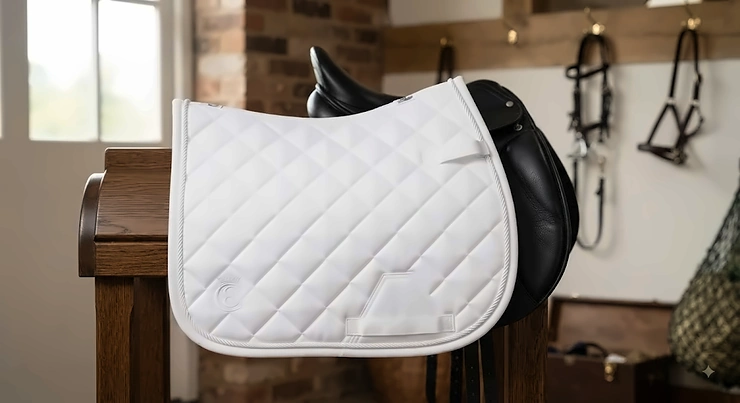
This guide cuts through that. We’ve pulled together seven real, currently available pads that sit at or under the £40 mark, spanning honest budget schooling cloths right up to competition-ready options with proper contoured shaping. Along the way we’ll cover the quilting patterns that actually matter, why saddle pad shaping affects your horse’s spine clearance, and what British Dressage rules say about what you can and can’t put under your saddle on competition day. No fluff, no invented five-star reviews — just real specs, honest analysis, and enough detail that you can order with confidence tonight.
What Is a Dressage Saddle Pad?
A dressage saddle pad is a shaped cotton or polycotton cloth worn beneath a dressage saddle, cut long and narrow to clear the saddle’s extended flaps and billets. Unlike a general purpose numnah, it’s contoured at the front to avoid bulking up around the knee block, and it’s almost always finished in white or a neutral colour for the show ring.
Beyond looks, the pad’s real job is quieter but more important: it absorbs sweat, spreads pressure a little more evenly across the panels, and gives you a washable buffer between an expensive saddle and a horse who thinks rolling in mud is a personality trait.
Quick Comparison Table
| Product | Type | Price Range | Best For |
|---|---|---|---|
| WeatherBeeta Prime Dressage Saddle Pad | Polycotton, high wither | Around £30-£37 | Showing in white |
| Shires ARMA Deluxe Cotton Dressage Saddlecloth | 100% cotton, quilted | Around £35 | All-round daily use |
| HKM Saddle Pad Madrid | Polyester, square quilting | Around £28-£32 | Moisture control on a budget |
| Rhinegold Wave Saddle Pad | Cotton, wave-stitch | Around £25-£35 | Schooling and turnout |
| Aubrion Branded Dressage Saddlecloth | Cotton, branded trim | Around £12-£20 | Tightest budgets |
| Shires ARMA Eltar Satin Dressage Saddlecloth | Satin, honeycomb quilt, contoured | Around £40 | Contoured spine clearance |
| Rhinegold Cotton Saddle Pad (faux fur trim) | Cotton, faux fur lining | Around £20-£30 | Everyday comfort feel |
Looking at the spread, the gap between the cheapest and priciest option here isn’t as wide as you’d think — under £30 buys real quilted cotton, not a flimsy afterthought. The Aubrion Branded Dressage Saddlecloth wins on pure price, but the Shires ARMA Eltar Satin Dressage Saddlecloth justifies sitting right at the £40 ceiling through its contoured shaping, which the flatter cotton cloths simply don’t offer. If your horse has a noticeably curvy back or high withers, that distinction is worth the extra spend.
💬 Just one click — help others make better buying decisions too!😊
Top 7 Dressage Saddle Pads Under £40: Expert Analysis
1. WeatherBeeta Prime Dressage Saddle Pad — high wither design built for the white ring
The standout here is the high wither cut, which gives noticeably more clearance than flatter budget pads — useful if your horse’s withers are anything above average. The pad itself is polycotton with a polyester wick-easy lining and a breathable mesh spine, machine washable at 30°C (no tumble drying, so factor that into your show-morning routine). In practice, that combination means the pad dries fast between uses and doesn’t hold onto sweat smell the way plain cotton sometimes does.
Based on the spec sheet, this is a pad built for riders who show regularly rather than one that’s trying to double as an everyday schooling cloth — the covered girth patch and touch-tape D-ring loops are designed for a clean, secure look rather than heavy daily wear. Reviewers on Amazon UK consistently mention that the white washes up bright with an oxygen-based stain treatment, and several note buying it specifically because the lines sit flatter under the saddle than cheaper alternatives they’d tried first.
Pros:
- ✅ High wither cut suits horses with pronounced withers
- ✅ Wicking lining dries faster than plain cotton
- ✅ Reviewers report the white cleans up well
Cons:
- ❌ Not tumble-dry safe, so drying takes planning
- ❌ Sits at the top of this budget bracket
Price range: around £30-£37 depending on size and colour, at the time of research. For a rider who competes most weekends, this is solid value — the wicking lining should mean fewer replacements than a basic cotton pad exposed to the same wash cycle.
2. Shires ARMA Deluxe Cotton Dressage Saddlecloth — best all-round quilted classic
What stands out immediately is how unfussy this pad is: 100% cotton outer, classic diamond quilting, available in black or white, and priced at a flat £35 direct from Shires. That simplicity is the point — this isn’t trying to be a technical performance product, it’s trying to be the pad you reach for every single day without thinking about it.
The quilting here isn’t just decorative. On a spec level, diamond quilting distributes the wadding fill more evenly than a plain stitched pad, which in practice means less shifting and bunching once you’re twenty minutes into a schooling session. What most buyers overlook about cotton pads like this one is that they need slightly more frequent washing than synthetic-lined alternatives, since cotton holds moisture rather than wicking it away — but they’re also cheaper to replace and machine wash without fuss.
Aggregated customer sentiment across cotton Shires saddlecloths in this range tends to praise the fit and simplicity, though as with any pure cotton pad, some buyers note it takes longer to dry overnight than synthetic-lined competitors.
Pros:
- ✅ Genuinely all-purpose, day-in day-out reliability
- ✅ Diamond quilting reduces filling movement
- ✅ Straightforward machine care
Cons:
- ❌ Cotton dries slower than synthetic-lined pads
- ❌ Limited colourway (black or white only)
Price range: around £35 at the time of research. For anyone who wants one dependable pad rather than a wardrobe of them, this is the sensible mid-range pick.
3. HKM Saddle Pad Madrid — square quilting built for moisture control
The Madrid’s square quilting pattern is the headline feature, and it’s a genuinely functional choice rather than a style flourish — square quilting has a shorter stitch interval than diamond quilting, which HKM’s own spec notes helps the foam-and-wadding fill absorb impact and moisture more evenly across the pad’s surface. On paper, that means less pooling of sweat in any one spot compared with a plainly stitched budget cloth.
Velcro girth loops keep the pad anchored during work, and the silver cord trim gives it a slightly dressier look than a purely functional schooling pad, without pushing the price near the £40 ceiling. Based on the spec comparison with the other pads here, the Madrid sits comfortably in the “does more than it needs to for the price” category — 100% polyester construction keeps costs down while the quilting does the heavy lifting on comfort.
Verified UK retailer listings show it priced around £29.57 including VAT, making it one of the more consistently available budget-quilted options across European tack retailers shipping to the UK.
Pros:
- ✅ Square quilting spreads moisture more evenly
- ✅ Velcro girth loops keep it securely anchored
- ✅ Genuinely competitive price for a quilted pad
Cons:
- ❌ Polyester lacks cotton’s natural breathability
- ❌ Silver cord trim may be too decorative for plain schooling
Price range: around £28-£32 at the time of research. Good value if moisture management matters more to you than a purely traditional cotton feel.
4. Rhinegold Wave Saddle Pad — distinctive wave-stitch quilting pattern
Rhinegold’s wave stitching is one of the more visually distinctive quilting patterns on the market, but the shape isn’t purely cosmetic — the waffle-textured lining underneath is designed to keep air moving against the horse’s back rather than trapping heat the way a flat lining would. The cotton outer keeps the classic look while the ventilated waffle spine does the practical work.
Here’s what the spec sheet won’t tell you outright: wave-stitched pads like this tend to hold their shape better over repeated washes than simple straight-line quilting, because the curved stitch lines distribute stress across more contact points. Touch-tape closure girth placement straps and twin satin rope binding round out a pad that reads as more premium than its price suggests.
Reviewers on Amazon UK describe the mesh underside as noticeably cooling in warmer weather, and several note buying multiples once they’d tried the colour range — a decent proxy for satisfaction, even without exact star-rating figures to hand.
Pros:
- ✅ Ventilated waffle spine aids airflow
- ✅ Wave quilting holds shape well over repeated washes
- ✅ Wide colour range for matching turnout sets
Cons:
- ❌ Cotton outer still needs regular washing
- ❌ Waffle lining adds slight bulk versus flatter pads
Price range: typically around £25-£35 at the time of research, varying by colour and retailer. A strong pick if you ride in variable UK weather and want a pad that breathes.
5. Aubrion Branded Dressage Saddlecloth — the tightest budget without cutting the dressage cut
This is the pad for the “I just need something that fits properly and doesn’t cost a fortune” brief. At a listed price around £12-£20 depending on retailer, it undercuts almost everything else on this list while still being a genuine dressage-cut cloth rather than a repurposed general purpose pad — the shaping still clears dressage flaps and billets correctly.
Honest analysis here: at this price point, you’re not getting the wicking linings or reinforced girth guards of the pricier options, and the fill is noticeably thinner than the quilted cotton pads further up this list. What that means in practice is a pad that’s fine for schooling, lessons, or a spare-in-the-lorry emergency, but one you’ll likely want to replace sooner if it becomes your daily-use pad. It’s a sensible option for younger riders growing out of ponies quickly, or for owners with multiple horses who need cost-effective cover for each.
Pros:
- ✅ Genuine dressage cut at an entry-level price
- ✅ Low enough cost to buy as a spare without guilt
- ✅ Branded trim gives a tidy, non-flashy finish
Cons:
- ❌ Thinner fill than the quilted pads on this list
- ❌ Less durable for daily heavy use
Price range: around £12-£20 at the time of research. Best value if you need multiples rather than one showpiece pad.
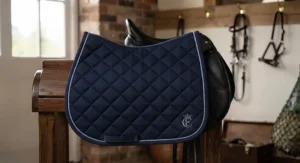
6. Shires ARMA Eltar Satin Dressage Saddlecloth — contoured shaping at the £40 ceiling
This is the pad on this list that earns its price through genuine contoured shaping rather than branding. Where the cotton cloths above are cut relatively flat, the Eltar’s contoured dressage cut is specifically shaped to clear the spine, which matters most for horses with a pronounced wither or a shorter back where a flat pad tends to bridge or press unevenly.
The honeycomb quilt pattern is longer in stitch interval than the Madrid’s square quilting, giving it a plusher, more “competition” feel, while the ULTRA DRI ZONE lining wicks sweat away from the horse’s back to reduce rub risk — something cotton-only pads can’t match. A polyurethane contour girth guard protects the wear-prone girth area, and the satin finish with twtwin rope trim gives it a genuinely show-ready look rather than a schooling one.
Based on the spec comparison against the rest of this list, the trade-off is straightforward: you’re paying the full £40 for contoured shaping and a technical lining, versus a flatter, cheaper cotton alternative. For horses that don’t need extra spine clearance, that spend may be unnecessary — but for those that do, nothing else on this list matches it.
Pros:
- ✅ Contoured cut gives genuine spine clearance
- ✅ Wicking lining actively reduces rub risk
- ✅ Girth guard adds durability at wear points
Cons:
- ❌ Sits right at the £40 ceiling
- ❌ Satin finish shows dirt more than matte cotton
Price range: around £40 at the time of research. Worth the spend specifically for horses with pronounced withers or a short back needing extra clearance.
7. Rhinegold Cotton Saddle Pad (faux fur trim) — everyday comfort with a luxury feel
Marketed primarily as a comfort-focused cotton pad, this one earns its place through the faux fur lining and trimmed edges, which give it a noticeably softer feel against the horse’s back than a plain quilted cotton pad. It comes in three sizes — pony, cob and full — with girth replacement straps included, making it a flexible option across a multi-horse yard.
Here’s the honest trade-off: this isn’t a dedicated dressage-cut competition pad in the way the Eltar or the ARMA Deluxe are, so if strict competition presentation matters to you, it’s better suited to schooling and everyday hacking than the show ring. What it does well is comfort — the faux fur reduces friction in a way plain cotton doesn’t, which matters for horses prone to rubbing along the girth or spine line.
Amazon UK listings show it consistently among the best-selling saddle pads in the Tack category, with reviewers commonly citing the “luxury feel” and softness as the deciding factor over cheaper plain-cotton alternatives.
Pros:
- ✅ Faux fur lining reduces friction and rubbing
- ✅ Available in three sizes for different horses
- ✅ Consistently a best-seller in its category
Cons:
- ❌ Not a strict competition dressage cut
- ❌ Faux fur needs more careful washing than plain cotton
Price range: around £20-£30 at the time of research. A comfort-first pick for schooling and everyday use rather than the show ring.
Top 7 Products: Full Comparison
| Product | Fill/Lining | Quilting | Best For | Price Range |
|---|---|---|---|---|
| WeatherBeeta Prime Dressage Saddle Pad | Wick-easy polyester lining | Plain, high wither cut | Showing in white | £30-£37 |
| Shires ARMA Deluxe Cotton Dressage Saddlecloth | 100% cotton | Diamond | Daily all-round use | Around £35 |
| HKM Saddle Pad Madrid | Foam and wadding | Square | Budget moisture control | £28-£32 |
| Rhinegold Wave Saddle Pad | Waffle-textured lining | Wave-stitch | Schooling in warm weather | £25-£35 |
| Aubrion Branded Dressage Saddlecloth | Thin cotton fill | Basic | Tightest budgets | £12-£20 |
| Shires ARMA Eltar Satin Dressage Saddlecloth | ULTRA DRI ZONE lining | Honeycomb, contoured | Spine clearance | Around £40 |
| Rhinegold Cotton Saddle Pad (faux fur trim) | Faux fur | Basic quilted | Everyday comfort | £20-£30 |
Read across this table and a pattern emerges: quilting pattern and lining type track price far more closely than branding does. The HKM Saddle Pad Madrid and Shires ARMA Deluxe Cotton Dressage Saddlecloth sit almost identically on value once you account for their different quilting approaches, while the Shires ARMA Eltar Satin Dressage Saddlecloth stands apart purely because of its contoured cut rather than any single spec line. If you’re torn between two similarly priced pads, the quilting style and lining are the details actually worth comparing.
Practical Usage Guide: Setup, Care and the First 30 Days
Getting a new pad right starts before it ever touches your horse’s back. Lay it flat on the saddle first, centring the spine seam directly over your horse’s spine, then lower the saddle onto it rather than sliding the pad in afterwards — sliding compresses the fill unevenly and undoes any careful positioning. Once girthed, reach under the pommel and gently pull the pad up into the gullet so it isn’t pressing down on the withers; this single step prevents more rubbing than any fabric choice ever will.
In the first 30 days, wash the pad after every two to three uses rather than waiting until it looks dirty — sweat salts left in the fibres are what cause rubbing, not visible mud. Stick to a 30°C wool or delicate cycle and avoid fabric softener, which clogs wicking linings and reduces their effectiveness over time. Air dry flat rather than on a hanger, since hanging can distort the shaping on contoured pads like the Eltar.
The most common first-month mistake isn’t fabric-related at all — it’s girth strap length. Too-tight touch-tape straps bunch the pad forward under work, while too-loose ones let it slip back and press on the loins. Check the strap tension after the first ten minutes of riding, not just before you mount, since pads settle once the horse is moving.
Real-World Scenarios: Which Pad Suits Which Rider
The competition-weekend regular: if you’re showing most Saturdays on a budget, the WeatherBeeta Prime Dressage Saddle Pad makes sense specifically because of its wicking lining — you need it clean and dry again by the following weekend, and plain cotton alone won’t manage that turnaround reliably.
The full-time livery yard owner with three horses: cost per pad matters more than any single premium feature here. Two of the Aubrion Branded Dressage Saddlecloths as spares plus one Shires ARMA Deluxe Cotton Dressage Saddlecloth for the horse ridden most often gives solid coverage without breaking £100 total, and keeps every horse in a genuine dressage cut.
The rider whose horse has pronounced withers or a cobby, short back: this is precisely the scenario the Shires ARMA Eltar Satin Dressage Saddlecloth‘s contoured shaping was designed for. A flat cotton pad on a horse like this tends to bridge across the spine, and the extra £5-10 over a basic cloth is genuinely functional spend rather than a cosmetic upgrade.
The once-a-week hacker who occasionally schools in a dressage saddle: the Rhinegold Cotton Saddle Pad with its faux fur trim covers the comfort angle without needing competition-grade presentation, and its multiple sizing options make it easy to match to a borrowed or shared saddle.
How to Choose a Dressage Saddle Pad Under £40
- Measure your horse’s spine length and wither height first. A pad that’s too short will pull forward under the cantle; too flat on a high-withered horse and you’ll see pressure marks within weeks.
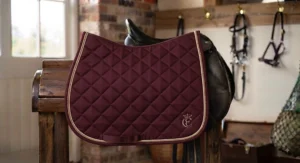
- Match the quilting to your priority. Square quilting (like the Madrid) favours moisture control; diamond quilting (like the ARMA Deluxe) favours even fill distribution; honeycomb (like the Eltar) favours a plusher competition feel.
- Check the lining material against your climate and workload. Synthetic wicking linings dry faster for frequent riders; cotton is cheaper to replace but slower to dry.
- Decide whether you need true contoured shaping. Only necessary if your horse has a pronounced wither or short back — otherwise a flat cut saves money without any real downside.
- Confirm competition colour rules if you’re showing. White or cream with contrasting piping is the safest bet for affiliated dressage; save bold colours for schooling.
- Budget for at least one spare. A single pad worn daily wears out faster than two rotated pads, so splitting your £40 budget across two cheaper cloths can outlast one premium one.
- Read the wash instructions before buying, not after. Tumble-dry-safe pads suit busy yards; delicate hand-wash-only pads suit lower-mileage riders with more laundry time.
Quilting Patterns Explained: Diamond, Square and Wave Stitching
Quilting pattern isn’t just a styling choice — it directly affects how evenly the pad’s filling stays distributed under repeated pressure. Diamond quilting, seen on the Shires ARMA Deluxe Cotton Dressage Saddlecloth, is the traditional standard: a 45-degree cross-stitch that spreads the wadding evenly and resists the fill shifting toward one edge over time. It’s the safest, most universally accepted look for affiliated competition too.
Square quilting, used on the HKM Saddle Pad Madrid, uses a tighter grid with a shorter stitch interval, which in practice means more contact points holding the fill in place — useful for pads that need to manage moisture as well as cushioning, since the tighter grid also helps channel sweat rather than letting it pool. Wave or curved stitching, as seen on the Rhinegold Wave Saddle Pad, is less common but genuinely functional: the curved lines distribute stress across more directions than straight stitching, which is part of why wave-stitched pads tend to hold their shape well after repeated machine washing.
Honeycomb quilting, found on the premium Shires ARMA Eltar Satin Dressage Saddlecloth, uses the longest stitch interval of the four, which gives a plusher, loftier feel but slightly less rigidity than tighter patterns — a reasonable trade-off on a pad that’s already contoured for shape rather than relying purely on quilting to hold its form.
Saddle Pad Shaping: Straight-Cut vs Contoured Dressage Pads
Most budget dressage saddle pads, including the Aubrion Branded Dressage Saddlecloth and the Shires ARMA Deluxe Cotton Dressage Saddlecloth, use a straight-cut shape: essentially flat with a dressage-length silhouette to clear the longer flaps. This works well for horses with an average, well-rounded back, and it’s cheaper to manufacture, which is a large part of why straight-cut pads dominate the sub-£35 bracket.
Contoured shaping, as used on the Shires ARMA Eltar Satin Dressage Saddlecloth, curves the pad around the spine rather than sitting flat across it, leaving a channel of clearance down the centre. This matters most for horses with pronounced withers, a dipped or “sway” back, or a noticeably narrow spine, where a flat pad would otherwise bridge and create pressure points along the edges rather than the centre. The World Horse Welfare saddle fitting guidance developed with the Animal Health Trust makes the same point about saddles generally: fit that accounts for the individual horse’s shape reduces the risk of back pain far more reliably than any single material choice.
The honest takeaway: shaping matters more for problem-shaped backs than it does for an average, well-muscled horse. If your horse has never shown a sign of discomfort under a flat pad, a contoured one is a nice-to-have rather than a necessity — but if you’ve noticed rubbing, dry patches, or uneven sweat marks after work, upgrading the shaping before upgrading the saddle itself is a cheap first troubleshooting step.
White Dressage Saddle Pads: Competition Standard Explained
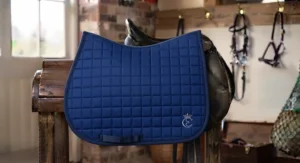
White remains the default choice for affiliated dressage for a simple reason: it reads as clean, formal and traditional to judges, and it’s the colour least likely to draw a raised eyebrow at any level. The WeatherBeeta Prime Dressage Saddle Pad in white is a straightforward example — a durable, wicking pad in the exact shade competition riders reach for without a second thought.
Cream and off-white are generally accepted as equivalents, and contrasting piping in navy, black or a sponsor colour is permitted without drawing attention. Where riders get caught out is less about the base colour and more about upkeep — a grubby, greying white pad looks worse in the ring than a clean coloured one, so factor washing frequency into your decision if you’re buying specifically for showing rather than schooling.
Dressage Competition Rules: What Your Saddle Pad Must Comply With
Beyond colour, British Dressage’s official competition rules set out what’s permitted in the Members’ Handbook and the accompanying Approved Tack and Equipment Guide, which is worth checking directly before your first affiliated outing rather than relying on secondhand advice from the yard. As a general standard across UK dressage, saddle cloths and numnahs are expected to be white or cream, may include contrasting piping, and can display a sponsor’s logo provided it stays within the permitted size on each side of the pad.
None of the seven pads in this guide would fall foul of those rules in white or cream colourways, though it’s worth checking your specific affiliation and level before entering, since Quest and lower-level classes are typically more relaxed than full British Dressage or FEI-affiliated tests. If you compete unaffiliated at a local level, most venues follow the same conventions informally even without enforcing them strictly.
Dressage Saddle Pad vs General Purpose Saddle Pad: What’s the Real Difference
| Factor | Dressage Saddle Pad | General Purpose Saddle Pad |
|---|---|---|
| Cut | Long, straight-cut to clear dressage flaps | Shorter, rounded cut |
| Girth strap position | Set back for longer dressage billets | Set forward for shorter GP billets |
| Competition colour rules | Typically white/cream required | More flexible, often any colour |
| Shaping | More likely to be contoured | Usually flatter |
The core difference isn’t comfort or quality, it’s compatibility: a general purpose pad simply won’t sit correctly under a dressage saddle’s longer flap and billet configuration, often bunching visibly at the front. Buyers new to dressage sometimes assume any quilted pad will do, but based on the spec comparison above, the girth strap positioning alone can cause a genuinely poor fit if you use the wrong cut. If you already own a general purpose pad and are borrowing a dressage saddle for a one-off lesson, it’ll function in a pinch — but for regular use or any affiliated competition, the dedicated cut in every product on this list is worth the correct spend.
Long-Term Cost and Maintenance: Is a Budget Pad Worth It?
Run the numbers over a full season and the cost-per-use gap between these pads narrows considerably. The Aubrion Branded Dressage Saddlecloth at roughly £15 might need replacing after a single busy season of daily use, putting its effective annual cost close to that of the Shires ARMA Deluxe Cotton Dressage Saddlecloth at £35, which typically lasts two to three seasons with proper washing. The Shires ARMA Eltar Satin Dressage Saddlecloth at £40 sits at a similar per-season cost once you factor in its more technical lining resisting wear better than plain cotton.
| Pad | Approx. Price | Typical Lifespan | Rough Cost Per Season |
|---|---|---|---|
| Aubrion Branded Dressage Saddlecloth | £12-£20 | 1 season, heavy use | £12-£20 |
| Shires ARMA Deluxe Cotton Dressage Saddlecloth | Around £35 | 2-3 seasons | £12-£18 |
| Shires ARMA Eltar Satin Dressage Saddlecloth | Around £40 | 3+ seasons | Under £15 |
Reading the table straight, the cheapest upfront pad isn’t necessarily the cheapest over time — it simply front-loads the spend into a single purchase rather than spreading it. Maintenance habits matter just as much as the purchase price: washing at the correct temperature, avoiding fabric softener on wicking linings, and drying flat rather than on a peg all extend any pad’s working life regardless of which one you buy.
✨ Don’t Miss These Exclusive Deals!
🔍 Take your dressage kit to the next level with these carefully selected pads. Click through to check current pricing and availability before your next order. A pad that actually fits will save you more in vet and physio bills than it ever costs upfront!
Common Mistakes When Buying a Dressage Saddle Pad Under £40
The most frequent mistake is buying on colour alone without checking the cut — a striking pattern means nothing if the pad doesn’t clear the dressage saddle’s flaps correctly. A close second is ignoring wash instructions until after purchase; tumble-drying a pad rated for air-drying only can shrink or warp the shaping within a handful of washes, quietly undoing whatever you paid extra for.
Buyers also commonly underestimate sizing: pony, cob and full sizing genuinely differ in spine length, and a pad that’s slightly too short will ride up under the cantle during work, however well it fits when the horse is standing still. Finally, don’t overlook the British Dressage tack and competitor dress guidance if you’re planning to compete — sponsor logos, for instance, are capped at a specific size on each side of the pad, and it’s an easy detail to miss until a steward flags it on the day.
FAQ
❓ What is the best dressage saddle pad under £40?
❓ Can I use a general purpose saddle pad under a dressage saddle?
❓ Does a white dressage saddle pad have to be pure white for competition?
❓ How often should I wash a dressage saddle pad?
❓ What's the difference between diamond and honeycomb quilting on a saddle pad?
Conclusion
A dressage saddle pad under £40 doesn’t have to mean compromise — as this list shows, real quilting quality, genuine dressage shaping and even contoured spine clearance are all available well within that budget if you know what to look for. The right choice ultimately comes down to your horse’s shape and your own riding pattern: a flat, straightforward cotton pad like the Shires ARMA Deluxe Cotton Dressage Saddlecloth serves most average-backed horses perfectly well, while a pronounced wither or short back makes the contoured Shires ARMA Eltar Satin Dressage Saddlecloth worth its place at the top of the price range.
Whichever you choose, remember that quilting pattern, shaping and lining material aren’t marketing fluff — they’re the practical details that determine whether your horse stays comfortable through a full season of work. Measure first, match the pad to your horse’s actual back shape, and let the rest of the decision follow from there rather than from the prettiest colour on the page.
Recommended for You
- Affordable GP Numnah: 7 Brilliant Budget Picks for 2026
- Affordable Treeless Saddle: 7 Best UK Picks for 2026
- Affordable Endurance Saddle: 7 Best Budget Picks for 2026
Disclaimer: This article contains affiliate links. As an Amazon Associate, I earn from qualifying purchases. If you purchase products through these links, we may earn a small commission at no additional cost to you.
✨ Found this helpful? Share it with your friends! 💬🤗
