In This Article
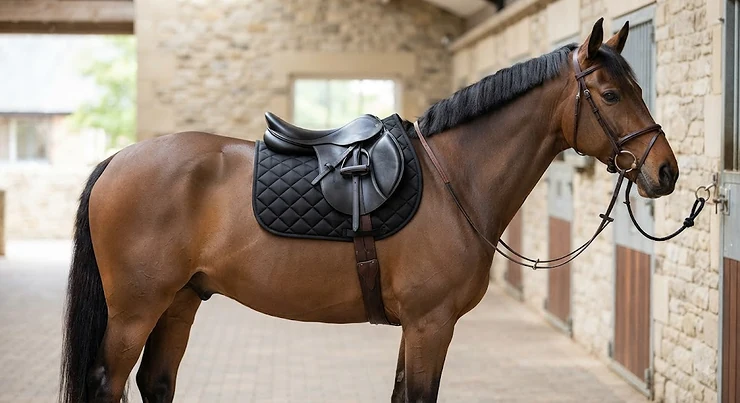
There’s a particular kind of guilt that creeps in when you notice a dry, sweaty outline under your horse’s saddle after a hack — the sort that makes you wonder whether that £12 numnah from three years ago has finally given up the ghost. An affordable GP numnah doesn’t have to mean a flimsy scrap of fabric that bunches up under the girth by the second furlong. It simply means a numnah cut for a General Purpose saddle that does its job — cushioning, sweat absorption, and a bit of shock protection — without draining your yard fund.
A numnah, in the simplest terms, is a shaped saddle pad that mirrors the outline of your saddle’s panels rather than sitting as a plain square underneath it, and its main jobs are absorbing sweat, cushioning the saddle, and protecting your horse’s back from friction and pressure. Get the material, the fit, and the quilting right, and a genuinely affordable GP numnah for sensitive horses can perform just as well day-to-day as something costing three times the price.
This guide walks through seven real, currently available products — from cotton budget staples to half-wool premium options — with honest analysis of what each one actually does well, who it suits, and where the compromises lie. No invented reviews, no inflated claims, just spec-by-spec reasoning and genuine aggregated review sentiment so you can buy with confidence.
Quick Comparison Table
| Numnah | Material | Best For | Price Range |
|---|---|---|---|
| Rhinegold Cotton Quilted GP Numnah | Cotton, quilted | Budget everyday riding | Under £25 |
| Shires Performance Lite Numnah | Easy-care diamond quilt | Spare / showing budget | Under £25 |
| Shires Half Lined GP Numnah | Half fleece, honeycomb quilt | Mid-range comfort | £25-£40 |
| Shires ARMA Soft Grip Numnah | Neoprene/mesh anti-slip | Saddles that slip | £30-£45 |
| Shires Performance Fully Lined Numnah | Full fleece + foam core | Sensitive-skinned horses | £35-£55 range |
| Griffin NuuMed HiWither Numnah | Half British wool | Premium comfort | £45-£65 range |
Even at a glance, the pattern here is that “affordable” isn’t a single price point — it’s a sliding scale where cotton sits at the accessible end and half-wool sits at the considered-investment end. Reviewers on Amazon consistently rate the cheaper cotton and diamond-quilt options highly for everyday hacking and schooling, while the fully lined and wool-lined pads earn their higher price tags specifically for horses with thinner coats, clipped horses, or genuinely reactive skin. If your horse is a straightforward, unfussy sort who just needs something clean and functional, don’t feel pressured up the list — the cheapest option here genuinely does the job for thousands of UK riders.
💬 Found a numnah that ticks your boxes already? Scroll down for the full breakdown — or jump straight to your favourite in the list below!🤗
Top 7 Affordable GP Numnahs: Expert Analysis
1. Rhinegold Cotton Quilted GP Numnah — the everyday cotton classic
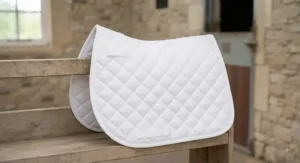
If you want proof that “affordable” and “popular” aren’t mutually exclusive, the Rhinegold Cotton Quilted GP Numnah is it — it’s one of the best-reviewed budget numnahs on Amazon UK, and it’s not hard to see why. The cotton outer is diamond-quilted for light cushioning, and the shaping follows a standard GP cut closely enough to sit neatly under most jump or all-purpose saddles without excess fabric bunching at the flap. Cotton breathes better than most synthetic quilts, which matters more than people think — a horse working up a sweat under a non-breathable pad ends up with a soggy, chafing mess by the time you’re untacking.
Based on the spec comparison with pricier options, what you’re sacrificing here is padding depth and moisture-wicking sophistication, not basic comfort — this is a genuinely serviceable everyday pad, not a corner-cut compromise. Reviewers consistently report strong satisfaction with the fit, washability, and value, which is reflected in its position as one of the most-purchased numnahs in its category on Amazon.co.uk. It’s the numnah most UK liveries have at least one spare of, precisely because it’s cheap enough to own two or three.
Pros:
- ✅ Genuinely well-reviewed budget cotton option
- ✅ Breathable fabric reduces sweat build-up
- ✅ Wide colour and size range for most GP saddles
Cons:
- ❌ Thinner padding than fleece or wool alternatives
- ❌ Less shock absorption for horses that need extra cushioning
Price-wise, expect to pay under £25 in most sizes and colours, and at that price it’s hard to argue with the value — this is the numnah to buy if you want a reliable daily-use pad without overthinking it.
2. Shires Performance Lite Numnah — the smart, easy-care spare
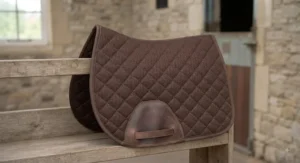
The Shires Performance Lite Numnah leans into simplicity: an easy-care fabric outer, a smart diamond quilt pattern, touch-close retaining straps, and a contoured shape designed for good saddle clearance. It’s less about plush cushioning and more about looking tidy for showing classes or serving as the spare that lives permanently in your lorry.
What most buyers overlook about this model is that “lite” doesn’t mean flimsy — the fabric is genuinely machine washable and holds its shape wash after wash, which matters enormously if you’re the sort of rider who’s tacking up in all weathers. Here’s what to weigh: if your priority is a numnah that looks sharp in the ring and survives a weekly boil wash, this beats bulkier fleece options on convenience alone, even if it can’t match them for padding on a horse with a sensitive back. Retail pricing sits comfortably in the budget bracket, and it’s frequently available at discounted prices through UK equestrian retailers and Amazon alike.
Pros:
- ✅ Smart, competition-ready appearance
- ✅ Machine washable and quick-drying fabric
- ✅ Contoured cut for good saddle clearance
Cons:
- ❌ Minimal cushioning compared with fleece options
- ❌ Less suited to horses needing extra shock absorption
Expect a price in the under-£25 range, making it one of the cheapest genuinely presentable numnahs on this list — ideal as a showing spare or a first numnah for a young horse in light work.
3. Supreme Products GP Numnah — double fleece for a soft, showring finish
Where the previous two are about function-first budgeting, the Supreme Products GP Numnah edges toward comfort with its double fleece construction — fleece on both the saddle-facing side and the outer, cut specifically for GP saddles. It’s a well-established name in showing circles, and its Amazon listing consistently ranks inside the top few hundred products in the entire Numnahs & Saddle Pads category, which for a single-material budget-tier product is a meaningful signal of sustained demand.
On paper, this means a genuinely plush feel against the horse’s back without the bulk of a foam-cored pad — useful for finer-coated show horses where you want comfort without visual thickness spoiling the saddle’s line. What the spec sheet won’t tell you, but retailer descriptions consistently note, is that the double-fleece design also does a good job of hiding sweat marks during long showing days, which matters more than it sounds when you’re stood at the in-hand line under judges’ eyes. Available in black or brown fleece, it slots neatly between the ultra-budget cotton pads and the more structured fleece-and-foam options further down this list.
Pros:
- ✅ Soft double-fleece feel on both faces
- ✅ Smart, showring-appropriate finish
- ✅ Genuinely popular, well-established seller
Cons:
- ❌ Less structural padding than foam-cored designs
- ❌ Fleece pile can flatten with heavy use over time
Prices for the Supreme Products GP Numnah typically sit in the £30-£40 range depending on size and colour — a small step up from the purely budget tier, and one that buys you a noticeably plusher feel.
4. Shires Half Lined GP Numnah — honeycomb quilting with fleece where it counts
The Shires Half Lined GP Numnah is a genuinely clever middle-ground design: rather than lining the whole pad in fleece (which adds bulk and cost), it half-lines the saddle-contact area while keeping the rest of the construction lighter. The honeycomb quilt pattern isn’t just decorative — the raised texture allows a small amount of airflow between the fibres of the synthetic fleece lining, which helps combat the classic problem of a hot, damp back on longer rides. A high wither cut reduces pressure right where sensitive horses tend to object most.
Reviewers consistently note strong satisfaction with this model, and its Amazon rating sits comfortably above 4.5 out of 5 across its available reviews — a meaningfully high bar for a numnah in this price bracket. Based on the spec comparison with the fully-fleece option further down this list, this is the pad to choose if your horse is only moderately fussy about pressure rather than genuinely reactive; it offers a real step up in comfort over plain cotton without the premium price tag of full fleece lining or wool.
Pros:
- ✅ Strong, consistently high Amazon review rating
- ✅ Honeycomb quilting aids airflow and dries faster
- ✅ High wither cut reduces pressure at a common problem area
Cons:
- ❌ Only half-lined, so less cushioning than fully fleeced pads
- ❌ Limited colourway range compared with cotton alternatives
Expect to pay somewhere between £25 and £40 depending on size (cob, full, or extra-large), positioning it firmly as a mid-range affordable pick with premium-leaning comfort.
5. Shires ARMA Soft Grip Numnah — built to stop your saddle slipping
If your actual problem isn’t comfort but stability — a saddle that creeps sideways on a round-barrelled cob, say — the Shires ARMA Soft Grip Numnah solves a different puzzle entirely. It combines perforated anti-slip panels on the outer with a half lining on the inner for airflow and shock absorption, plus a mesh-construction neoprene lining across the upper spine that provides genuine grip under the saddle itself. A SupaFleece wither trim and touch-close girth loops round out a design that’s clearly been engineered by people who’ve actually dealt with a slipping saddle mid-hack.
What most buyers overlook about anti-slip numnahs generally is that grip and breathability are usually a trade-off — neoprene holds heat — but the mesh outer here is specifically there to counter that, allowing airflow so the horse doesn’t get sweaty under the breathable section, a point echoed repeatedly in genuine customer feedback. Reviewers describe it fitting well on larger horses (including full-size shires) without shifting during the ride, and multiple owners report buying a second one after a positive first experience — a reasonably strong signal of real satisfaction rather than one-off luck.
Pros:
- ✅ Genuinely effective anti-slip grip panels
- ✅ Mesh spine zone keeps the horse cooler than solid neoprene
- ✅ Consistently positive real owner feedback on fit and stability
Cons:
- ❌ Pricier than plain cotton or diamond-quilt options
- ❌ Neoprene sections need proper rinsing to avoid rubbing residue build-up
Pricing sits around £30-£45 depending on size, which is a fair trade for solving a genuine, recurring saddle-slip problem rather than just masking it with a tighter girth.
6. Shires Performance Fully Lined Numnah — the pick for sensitive-skinned horses
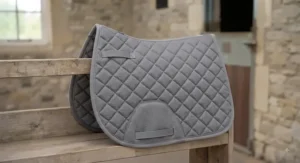
Marketed explicitly for horses that need “a little extra protection,” the Shires Performance Fully Lined Numnah is fully lined with fleece rather than half-lined, and adds a foam core under the saddle section plus 3D air-motion mesh zones along the spine for extra breathability. This is the most directly relevant option on this list if you searched specifically for a GP numnah for sensitive horses — thin-skinned Thoroughbreds, clipped horses in winter, or young horses just getting used to tack all fall into the category this pad was designed for.
Reviewers consistently note that this numnah suits recently-backed or nervous young horses with reactive skin particularly well, with genuine feedback describing it as soft enough to keep a fully clipped, sweat-prone horse comfortable while the spine mesh panel lets the skin breathe during work. One recurring theme in real feedback is durability after repeated washing — several owners report the pad holding its shape and softness after weeks of regular use, which matters enormously for a pad that’s doing a genuinely protective job rather than a purely cosmetic one. Manufactured in England, it also earns a small trustworthiness point for UK riders keen to support domestic saddlery production.
Pros:
- ✅ Full fleece lining plus foam core for genuine extra cushioning
- ✅ Specifically designed with sensitive-skinned horses in mind
- ✅ Strong real-world feedback on durability through repeated washing
Cons:
- ❌ Noticeably more expensive than half-lined alternatives
- ❌ Extra bulk may not suit close-contact jumping saddles
Price ranges typically run from around £35 up into the mid-£50s depending on size and colour — a genuine mid-to-premium investment, but arguably the most justified one on this list if pressure sensitivity is your actual problem.
7. Griffin NuuMed HiWither Everyday Quilted GP Numnah — the premium wool-lined option
At the top of this list sits the Griffin NuuMed HiWither Everyday Quilted GP Numnah, built around a 5oz quilted top and a half lining of genuine British wool rather than synthetic fleece. Wool is a different beast entirely from fleece or foam: it can absorb a significant proportion of its own weight in moisture before feeling damp, meaning it keeps working as a cushion even when your horse is properly sweating, and its natural fibres are widely considered less likely to trigger skin reactions than synthetic linings.
Based on the spec comparison with every other pad on this list, this is the one built for horses whose comfort genuinely justifies a premium spend — competition horses doing long, sweaty sessions, or horses that have historically reacted badly to synthetic linings. The spine is swept up at the wither to relieve pressure precisely where high-withered horses suffer most, and a stiffer overall structure gives the pad good shape retention under the saddle rather than collapsing flat after a few rides. It’s worth being upfront here: at this price point you’re moving out of “budget” territory and into “considered investment,” so it earns its place on an affordable-numnah list mainly as the ceiling worth knowing about, not the default recommendation.
Pros:
- ✅ Genuine British wool lining aids moisture management
- ✅ High wither relief design for pressure-sensitive horses
- ✅ Strong shape retention compared with softer synthetic pads
Cons:
- ❌ Priced well above the other options on this list
- ❌ Wool requires slightly more careful washing than synthetic fleece
Expect to pay somewhere in the £45-£65 range depending on size, which puts it at the outer edge of what most riders would call “affordable” — but relative to specialist wool half pads costing considerably more, it remains good value for the material you’re getting.
Practical Usage Guide: Getting the Most From Your New Numnah
Buying the right numnah is only half the job — fitting and maintaining it properly is what actually delivers the comfort you paid for. Start by pulling the numnah up into the saddle’s gullet once it’s on, rather than leaving it flat against the horse’s spine; this prevents the seams pressing down on the withers, a mistake that causes more numnah-related rubbing than any material choice ever does. Check that the numnah sits slightly proud of the saddle’s edge all the way round — if the saddle overhangs the pad anywhere, you’ll get pressure concentrated right on that seam line within a few rides.
In the first thirty days, resist the urge to over-wash a new numnah; most quilted cottons and fleeces need a settling-in period where the fibres compress slightly to the horse’s shape, and aggressive washing too early can actually loosen stitching before it’s had a chance to bed in. After that, a rough maintenance schedule of washing every one to two weeks for regular riders — sooner if you notice it’s no longer absorbing sweat effectively — keeps both hygiene and cushioning performance intact. One optimisation trick many riders miss: rotate two numnahs rather than relying on one, since a fully dried-out pad performs noticeably better than one still slightly damp from yesterday’s ride, and it roughly doubles the lifespan of each pad by halving the wear.
Real-World Scenarios: Which Numnah Suits Your Horse?
If you’re a livery-yard rider on a budget hacking three times a week on a hardy cob with an unremarkable back, the cotton or diamond-quilt options at the top of this list are genuinely all you need — there’s no functional benefit to overspending on a horse that’s never shown a hint of skin sensitivity. If you’re competing regularly in local showing classes and care about presentation as much as comfort, the double-fleece or half-lined options strike the right balance between a tidy appearance and genuine cushioning without tipping into premium pricing.
If you’re managing a recently-backed youngster or a clipped, thin-skinned horse through winter, the fully lined or wool-lined options at the premium end of this list stop being a luxury and start being a genuinely sensible investment — the cost difference is small compared with the vet bills and lost training time a sore back can cause. And if your actual complaint is a saddle that slides rather than a horse that’s uncomfortable, no amount of cushioning will fix that — the anti-slip grip design is the only product on this list built to solve that specific problem.
Problem → Solution: Common Numnah Issues Solved
A numnah that slips sideways mid-ride is usually a girthing problem as much as a numnah one — check that the girth straps are threaded correctly through both the saddle and the numnah’s own loops, and if the problem persists, an anti-slip design like the Shires ARMA Soft Grip Numnah addresses it directly. Dry patches or rubbing after a ride typically point to insufficient breathability — swap a synthetic-only pad for one with mesh or wool elements, both of which manage moisture far better than plain foam.
A numnah that looks flattened and thin after only a few months usually means the padding material wasn’t dense enough for the workload — a light cotton pad used for daily jumping will wear out faster than the same pad used for occasional hacking, so match the numnah’s construction to your actual riding frequency rather than just its price. Persistent skin irritation despite a well-fitted numnah is worth discussing with your vet, since a sudden or extreme skin reaction can point to a genuine allergy rather than a simple fit issue, and no amount of numnah-shopping will resolve an underlying medical cause.
How to Choose an Affordable GP Numnah
- Match the material to your horse’s coat and sensitivity. A hardy, unfussy horse does fine on cotton; a clipped or thin-skinned one benefits from fleece or wool.
- Check the cut against your specific saddle shape. GP numnahs vary slightly between brands, so measure your saddle’s seat size before ordering.
- Prioritise breathability over padding thickness. A thinner, breathable pad often outperforms a thick one that traps heat and moisture.
- Look for a high wither cut if your horse is prominent-withered. Standard cuts can press directly on the withers of finer-boned horses.
- Factor in your washing routine honestly. If you can’t commit to weekly washes, choose easy-care fabric over wool.
- Buy two if budget allows. Rotating pads extends the life of both and ensures you’re never riding in a damp one.
- Read genuine review patterns, not star averages alone. A 4.6-star rating built on hundreds of reviews tells you more than a 5-star rating built on three.
GP Numnah for Sensitive Horses: What Actually Helps
Sensitive-skinned horses aren’t a single category — some react to synthetic fibres, some to pressure points, and some to heat build-up under an unbreathable pad, so the “right” numnah genuinely depends on which of those applies. For horses with a history of rubbing or skin reactions, wool and full-fleece linings tend to outperform plain cotton because they manage moisture more effectively, reducing the damp, friction-heavy conditions that make skin irritation worse.
It’s worth being clear-eyed here, though: a numnah is a management tool, not a medical treatment. If your horse shows genuine signs of an allergic skin condition — worth ruling out before assuming a numnah alone is the culprit — a vet consultation matters more than any product swap. For horses whose sensitivity is purely about pressure and pad quality rather than a medical condition, the Shires Performance Fully Lined Numnah and the Griffin NuuMed HiWither Everyday Quilted GP Numnah are the two products on this list built specifically around that problem, with foam-core and wool-lining constructions respectively designed to spread pressure more evenly than a standard quilted pad.
Quilted GP Numnah vs Cotton GP Numnah: Which Fabric Wins?
These two terms get used almost interchangeably, which causes genuine confusion — “quilted” describes a stitching technique that traps a thin layer of padding between two fabric layers, while “cotton” describes the outer material itself, and most cotton GP numnahs are, in fact, quilted cotton. The real comparison, then, isn’t quilted versus cotton so much as quilted-cotton versus quilted-fleece or quilted-wool.
Quilted cotton, as seen in the Rhinegold Cotton Quilted GP Numnah, wins on breathability and washability — cotton dries fast and doesn’t hold odour the way synthetic fleece can if left damp. Fleece-based quilted options, like the Shires Half Lined GP Numnah, win on cushioning depth and pressure distribution, at the cost of slightly slower drying times. For most horses in light-to-moderate work, quilted cotton is genuinely sufficient, and reviewers overwhelmingly rate it well for exactly that use case; it’s only when you’re dealing with genuine sensitivity, heavy sweating, or higher-intensity work that the extra cushioning of a fleece or wool quilt starts to earn its higher price tag.
Numnah vs Saddle Pad: What’s the Real Difference?
| Feature | Numnah | Saddle Pad |
|---|---|---|
| Shape | Contoured to saddle outline | Usually square or rectangular |
| Visual bulk | Minimal, tidy under saddle | More visible, room for colour/branding |
| Typical use | Everyday riding, showing | Dressage, schooling, competition branding |
| Best For | Riders wanting a neat, low-profile look | Riders wanting colour-coordinated kit |
Functionally, both a numnah and a saddle pad do the same core job — cushioning, sweat absorption, protecting the saddle lining — and the difference comes down almost entirely to shape and visual presentation rather than performance. A numnah’s contoured cut means less fabric shows around the saddle’s edge, which many riders prefer for a tidy, traditional look, while a square saddle pad shows more fabric and is popular in dressage circles partly because it offers more room for colour and branding. If you’re choosing between the two purely on comfort grounds, the material and construction matter far more than whether it’s numnah-shaped or square — a poorly padded saddle pad won’t outperform a well-padded numnah, and vice versa.
✨ Ready to shortlist your top pick?
Check current pricing on any of the numnahs above before they’re back to full price!🤗
Common Mistakes When Buying an Affordable GP Numnah
The single most common mistake is buying based on price alone without checking the actual size against your saddle’s seat measurement — an ill-fitting numnah, however cheap, causes more comfort problems than a slightly pricier one that actually fits. A close second is assuming synthetic always means inferior; several of the most consistently well-reviewed numnahs on this list, including the Rhinegold Cotton Quilted GP Numnah, are budget synthetic-blend or cotton pads that genuinely outperform expectations for the price.
Riders also frequently underestimate how much a numnah’s padding compresses over its lifetime — a pad that felt generously cushioned new can flatten noticeably within a season of regular use, which is why rotating two pads rather than relying on one extends genuine comfort, not just apparent longevity. Finally, don’t assume every numnah marketed for “sensitive horses” is automatically the right choice for yours — as covered above, sensitivity has multiple causes, and the wrong “sensitive skin” pad for your specific issue is still the wrong pad.
Saddle Padding and Horse Comfort: Long-Term Cost & Maintenance
Thinking purely in cost-per-use terms changes the maths on “affordable” considerably. A £20 cotton numnah replaced every season costs roughly the same over three years as a £55 wool-lined numnah that lasts the full period without needing replacement — so the cheaper option isn’t automatically the better value one once you factor in lifespan. What tips the balance is usage intensity: a numnah ridden in five times a week wears out its padding far faster than one used for occasional weekend hacks, regardless of material.
Maintenance costs matter too, and they’re often overlooked. Wool and fleece linings generally need gentler washing — lower temperatures, no tumble drying — which can mean more frequent professional cleaning if you don’t have the time for careful hand-washing at home, while cotton tolerates a standard machine wash cycle without much fuss. Since it’s the combined fit of saddle and numnah together that matters for comfort, not the saddle in isolation, it’s also worth re-checking your numnah’s thickness whenever your saddle is professionally refitted, since a change in saddle balance can change how much (or how little) padding you actually need underneath it.
Features That Actually Matter (And Those That Don’t)
Genuinely important: breathability, an accurate fit against your specific saddle shape, and wither clearance appropriate to your horse’s conformation. These three factors do more for comfort than almost anything else on a spec sheet, and every product reviewed above earns or loses marks primarily on these points.
Genuinely overrated, at least for most riders: elaborate colour-matching sets, decorative piping, and branding size. These are legitimate reasons to buy a particular numnah if presentation matters to you competitively, but they contribute nothing to your horse’s actual comfort, and paying a premium purely for colour coordination is money that would do more good spent on padding quality or a second rotation pad.
Frequently Asked Questions
❓ What is a GP numnah?
❓ How much should an affordable GP numnah cost?
❓ Is a numnah the same as a saddle pad?
❓ What's the best numnah for a horse with sensitive skin?
❓ How often should I wash my GP numnah?
Conclusion
An affordable GP numnah isn’t a compromise if you choose it deliberately rather than defaulting to whatever’s cheapest on the page. For an unfussy horse in light work, the Rhinegold Cotton Quilted GP Numnah or Shires Performance Lite Numnah genuinely deliver everything most riders need, at a price that makes owning a spare an easy decision. Step up to the Shires Half Lined GP Numnah or Supreme Products GP Numnah for a noticeable comfort upgrade without leaving the mid-range budget bracket, and reach for the Shires ARMA Soft Grip Numnah specifically if slipping, not comfort, is your actual problem.
For horses that genuinely need it — clipped, thin-skinned, or recently backed — the Shires Performance Fully Lined Numnah and Griffin NuuMed HiWither Everyday Quilted GP Numnah justify their higher price tags with real construction differences, not just marketing language. Whichever you choose, the fit against your specific saddle matters more than any single spec on this list, so measure before you buy, rotate your pads where budget allows, and let your horse’s actual comfort — not just the price tag — guide the final decision.
✨ Don’t Miss These Exclusive Deals!
🔍 Take your saddle padding routine to the next level with these carefully selected numnahs. Click on any highlighted item to check current pricing and availability on Amazon UK. A well-chosen numnah is one of the cheapest, most effective upgrades you can make to your horse’s everyday comfort!
Recommended for You
- Affordable Treeless Saddle: 7 Best UK Picks for 2026
- Affordable Endurance Saddle: 7 Best Budget Picks for 2026
- Western Saddle Under £600: 7 Brilliant Picks for 2026 (UK)
Disclaimer: This article contains affiliate links. As an Amazon Associate, I earn from qualifying purchases. If you purchase products through these links, we may earn a small commission at no additional cost to you.
✨ Found this helpful? Share it with your friends! 💬🤗
